

In 1167, during the reign of Emperor Xiaozong of the Southern Song Dynasty, a story from Fengcheng, Jiangxi, was recorded as a warning to later generations. It tells of a family driven from home by flood and hunger, and of the split-second moral choice that determined who would receive blessings and who would meet disaster.
More than 800 years later, the story still carries force. It is simple, severe, and unforgettable: when people are pushed to the edge, the thoughts they hold onto in that moment can shape everything that follows.
A cruel decision at the river
That year, severe flooding struck Jiangxi. Families living near the river watched their crops disappear and were left with little choice but to leave home in search of food and work.
One farming family in Fengcheng had run out of provisions. With nothing left to eat, the farmer set out eastward toward Linchuan, taking with him his 70-year-old mother, his wife, and their two young children.
Along the way, they came to a small stream with no bridge.
The farmer quietly pulled his wife aside and spoke in a low voice. Grain was expensive, he said, and times were hard. The five of them could not all survive together. He would carry the children across first, and she could follow behind. As for his elderly mother, she was old, sick, and too weak to be of any help. Better to leave her on the near bank. Unable to cross by herself, she would be left behind, and there would be one less mouth to feed.
Before his wife could answer, he picked up the children and crossed the stream, leaving his mother where she stood.
His wife, however, could not bring herself to abandon the old woman. She put aside everything her husband had said, took her mother-in-law by the arm, and led her into the water. The current was strong enough that the elderly woman could barely keep her footing, so the wife held her close and supported her every step of the way.
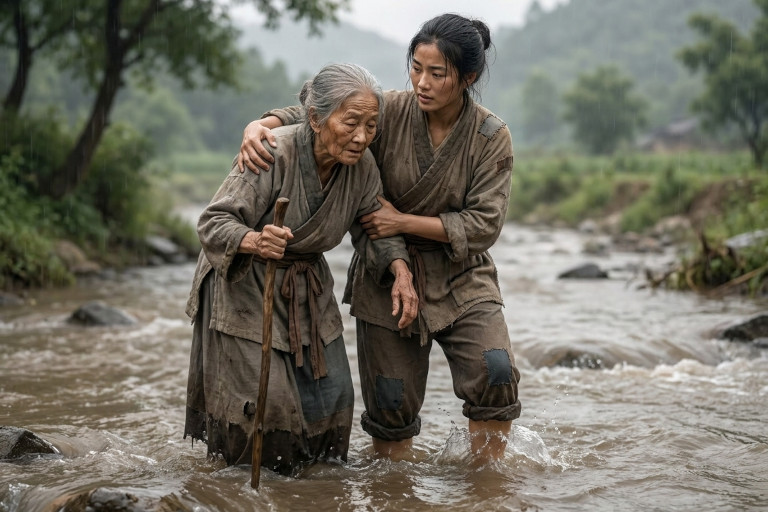
Halfway across, she became stuck in a patch of mud. When she bent down to pull her shoe free, she realized it had been pinned beneath a heavy object. She moved it aside and discovered that it was a lump of silver.
Overjoyed, she turned to her mother-in-law and said that Heaven had given them a gift. They had left home because they were poor, but now they had enough not only to eat, but to return home and even start a small business. They no longer needed to keep fleeing.
She carefully helped the old woman back to the bank, then crossed the stream again to find her husband and children and tell them the news.
Kindness brings an unexpected turn
When she reached the far side, she saw only the two children playing in the sand. Her husband was nowhere in sight.
She quickly asked where their father had gone.
The children, too young to understand what had happened, pointed toward the woods and said that just after arriving, a large orange-and-black ox had carried him off.
The wife was horrified. What kind of beast could snatch away a man? She ran into the trees and soon found the answer. On the ground were bloodstains, scattered bones, and clumps of hair. Her husband had been completely devoured. What the children had described was no ox, but a starving tiger.

Grief-stricken, the family returned to Fengcheng.
A warning preserved for later generations
The story was later heard by the Song Dynasty scholar Hong Mai, who included it in Yijian Zhi, his well-known collection of strange and cautionary accounts. According to the record, Hong Mai learned of the incident through Lan Shucheng, who was serving as prefect of Linchuan at the time.
He ended the account with a stark judgment: “The punishment for unfilial conduct comes with such speed.”
The point of the story is not subtle. The farmer tried to calculate his way out of hardship by casting aside the person who had once raised him. In the same moment, his wife chose compassion. One acted out of selfishness and cruelty; the other held fast to kindness even when her own future looked uncertain. Their paths separated at the very instant of that choice, and so did their fates.
Stories like this were passed down not merely to shock readers, but to remind them that character is revealed most clearly in moments of pressure. When circumstances are desperate, people often believe they must protect themselves first and justify whatever they do in the name of survival. Yet this story suggests the opposite: even in hardship, abandoning what is right can bring ruin, while holding onto mercy may open a road where none seemed possible.
That is why the tale still resonates centuries later. It presents one family, one stream, and one decision, but the question it raises is universal. When a hard choice comes, what kind of heart will a person reveal?
Source: Yijian Ding Zhi, Volume 11, Story 14
Translated by Cecilia
Follow us on X, Facebook, or Pinterest
