

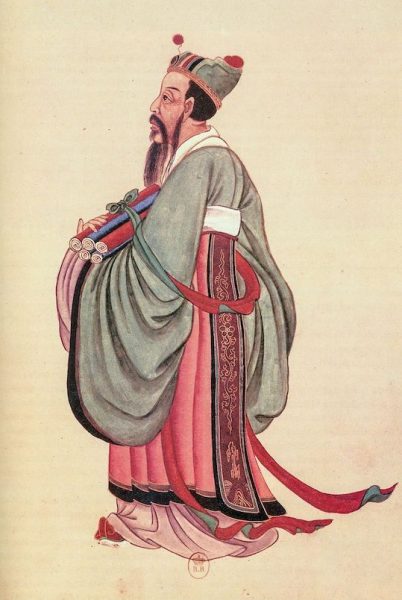
In a small kingdom in northeast China, more than 2,500 years ago, a teacher walked the dusty roads with a band of devoted students. The political world was unraveling. Feudal lords were turning on their kings, and the old rituals had hollowed out into theater. Families fractured, and ordinary people wondered whether anyone still knew what it meant to be good. The teacher’s name was Kǒngzǐ (孔子). The West would come to call him Confucius. He died believing his lifework had failed.
He could not have been more wrong. Within a few centuries, his ideas would shape every Chinese family, every imperial court, and every classroom from Korea to Vietnam. Today, more than two thousand years after his death, the question of how Confucius influenced Chinese morals and ethics is the question of how an entire civilization learned to think about character, family, and the well-lived life.
This is not the story of a distant philosopher whose teachings belong in a museum. It is the story of a man who looked at a society in chaos and asked a startlingly simple question: What would happen if each person, beginning with themselves, became a little more decent? His answer, refined across decades of teaching, became the moral foundation of East Asia. And it still has something quiet and useful to say to anyone trying to live well today.
The world that made Confucius: A China in search of order
Confucius lived from roughly 551 to 479 BCE, during what historians call the late Spring and Autumn period. The Zhou Dynasty (周朝) had spent centuries holding China together through an elaborate web of rituals, ranks, and royal authority. By the time Confucius was born, that web was torn apart. Powerful regional lords ignored the king. Generals rebelled. Diplomats schemed. The classical rites that once bound society together had become empty performances, the words spoken without conviction, the gestures made without meaning.
The translator and scholar William Blakney once observed that Confucius’s philosophy emerged not from solitude but from the press of people. Chinese society was densely populated, communal, and deeply dependent on shared codes of conduct. When those codes failed, daily life unraveled with them. Confucius watched it unravel. He spent his early career as a minor official, serving in the small state of Lu, in what is now Shandong Province. He saw rulers who taxed their people into starvation, courtiers who plotted against their own brothers, and ceremonies performed by men who had forgotten what the ceremonies were for.
His response was not to invent something new. He insisted, with characteristic humility, that he was merely a transmitter, recovering the wisdom of an earlier, better age. He pointed back to the early Zhou kings, to the legendary sage-rulers Yao and Shun, and to a vision of society in which moral cultivation was the work of every person, every day.
Confucius gathered students. He talked with them, walked with them, and answered their questions about how to live. He never wrote a treatise. After his death, his disciples collected his sayings in a slim, irregular volume called the Analects (论语, Lúnyǔ), the single most important book in the history of Chinese thought. Nspirement has explored this book in depth, drawing on the Analects’ wisdom.
The Analects contains no system. It is not philosophy in the European sense. It reads, instead, like a notebook of conversations, full of pauses, doubts, jokes, and quietly devastating moral observations. From this fragmentary text, an entire civilization built its understanding of character.

The heart of Confucian Ethics: Cultivated character, not memorized rules
To understand how Confucius influenced Chinese morals and ethics, you have to begin with a distinction he made over and over again, often without quite saying it directly. He distinguished between two kinds of moral life. The first was rule-based: a person memorized the proper rituals, performed the right gestures at the right times, and could be counted on to behave correctly in any defined situation. The second was character-based: a person had so deeply internalized goodness that the right action arose naturally from who they were, not from a rulebook they consulted. Confucius respected the first. He revered the second.
Throughout the Analects, he returns to this contrast. A man who follows the rites but lacks an inner life, he warned, is no better than someone wearing fine clothes over a body that is sick. The form is correct. The substance is missing. This insight had enormous consequences. It meant that the goal of education was not the production of well-trained subjects. It was the production of full human beings. It meant that morality could not be legislated from above. It had to be cultivated from within. It meant that even the smallest action, performed with sincere intention, mattered more than the grandest ceremony performed mechanically.
The Confucian word for this lifelong process was xiūshēn (修身), most simply translated as self-cultivation. It is the daily, patient, often invisible work of becoming a better person: examining your conduct each evening, watching your speech, asking, after a difficult conversation, whether you spoke from kindness or from pride. The work is never finished.
This is also why Confucius prized education so highly. Not as a path to wealth or status, but as the discipline through which a person learns to see themselves clearly and to act with care. A nation full of cultivated individuals, he believed, would naturally produce wise leaders, harmonious families, and a culture that could survive almost anything.
There is a famous story about a moment when Confucius nearly accused his most beloved disciple, Yan Hui, of stealing rice, only to discover that the truth was something quite different. The story illustrates how easily even a wise teacher can misjudge, and why a moral life requires patient observation rather than quick conclusions. Nspirement has covered the parable of how Confucius dealt with Yan Hui when he stole the rice. This is the bedrock of Confucian ethics: character is cultivated, not commanded.o him. These writings arose partly out of the immense evils that had befallen the Chou Dynasty.
The Five Constant Virtues (Wǔ Cháng 五常): A code for the whole person
If self-cultivation is the verb of Confucian ethics, the Five Constant Virtues are its nouns. Together, they form the moral architecture of a fully developed human being. Later Confucian thinkers, especially the Han Dynasty scholar Dong Zhongshu, codified them as the Wǔ Cháng, the Five Constants. Each of them lives somewhere between an instinct and a discipline, and each connects naturally to the eight cardinal virtues that later Chinese culture drew from Confucian roots.
Ren (仁): Benevolence and humaneness
Ren is the highest of the virtues, the one that holds the others together. It is often translated as benevolence, humaneness, or simply love, though no English word fully carries it. The Chinese character itself is a quiet hint: a person (人) standing beside the number two (二). To be ren is to be the kind of person whose existence creates room for another.
In practice, ren shows up in the smallest moments. Choosing patience instead of irritation. Listening before correcting. Offering kindness with no expectation of return. Confucius believed ren could not be taught directly, only modeled and chosen, again and again, until it became the natural tone of a life.
Yi (義): Righteousness beyond rules
Yi is doing what is right, even when the rules cannot tell you what right looks like. It is the virtue of moral judgment, the ability to read a situation honestly and respond with integrity rather than convenience. A person of yi refuses dishonest gain, speaks an unwelcome truth when it is needed, and accepts the cost of doing so. The virtue is older than law, deeper than custom. It is the part of a person that recognizes a duty before anyone has named it.
Li (禮): Propriety, ritual, and respectful behavior
Li began as the formal rites of the Zhou court: the bowing, the offerings, the ceremonies that marked births, marriages, and funerals. Confucius expanded its meaning to cover the whole of conduct, from how one greets a guest to how one speaks to an elder. Properly understood, li is not a constraint. It is the outward shape of inner respect. Nspirement has explored this beautifully in the art of bowing, a Confucian practice in which the smallest physical gesture becomes a study in cultivated character.
Zhi (智): Wisdom and discernment
Zhi is not raw intelligence. Confucius made a sharp distinction between cleverness and wisdom. Zhi is the capacity to see things as they are, to know what you know and admit what you do not know, to perceive the difference between a clever argument and a true one. “When you know a thing, to hold that you know it; and when you do not know a thing, to allow that you do not know it: this is knowledge,” Confucius said in Analects 2.17. That single sentence captures the whole virtue.
Xin (信): Trustworthiness and keeping one’s word
Xin is the alignment between what a person says and what they do. The character is itself a small portrait, a person (人) beside speech (言). To live with xin is to be the kind of person whose word can be trusted because their word and their life do not part ways. Confucius treated xin as foundational. A person without xin, he said, is like a cart without a yoke. Nothing can pull it forward.
Filial Piety (Xiào 孝): The root of all other virtues
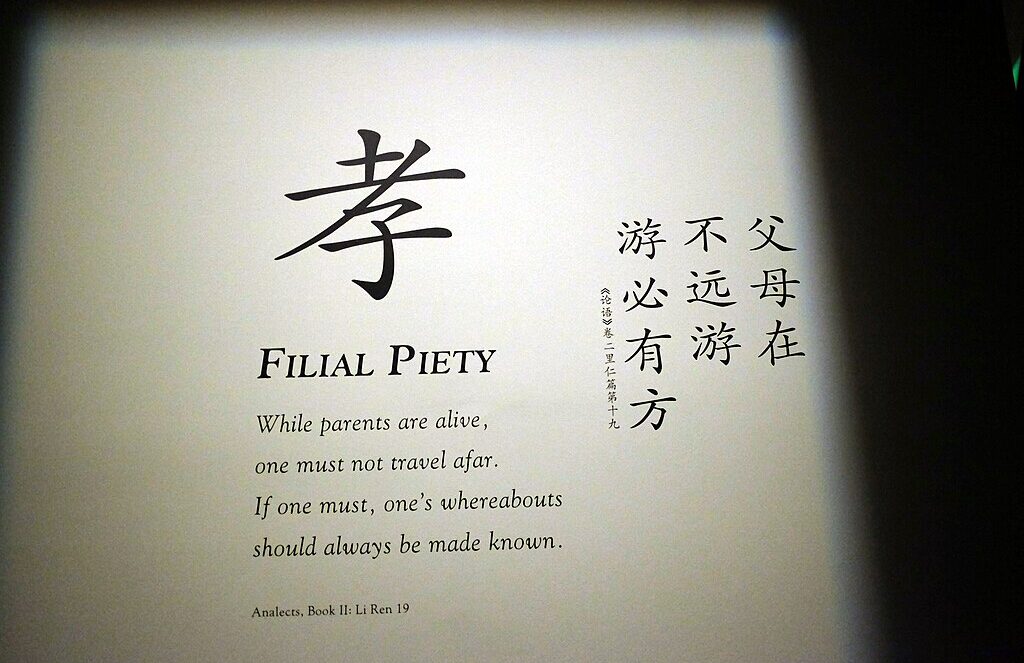
Of all the virtues Confucius emphasized, none was more foundational than xiào (孝), or filial piety: the love, respect, and care a person owes to their parents and elders. The deeper meaning of this virtue is explored in the Britannica entry on xiao. The Chinese character itself is a small parable. The radical for “old” (老) sits above the character for “son” (子), as if the younger generation were holding up the older. To honor one’s parents was, in Confucian thought, the first ethical act. Everything else followed from it.
The classical text known as the Xiaojing (孝经), or Classic of Filial Piety, expands on this idea. A person who has truly learned to love their parents will naturally extend that love outward to siblings, friends, the community, and ultimately the wider world. Xiào was not a sentimental virtue. It was a training ground. The Han Dynasty scholar who edited the Xiaojing put it sharply: filial piety is the root from which all other virtues grow. A society that taught its children to honor their elders was, in effect, teaching them to be capable of every other moral act.
This had profound consequences. Confucian families became the smallest moral schools in China, the place where a person learned restraint, gratitude, patience, and care. The state, in turn, came to view a virtuous family as the foundation of a virtuous nation. The emperor was seen as the father of his people, and the people, in turn, owed him a kind of national xiào.
The modern world has complicated this picture. Urbanization, smaller families, and the demands of individual ambition have placed real strain on traditional filial duties. Critics argue that xiào, taken to extremes, can suppress legitimate dissent or shield bad behavior in the name of family honor.
Yet the core of the virtue endures. To recognize that you did not arrive in this world alone, that someone fed you, taught you, and stayed up with you when you were small, and to let that recognition shape how you live, remains one of the most quietly powerful moral postures available to anyone.
The Five Relationships: A map for a harmonious life
Confucius understood ethics as relational. A person does not become good in isolation. They become good through appropriate conduct in their relationships with others.
He identified five relationships as foundational:
- Ruler and subject: Governed by loyalty and righteous service
- Father and son: Governed by affection and filial respect
- Husband and wife: Governed by mutual distinction and harmony
- Elder and younger siblings: Governed by guidance and deference
- Friend and friend: Governed by trust and shared cultivation
Western readers sometimes hear in this list a story of hierarchy and obedience. That is a misreading. In Confucian thought, every one of these relationships involves mutual obligation. The ruler owes the subject benevolent governance. The father owes the son a moral example. The elder sibling owes the younger guidance and care. Authority without responsibility was, to Confucius, no authority at all.
The person who handled all five relationships with integrity was the jūnzǐ (君子), the exemplary person. The word originally meant something like “prince’s son,” a member of the hereditary aristocracy. Confucius did something quietly revolutionary with it. He redefined nobility as a moral achievement available to anyone willing to do the work.
The jūnzǐ is not a saint. They make mistakes. They fall short. What distinguishes them is the choice, made daily, to act in alignment with the virtues, to honor the relationships entrusted to them, and to keep cultivating themselves long after most people have stopped trying. This redefinition of nobility lit a quiet fire under the Chinese imagination. For more than two thousand years, the idea that any person, regardless of birth, could become noble through moral cultivation has given Chinese culture one of its most enduring promises.
From personal practice to a civilization: How Confucian ethics shaped China
For nearly three centuries after Confucius’s death, his teachings competed for influence with rival schools, especially Daoism, Mohism, and Legalism, which believed only strict laws and harsh punishments could keep society in order. The decisive moment came under the Han Dynasty. After the brief, brutal reign of the Qin Dynasty, which had tried to govern solely by Legalism and collapsed in less than two decades, the Han emperors sought a more sustainable foundation. Under Emperor Wu (汉武帝, reigned 141 to 87 BCE), Confucianism became the official state ideology of China, a transformation chronicled at length in the Britannica overview of Confucianism.
The implications were enormous. A Confucian academy was established in the capital. Government posts were increasingly filled by men who had studied the Confucian classics. Over time, this evolved into the imperial examination system, a meritocratic process in which prospective officials were tested on their mastery of Confucian texts and their capacity for moral reasoning.
The exam system endured, in various forms, for more than 1,200 years. By the seventh century CE, it was already a regularized institution. Generations of Chinese boys, and eventually a small number of girls in private settings, spent their childhoods memorizing the Analects, the Mencius, and the other Confucian classics. The shape of an entire civilization, its bureaucracy, its families, and its sense of itself, was molded by these texts.
The influence did not stop at China’s borders. Korean, Japanese, and Vietnamese societies deeply absorbed Confucian ethics, building their own examination systems, family structures, and ethical vocabularies on Confucian foundations. To this day, the moral vocabulary of much of East Asia traces its lineage to a teacher who once walked the dusty roads of Lu, asking his students to be a little more decent than yesterday.
You can read more on this lineage in the broader landscape of Chinese culture and traditions.
Why Confucius still matters: Ancient wisdom for modern life
It is tempting, in the age of self-help apps and algorithmic advice, to set Confucius gently aside as a figure of historical interest only. That would be a mistake. The questions Confucius spent his life answering are the questions we are still living with. How do you become a person worth being? How do you raise children who can carry themselves through difficulty? How do you treat the people in your life, the ones you love and the ones who exhaust you, in a way you will not regret? How do you build a community that is not held together by surveillance and fear?
His answers do not require you to live in ancient China. They translate quietly into the small choices of any modern life. Ren shows up the moment you decide not to fire off the angry email. Yi arrives when you tell the inconvenient truth that someone needed to hear. Li is the small dignity of greeting your colleague properly, of putting your phone down at dinner, of speaking to a stranger with the same care you would offer a friend. Zhi is the courage to admit, in the middle of an argument, that you might be wrong. Xin is the slow, accumulated trust of a person whose word has matched their life for decades.
A simple Confucian practice for the modern reader: at the end of each day, ask yourself three questions. Did my actions match my words? Did I treat the people closest to me with care? Did I learn anything I am willing to act on tomorrow? These three questions are themselves drawn from the Analects, from a daily self-examination practiced by Zengzi, one of Confucius’s most devoted students. Twenty-five centuries later, they are still good questions to ask.
Conclusion: The quiet, patient power of a Confucian life
To ask how Confucius influenced Chinese morals and ethics is to ask how a teacher who never wrote a book, never held lasting political power, and died believing he had failed somehow came to shape the moral imagination of a quarter of humanity for more than two thousand years.
The answer is that he taught something the human heart already knew but had forgotten how to practice. That character is cultivated, not commanded. That the smallest household relationships are the seedbed of every larger virtue. That benevolence, righteousness, propriety, wisdom, and trustworthiness are not relics of an ancient code but the working tools of a fully human life.
Follow us on X, Facebook, or Pinterest
