
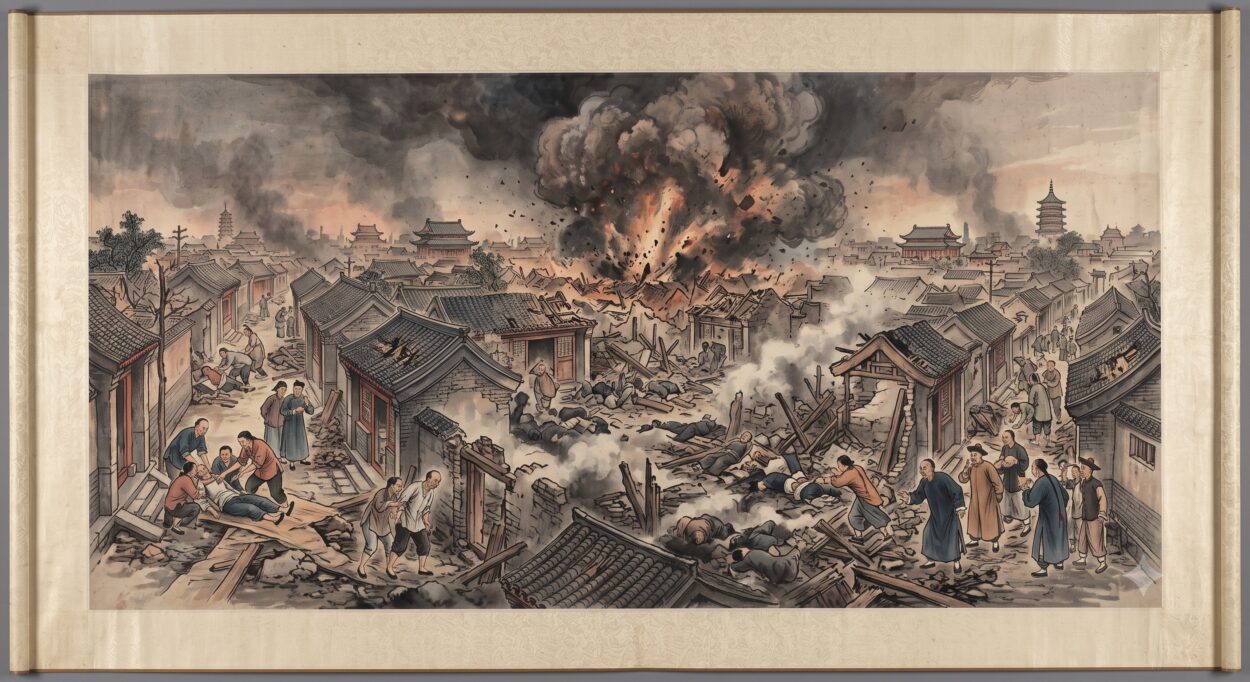
On the 7th day of the 5th month in the 25th year of the Guangxu era (June 14, 1899), an explosion occurred at the munitions depot in Shibei Hutong, Beijing, resulting in heavy casualties. “Shibei Hutong” was the name used during the Ming Dynasty, and to avoid confusion with the Shibei Hutong south of Xichang’an Street, it was renamed “Yude Hutong” in 1965. It is now situated in the central part of Beijing’s Xicheng District.
According to the Qing Dynasty ancient text Miscellaneous Notes of the Capital, on the 7th day of the 5th month in the 25th year of Guangxu, a fire broke out at the Shibei Hutong arsenal, leading to an explosion at the munitions depot. It was only 9:00 a.m. at the time. The entire western part of Beijing felt a huge tremor, like an earthquake; “buildings shook and collapsed, factory buildings were blown away, and huge craters appeared in the ground.” The nunnery, meditation rooms, and kitchen to the right were all completely destroyed, except for the Buddhist temple, which remained intact.
Numerous houses were destroyed, and many people were injured or killed. The relevant authorities, under imperial orders to investigate, deceived the court by claiming only six people had died, while in reality, the number was much higher. On that day, “body parts fell from the sky, and cannonballs landed on rooftops. It was the day of the Huguo Temple market, and all the glazed pottery was shattered.” Fortunately, the guards at the munitions depot were out having breakfast at the time, so many were unharmed. The area around the factory suffered greatly, with numerous deaths and injuries, so why did so many factory guards survive? The apparent reason is that they happened to be out eating at that time, but what was the real reason?
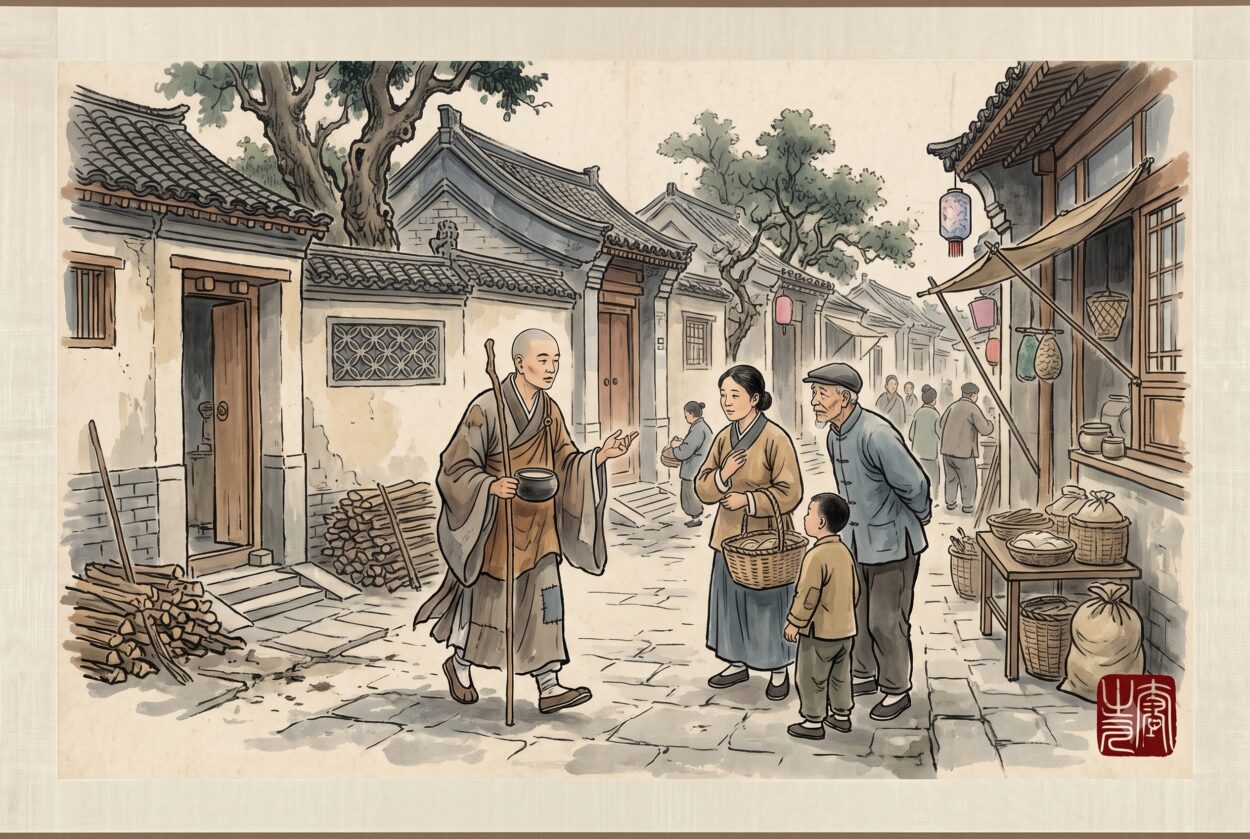
Guo Zeyun, the Secretary-General of the National Government during the Republic of China, had also served as an official during the Qing Dynasty and was in Beijing when the munitions depot incident occurred. According to his work Dongling Buzhi, which serves as the third part of his famous Dongling trilogy, which is often revered as the last great collection of traditional Chinese zhiguai (tales of the strange) literature, a monk appeared in the Shibei Hutong area more than 10 days before the explosion and asked for alms. The monk said: “Anyone who gives alms will be spared from disaster.”
However, most nearby residents were skeptical, and very few were willing to give. Interestingly, many guards were willing to donate. After the explosion, people reflected and realized that those who had given to the monk were safe. They then recognized that this monk was a high being sent to save lives! Before the explosion at the Shibei Hutong munitions depot, the monk sought alms, not out of financial need, but to discern who still held reverence for deities and spiritual practitioners, thus ensuring their safety from disaster. Such events are not isolated cases in history. Throughout history, there have been numerous accounts of people being spared disaster by treating practitioners kindly.
The strange encounter of Prime Minister Cen Wenben
Compiled during the Song dynasty (960-1279) at the behest of Emperor Taizong, the Taiping Guangji anthologized thousands of pages of unofficial histories, accounts, and minor stories from the Tang dynasty (618-907). In one account, Cen Wenben, a minister during the Tang Dynasty, was a devout Buddhist from a young age and often recited the “Lotus Sutra.” Once, while crossing a river by boat, the vessel suddenly capsized, drowning everyone on board. Cen also sank into the water, and at the brink of death, he suddenly heard someone in the water say: “As long as you chant the Buddha’s name, you will not die.” This was repeated three times, prompting Cen to chant. Suddenly, a large wave lifted him to the surface, allowing him to drift to the northern shore and escape death.
Later, Cen hosted a feast for the monks in Jiangling. Monks came to his home one after another, and one monk stayed until the end before leaving. Before departing, this monk told Cen: “The world is in turmoil, and you are fortunate to have escaped disaster; you will surely witness a time of peace and eventually become wealthy.” After saying this, the monk left and disappeared. When Cen returned to eat, he found two relics in his bowl. His fate, as the monk had predicted, indeed unfolded, and he rose to the rank of prime minister. Cen held practitioners in high regard and continuously supported them.
Li Shiqian’s blessings
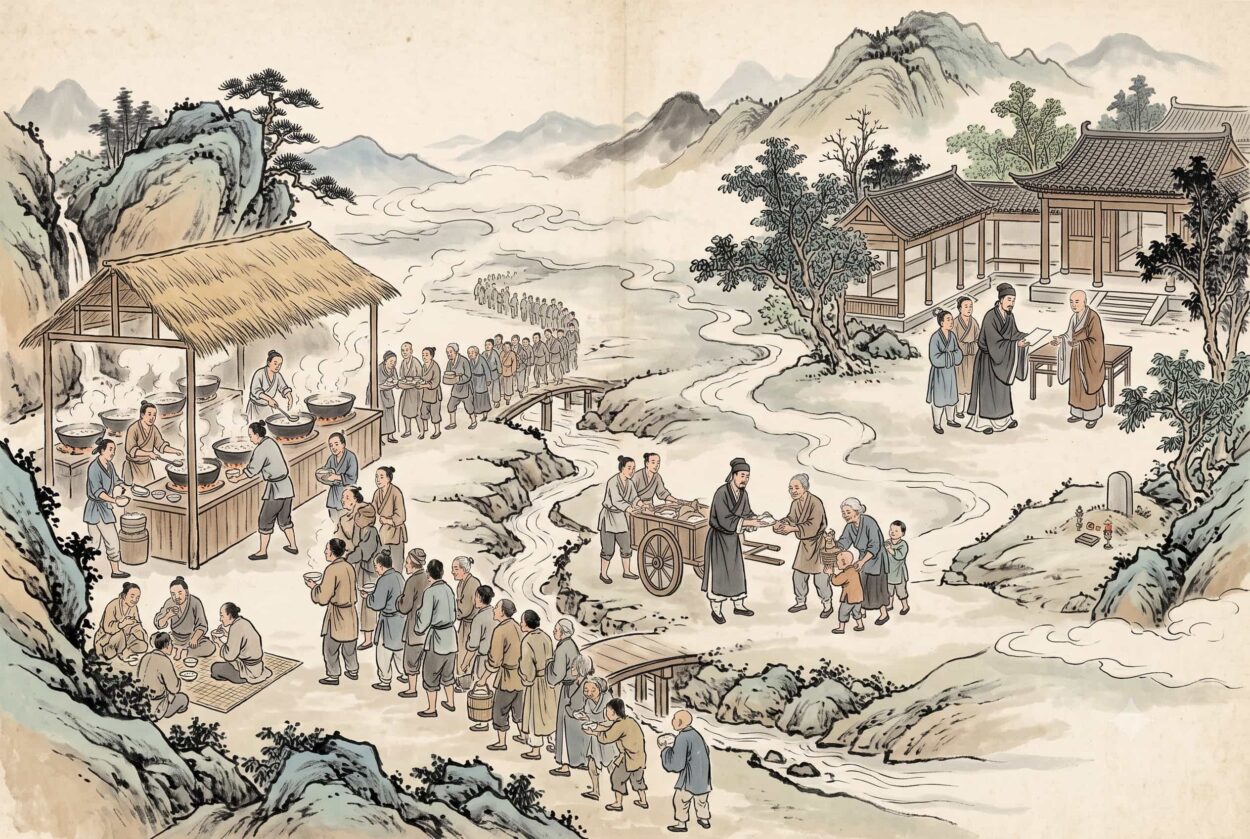
Further back, the Karma and Retribution Record recounts the deeds of Li Shiqian, a layman of the Sui Dynasty. After his mother passed away, he donated his private residence to be used as a temple, dedicating his life to charity and helping people experiencing poverty. During a great famine one year, he organized a porridge distribution center, saving the lives of tens of thousands.
Li respected the Three Treasures and never ceased to support the monks. He understood Buddhist teachings and explained karma and reincarnation, dispelling misconceptions. Because he respected practitioners and the countless lives he saved, his descendants thrived, and people believed this was the reward for his virtuous deeds. When Li passed away, tens of thousands attended his funeral, crying and lamenting: “Why are we still alive, while such a great benefactor as Mr. Li has passed away?” In fact, many disasters in history were preceded by warnings from enlightened beings. These beings often used metaphors or riddles to convey their messages.
During the Qing Dynasty, a similar event occurred in Ningjin County, Shandong. One year, during the wheat harvest, a Taoist priest told villagers that everyone must carry a bundle of wheat home after work, or they would be struck by hail. Upon hearing this, people looked up and saw clear skies, showing no signs of hail. Many were skeptical and, feeling lucky, chose not to carry the wheat bundles, while some believed the priest and followed his advice. As a result, after finishing work and before reaching home, a sudden storm hit, and hail began to fall. Those carrying wheat bundles quickly sheltered under them and remained unharmed, while the hail severely pelted those who did not.
Why does “donating to practitioners” allow one to escape calamity? There is a deeper reason behind this. In ancient thought, practitioners are seen as carriers of Buddhist teachings and guides for sentient beings; supporting practitioners is a way to uphold the Dharma. Those enlightened beings who sought alms before disasters already knew the heavenly secrets but could not speak plainly. Perhaps they could only use “seeking alms” to observe who still held reverence for practitioners and respect for karma. A person willing to give to a stranger monk demonstrates that they still harbor goodwill and believe in karma; such individuals are worthy of salvation.
Every era has its own tribulations, and every disaster is preceded by omens. The key question is: when a spiritual practitioner asks you for alms, or when someone tells you how to avoid disaster, do you simply laugh it off, or do you hold it in reverence? History has repeatedly shown that those who hold reverence and treat spiritual practitioners with kindness are often the ones who survive calamities.
Translated by Joseph Wu and reviewed by Maria
Follow us on X, Facebook, or Pinterest
