
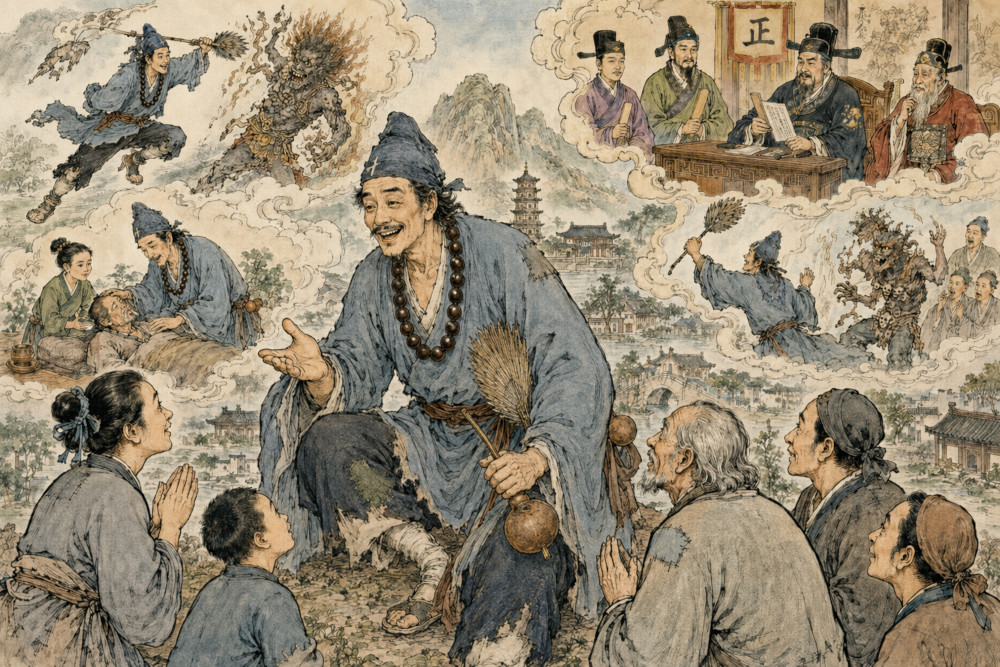
The Complete Biography of Ji Gong blends historical figures, folk legends, supernatural adventures, legal cases, and stories intended to encourage moral conduct. Alongside accounts of Ji Gong helping the poor, saving lives, subduing demons, and punishing corrupt officials and powerful bullies, the novel tells of impoverished scholars, filial children, righteous heroes, loyal ministers, and other virtuous people.
Through the experiences of characters such as Gao Guotai, Zhao Bin, and Chen Liang, these stories illustrate traditional principles including karmic retribution, loyalty, filial devotion, moral integrity, and the blessings that follow from accumulating virtue.
One such story concerns Gao Guotai, a poor scholar whose compassion remained steadfast even in his darkest hour.
A young nun’s forbidden affection
Gao Guotai was a native of Hangzhou during the Song Dynasty. Orphaned at an early age and left in poverty, he lived at a Buddhist nunnery where his aunt resided. There, he devoted himself to his studies in the hope of succeeding in the imperial examinations.
A young nun named Huixing also lived at the nunnery. She was graceful and attractive, and after noticing Gao’s distinguished bearing, she gradually developed feelings for him. Forgetting the vows she had taken, she expressed her affection in a poem:
Before the White-Robed Bodhisattva I stand,
Seeking neither the Buddha’s deliverance nor immortal life.
I ask only for a drop of dew from her willow branch
To bless two lotus blossoms joined as one in the human world.
The White-Robed Bodhisattva refers to Guanyin, who is often portrayed holding a willow branch and a vessel of compassionate dew. The twin lotus blossoms symbolized Huixing’s wish that she and Gao might become a couple.
After reading the poem, Gao did not exploit her feelings. Instead, he reflected that someone who had been able to leave the secular world and enter religious life must have accumulated spiritual roots, merit, and favorable karmic conditions in the past. Her present feelings, he believed, were only a moment of confusion.
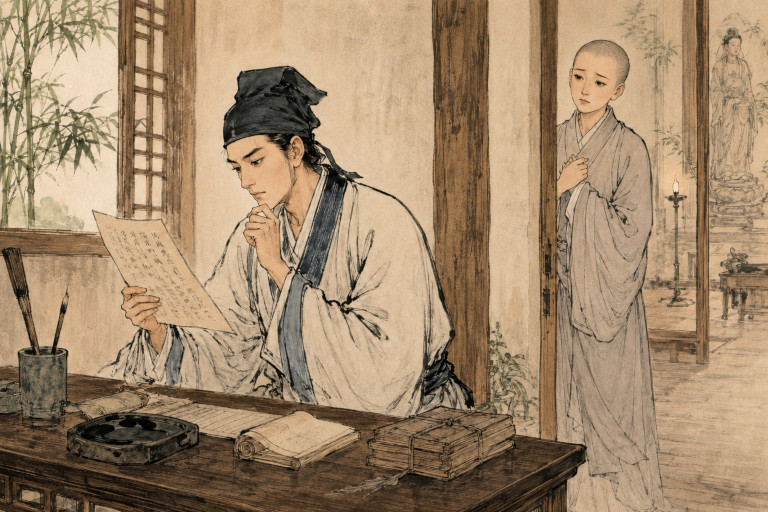
He decided to awaken her conscience with kind but solemn words, rather than encourage her to violate her vows and commit a serious wrong. He replied with a poem of his own:
A single deluded thought can unsettle the spirit;
Once the spirit strays, the six thieves disturb the heart.
When the heart falls into disorder, the body loses its master,
And the six paths of rebirth appear before your eyes.The turning of the six paths continues without end,
Through the many sufferings of beasts and hungry ghosts.
Do not surrender to greed, anger, and ignorance;
Once human birth is lost, it may not return for countless ages.
The “six thieves” refer to the senses, which Buddhist teaching says can disturb the mind when they are governed by desire and attachment.
Gao’s words struck Huixing like a thunderclap. Filled with shame, she recognized the danger of her thoughts. From that day forward, she avoided meeting him and applied herself diligently to Buddhist cultivation. In time, she attained spiritual fulfillment.
Gao also decided to leave the nunnery. He hoped that by removing himself, he could end Huixing’s attachment and prevent further feelings from arising between them.
Ji Gong’s unusual test
Gao rented a room from a wealthy landowner named Zhou Bancheng. After living there for six months, however, he had no money with which to pay the rent.
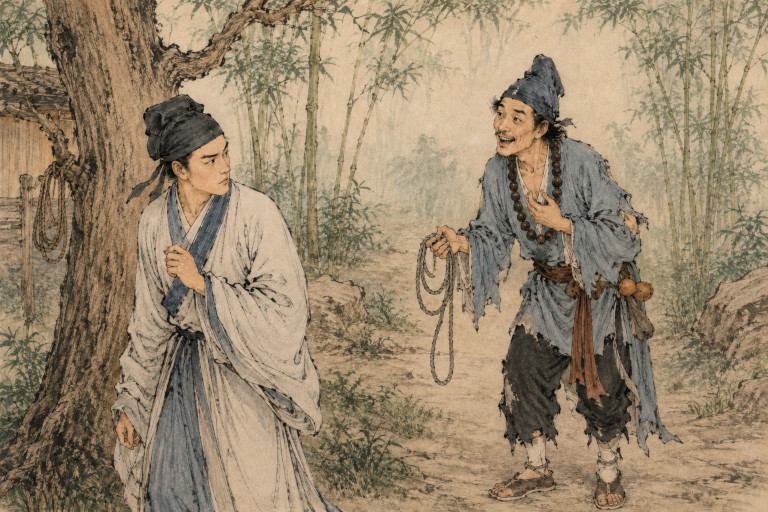
Without consulting his master, one of Zhou’s servants removed the door from Gao’s room. Unable to study in peace and humiliated by his desperate circumstances, Gao began to believe that his life had lost all meaning. Overcome by despair, he went into the woods behind the house intending to hang himself.
Just then, Ji Gong appeared carrying a rope.
“This is the tree I have chosen,” Ji Gong shouted. “Find another place for yourself. Do not try to take mine!”
Startled, Gao asked why Ji Gong wanted to end his life.
“I owe someone five taels of silver,” Ji Gong replied. “I cannot repay the debt, and I have no other way out. What has driven you here?”
Gao told him about his poverty, the unpaid rent, and the servant who had removed his door. He then took out the few pieces of silver he still possessed and offered them to Ji Gong.
“We are strangers,” Ji Gong said. “Why would you help me?”
“I have already lost hope and resolved to die,” Gao answered. “What use is silver to a dying man? It would be better for you to take it and repay your debt.”
Ji Gong was deeply moved. Even at the brink of death, Gao was still thinking of another person’s suffering.
He then revealed the truth.
“Zhou Bancheng is an old friend of mine,” he said. “Come with me. The matter of your rent can easily be settled.”
Gao followed Ji Gong back to Zhou’s residence. The servant had already reported their arrival, and Zhou hurried outside to greet them as honored guests.
Ji Gong explained that Gao had fallen behind on his rent and had nearly taken his own life after the servant removed his door. When Zhou learned that the servant had abused his authority and bullied Gao without permission, he became furious and ordered that the man be expelled from the household.
Ji Gong and Gao repeatedly pleaded on the servant’s behalf. Because of their intervention, Zhou allowed him to remain, although he severely reprimanded him.
The rewards of unseen virtue
Zhou was impressed by Gao’s generosity, compassion, and willingness to forgive. He invited the scholar to remain in his home and provided him with the support he needed to continue his studies.
With Zhou’s assistance, Gao worked harder than ever. He eventually placed first in the highest imperial examination and received the distinguished title of zhuangyuan.
Gao later served as an official known for his honesty, strict moral standards, and concern for the people. He provided relief to the poor and served for 20 years in public service without abandoning the principles that had guided him during his years of hardship.
Eventually, he came to recognize the transience of worldly status and success. He resigned from office and devoted the remainder of his life to spiritual cultivation. He lived to the age of 80 and also attained the fruits of his practice.
As Gao lay dying, he saw Huixing, the young nun he had once guided away from temptation, approaching through the sky on a cloud. Brilliant light filled the heavens, and auspicious clouds appeared in every direction.
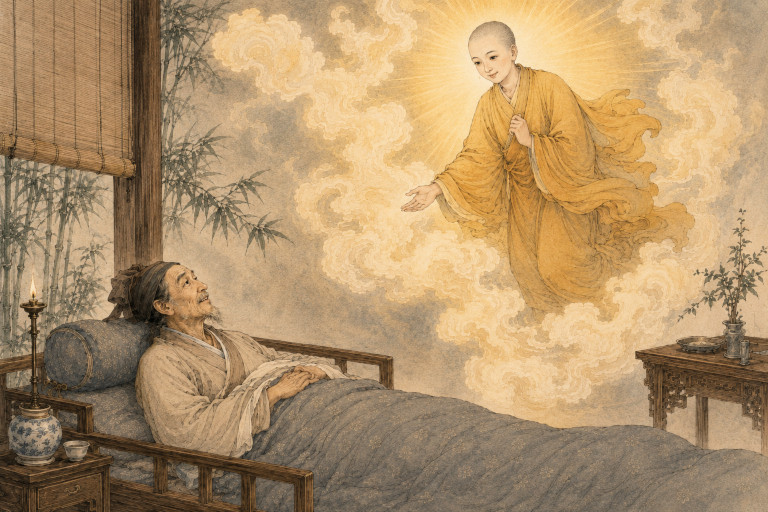
Smiling, she said: “Benefactor, please ascend to the lotus seat.”
She then guided Gao toward the Western Paradise.
Gao’s compassionate response many years earlier had helped Huixing awaken and complete her cultivation. At the same time, his own kindness, including the good deeds he performed without seeking recognition, accumulated lasting virtue.
His story was therefore passed down through the generations as an example of how a single righteous thought can change the course of more than one life.
Translated by Joseph Wu
Follow us on X, Facebook, or Pinterest
