

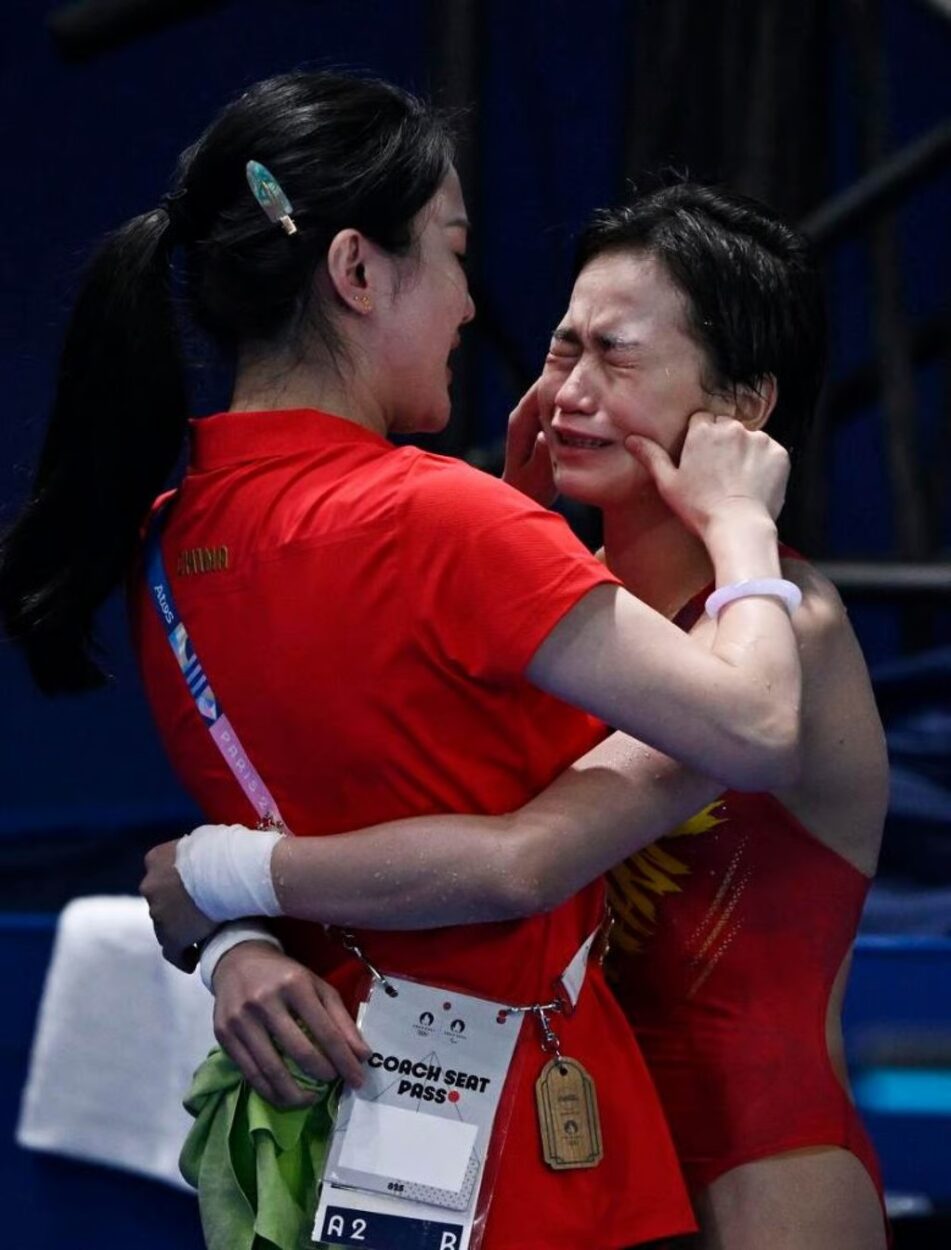
Quan Hongchan, the youngest athlete on the Chinese delegation at just 14 years old, won the gold medal in the individual 10-meter platform event at the 2024 Summer Olympics and, alongside teammate Chen Yuxi, also won gold in the 10-meter synchronized platform event. She subsequently drew widespread public sympathy after candidly expressing her desire to earn money to pay for her mother’s medical treatment. Some commentators believe that behind this outpouring of sympathy lie serious problems with rural healthcare in China.
After winning the gold medal, Quan Hongchan attended a post-competition press conference with her teammates. When a reporter asked her about the “secret to her success,” Quan Hongchan replied candidly: “Practice, of course,” adding: “Practice slowly, one move at a time.” When a reporter asked her why she wanted to win, she replied: “My mom is sick, but I really want to earn money to go back and pay for her treatment. I want to earn a lot of money so she can get better.” At this point, Quan Hongchan’s voice choked up slightly.
The harsh reality of her childhood background
The roots of Quan’s motivation stem from a childhood defined by financial hardship and family illness in rural Guangdong. Quan Hongchan was born in 2007 in Maihe Village, Mazhang Town, Zhanjiang, Guangdong, into a family that received the minimum living allowance; both her parents were farmers. She is the third child in the family, with an older brother and sister and a younger brother and sister. The family relied on her father’s sugarcane farming for their livelihood. In 2017, Quan Hongchan’s mother was involved in a car accident that fractured several of her ribs; her subsequent hospitalization depleted the family’s savings. To this day, her mother has not fully recovered and still requires treatment.
In 2014, at the age of 7, Quan Hongchan began training at the Zhanjiang Sports School. Four years later, she was selected for the Guangdong Provincial Diving Team and eventually joined the Chinese National Team. According to Chen Huaming, a diving coach at the Guangdong Provincial Sports School, Quan Hongchan was selected not only for her excellent jumping ability and explosive power, but also because her family was poor. Diving training requires daily exposure to the sun, and this alone is something many wealthy families find difficult to accept. Quan Hongchan has also mentioned that her family was poor: “During school breaks, I could only go home, and once I was home, I had nowhere else to go to play, so I just stayed at home. I’ve never even been to an amusement park, nor have I been to a zoo.” After her competitions, what she most wanted to do was “play video games and go to an amusement park.”

Aftermath of Gold: A hometown overwhelmed by fame
Following her victory, this poverty-stricken background suddenly became the epicenter of an aggressive public spectacle, as commercial and local interests rushed to capitalize on her name. It was revealed that after Quan Hongchan shot to fame by winning gold at the Tokyo Olympics, her once-quiet rural hometown in Zhanjiang, Guangdong, was suddenly “decorated with lanterns and banners, and teeming with visitors.”
A video circulating online shows that local authorities quickly organized construction crews to pave the courtyard and surrounding areas of Quan Hongchan’s family home with concrete in preparation for her return. Some people even set off deafening firecrackers at her home. Ailing mother sighs: “I never knew we had so many relatives.” Quan Hongchan couldn’t help but remark to the Strait Metropolis Daily: “I’ve only just realized we have so many relatives — they’ve all suddenly appeared, and some even rushed over with first-aid kits.” Unable to bear the disturbance, the family has closed their doors to visitors.
A man believed to be Quan Hongchan’s cousin had to step outside to appeal to the onlookers: “Please keep your voices down as much as possible. Whether you’re livestreaming or recording, you need to show some consideration for the elderly.” Quan Hongchan’s grandmother has been unable to rest for two days due to the excessive noise outside. Business opportunity? Her doorstep is piled high with “latiao.”
Most outrageously, upon learning that Quan Hongchan loves the snack “latiao,” many manufacturers have rushed to deliver multiple boxes, leaving the family at a loss. Not only that, but numerous cultural and tourist attractions, zoos, and amusement parks across China have sent invitations to Quan Hongchan; some attractions have even offered annual passes, VIP treatment, and unlimited game tokens so that Quan Hongchan can enjoy the amusement parks and zoos. In addition, three companies in Zhanjiang announced in turn that they would donate a luxury apartment, a retail store, and 200,000 yuan in cash to Quan Hongchan’s family. On August 6, representatives from the Zhanjiang Municipal Health Bureau and the Affiliated Hospital of Guangdong Medical University visited her grandfather’s hospital room to offer their condolences; the Affiliated Hospital of Guangdong Medical University also stated that it would provide comprehensive medical care for her grandfather and mother.
The healthcare crisis hiding behind the publicity
Critics argue that this sudden wave of localized “positive energy” philanthropy serves only to obscure a much larger, systemic failure in China’s rural infrastructure. This wave of “positive energy” hype cannot hide the harsh social reality behind Quan Hongchan’s victory. According to data from the Chinese government’s website, in 2011, 832 million people in China were enrolled in the New Rural Cooperative Medical Scheme, with a participation rate exceeding 96 %.
However, as of the end of 2018, the number of participants in the New Rural Cooperative Medical Scheme had dropped to only 130 million. Radio Free Asia quoted medical expert Yi Fuxian as saying that the New Rural Cooperative Medical Scheme is still far from sufficient to solve the problems faced by rural families; while medical expenses can now be reimbursed, there was previously no such coverage at all. Liao Cheng, a driver who also comes from a rural background, noted that the NRCM’s medical reimbursement restrictions are limited. When rural residents seek treatment in cities, they are reimbursed only 45% of costs if they have the proper referral paperwork, and only 25% if they do not. Furthermore, many medications are not covered at all.
In addition to low reimbursement rates, the healthcare system faces many serious problems. Liao Cheng analyzed that, compared to accepting “red envelopes” (bribes), this situation is nothing short of a disaster for ordinary rural residents. He believes that government monopolies and corruption are the root causes of overtreatment. Radio Free Asia wrote about the “Quan Hongchan phenomenon,” noting that while the media hails Quan Hongchan as a diving prodigy who has certainly “stilled the ripples of fate,” the approximately 600 million farmers in China behind her are not as fortunate.
Translated by Eva and reviewed by Helen London
Follow us on X, Facebook, or Pinterest
