
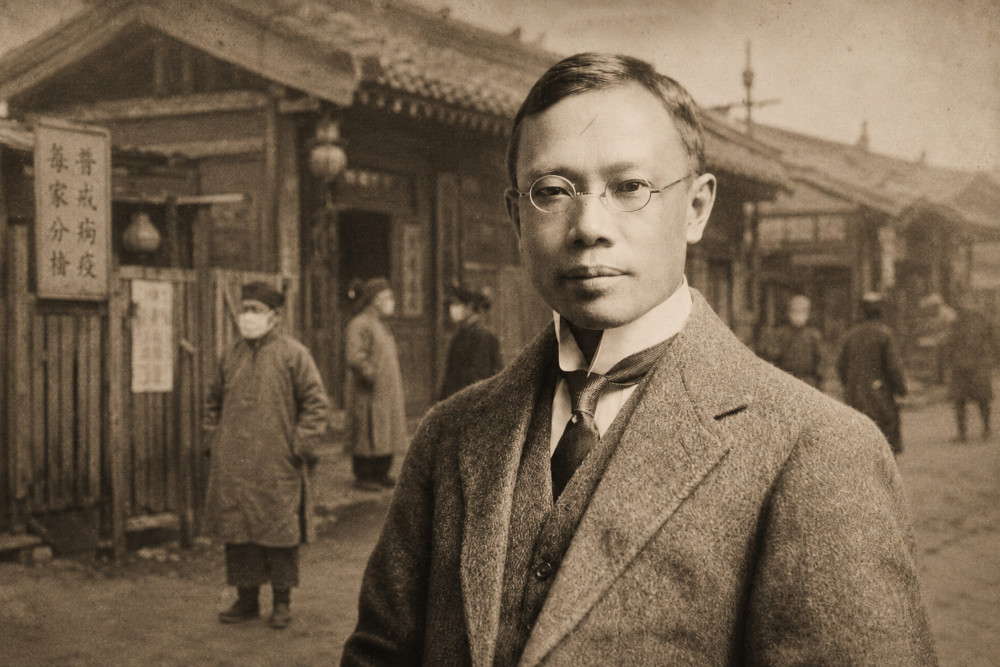
In the fall of 1910, a deadly epidemic began near Manzhouli, a border town between China and Russia, and spread rapidly across Northeast China. Railway lines carried the disease through cities, including Harbin, Changchun, and Mukden, now known as Shenyang. Although the outbreak remained concentrated in the Northeast, cases were also reported farther south. By the time it was contained in 1911, it had killed an estimated 60,000 people.
The epidemic was not only a medical emergency. Russia and Japan had extensive political and economic interests in Manchuria and questioned whether the weakened Qing government could control the outbreak. Chinese officials feared that failure could give the two foreign powers another justification to expand their authority in the region.
At the time, plagues were generally associated with rats and the fleas that fed on them. Yet the disease moving through Manchuria did not behave like the familiar bubonic form. Victims developed high fevers, coughed up blood, and often died within days. The illness appeared to pass directly between people, but its precise nature remained uncertain.
A dangerous investigation
In December 1910, the Qing Foreign Ministry summoned Dr. Wu Lien-teh, a 31-year-old physician and bacteriologist trained at the University of Cambridge. Born in Penang in British Malaya to a family of Chinese ancestry, Wu was then serving as vice director of the Imperial Army Medical College in Tianjin.
Wu and an assistant arrived in Harbin on December 24. The Chinese district of Fujiadian was in crisis. Medical personnel were scarce, the temperature had fallen far below freezing, and bodies were accumulating as the number of deaths increased.
Obtaining permission to examine a victim’s body was difficult because postmortem examinations conflicted with prevailing Chinese customs concerning respect for the dead. On his third day in Harbin, however, Wu was able to perform a postmortem examination on a woman who had died during the outbreak.
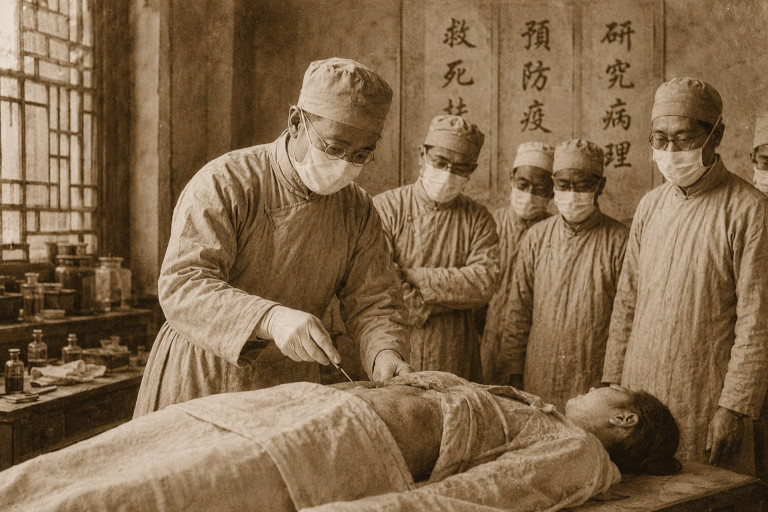
He found the plague bacterium, now known as Yersinia pestis, in her tissues and concluded that the epidemic was pneumonic plague. Unlike bubonic plague, which is commonly transmitted through the bites of infected fleas, pneumonic plague can spread directly from person to person through respiratory droplets during close contact.
Wu’s conclusion changed the strategy required to contain the disease. Rat control alone would not be enough. Patients had to be isolated, close contacts monitored, buildings disinfected, travel restricted, and medical workers protected from respiratory exposure.
Resistance and a fatal mistake
Wu promoted a cotton-and-gauze mask designed to cover the wearer’s nose and mouth. He also converted schools, warehouses, and railway cars into isolation facilities, and separated infected patients from those who had merely been exposed.
Not everyone accepted his diagnosis. Dr. Gérald Mesny, a French physician with experience treating bubonic plague, rejected Wu’s conclusion and examined plague patients without wearing the recommended protection. Mesny contracted pneumonic plague and died six days later.
His death demonstrated the danger of direct respiratory transmission. Demand for Wu’s masks rose sharply, and volunteers began producing them by the thousands. The masks, together with isolation and movement controls, became central parts of the campaign.
The difficult decision to cremate the dead
Despite these measures, deaths continued to rise through much of January 1911. The severe winter created another danger: the frozen ground made burial nearly impossible. When Wu inspected a burial ground outside Harbin, he found long rows of coffins and bodies awaiting burial.
Wu feared that the remains would become a serious public health hazard as temperatures rose. Cremation offered the fastest method of disposing of them, but burning the dead conflicted with deeply rooted Chinese burial traditions and ideas of filial duty. Wu therefore sought official authorization rather than proceeding on his own.
Local officials forwarded a request to the imperial government. After several days of deliberation, approval arrived. On January 31, 1911, the second day of the Lunar New Year, workers carried out a mass cremation in Harbin.
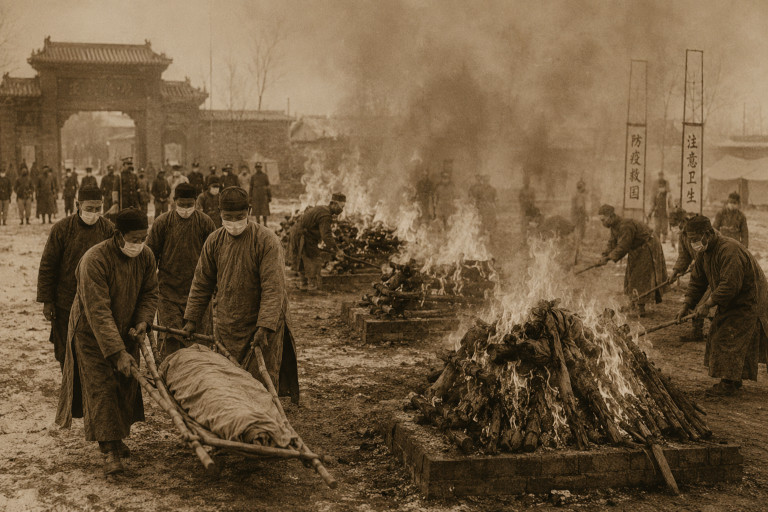
The cremation formed part of a coordinated campaign that also included masks, isolation hospitals, disinfection, checkpoints, railway restrictions, and the work of doctors, officials, soldiers, and volunteers.
By March 1, Harbin had recorded its last plague case. Other affected cities continued to report infections for several more weeks, but by spring, the epidemic had been brought under control.
A new place for China in public health
Wu emerged from the crisis as the leading figure in China’s plague response. Working with Chinese authorities, medical teams, local personnel, and international colleagues, he organized an effective campaign under extraordinarily difficult conditions. His correct diagnosis and decisive organization of the response helped transform a fragmented emergency effort into a coordinated public health campaign.
The campaign also had consequences beyond the immediate emergency. In April 1911, China hosted the International Plague Conference in Mukden, where specialists from a number of countries gathered to study the outbreak and discuss methods of preventing future epidemics. Wu chaired the conference, which was the first major international scientific gathering held in China.
The Qing government and several foreign governments honored Wu for his work. The following year, he became the first director of the North Manchurian Plague Prevention Service, which established hospitals and laboratories across the region. He later played a major role in the development of modern public health and medical institutions in China.
The Manchurian plague took tens of thousands of lives, but it also demonstrated that China could lead a modern, scientifically organized response to an international health crisis. Through sound diagnosis, decisive leadership, and the effective use of quarantine, masks, isolation, and movement controls, Wu Lien-teh helped bring a rapidly expanding catastrophe under control and established himself as one of the most important public health figures of the early 20th century.
Translated by Chua BC
Follow us on X, Facebook, or Pinterest
