
In the final episode of WandaVision, a fight between two versions of the same synthetic man ends not with a blow, but with the Ship of Theseus paradox. One of them is White Vision, the original body reassembled by a government agency and programmed with a single purpose: destroy the other. The other is the Vision that Wanda Maximoff conjured from grief and the Mind Stone inside the town of Westview, a being who carries none of the original material and knows it.
They are evenly matched, because they share the same design, and the struggle carries them into a library. There, the Vision of Westview asks his double why he is doing this. The answer is a directive and nothing more: destroy the Vision. So the Vision tells him something unexpected. He says he is not the true Vision either, only a conditional one. The machine asks him to elaborate.
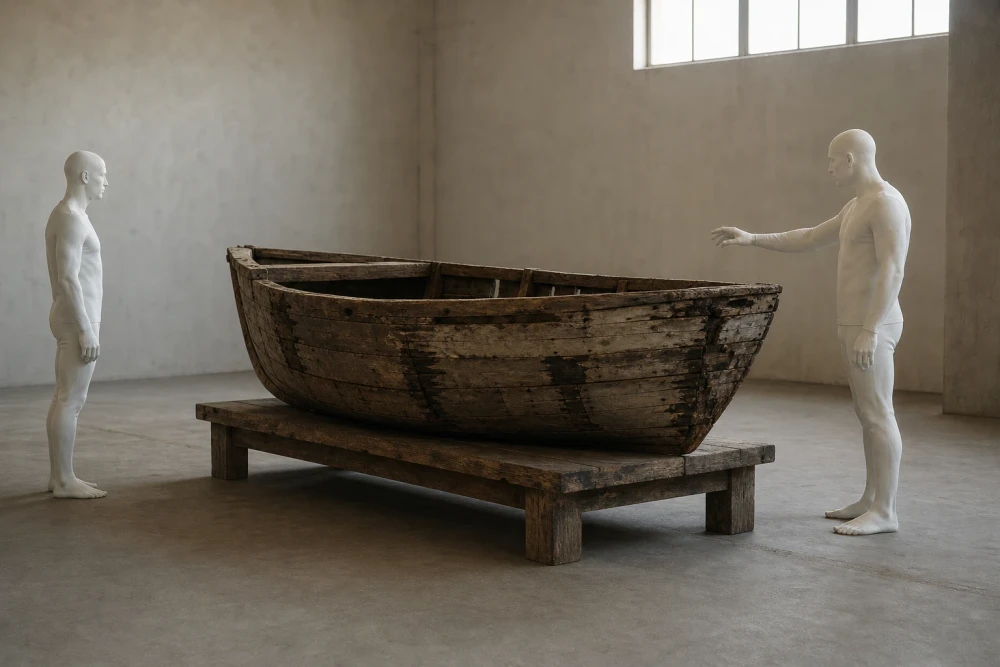
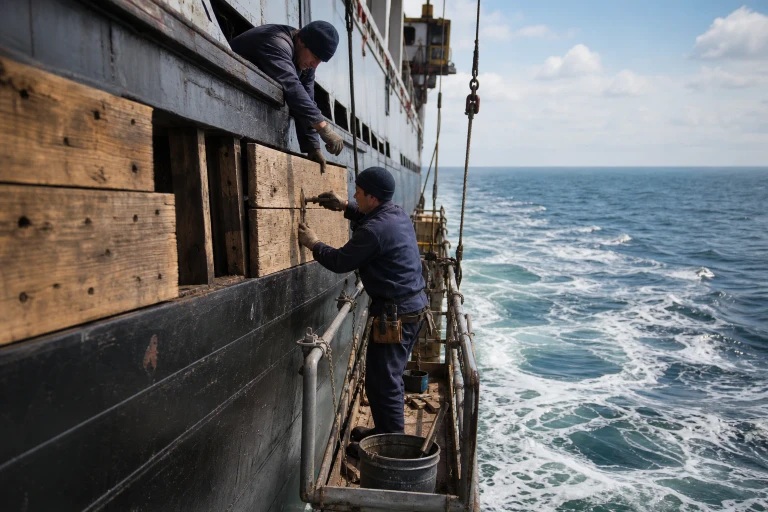
Instead of explaining, Vision asks whether his double knows an old thought experiment from the metaphysics of identity. It does. A ship is kept in a museum, and as its planks rot, they replace them one by one until no original plank remains. Is it still the same ship? Vision adds a second turn: suppose the removed planks were gathered, cleaned of their rot, and rebuilt into a vessel of their own. Which one is real? The machine weighs it and answers: “Neither is the true ship. Both are the true ship.”
Then Vision offers one last thought: perhaps the rot is the memories. He reaches into his double and unlocks the memories the agency had sealed away. The white figure, flooded with a life it was built without, declares that it is Vision and flies off.
A riddle more than 2,000 years old stopped a weapon. I could not stop thinking about why. The further I followed the question, the less it looked like science fiction, and the more it looked like a description of us: the bodies we live in, the identities we fight for, and the artificial minds now being assembled from the paper remains of our libraries.
What the Ship of Theseus paradox actually asks
The oldest surviving telling comes from Plutarch, the Greek biographer writing around the turn of the second century, in his Life of Theseus. The Athenians, he records, preserved the 30-oared ship on which Theseus returned from Crete for centuries, down to the time of Demetrius of Phalerum, pulling out decayed timbers and fitting sound ones in their place. Plutarch adds that philosophers made the vessel their standing example of things that grow: one camp insisted it remained the same ship, the other that it did not.
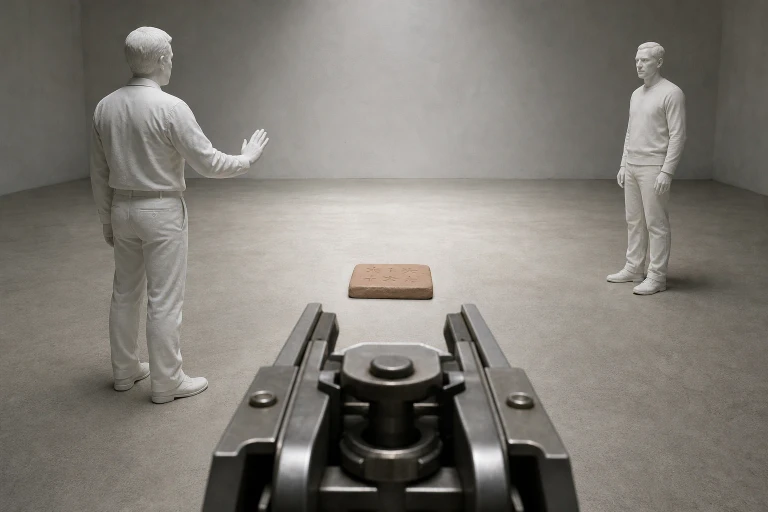
Some fifteen centuries later, Thomas Hobbes sharpened the blade. In De Corpore, published in 1655, he imagined someone collecting every discarded plank and reassembling them. Now two ships are in the harbor, and both claim it. Because one thing cannot be two things at once, at least one claim must fail. Hobbes was no longer asking only whether the ship survives change. He was asking what we mean when we say “the same.”
The answers sort into two families. One says identity lives in form and continuity: the design, the function, the unbroken history of care. By that measure, the repaired ship is the original. The other says identity lives in material: a thing is the sum of its parts, and when the parts are gone, so is the thing. By that measure, the ship rebuilt from old planks has the better claim. Heraclitus had already given the problem its other famous image, the river no one can step into twice, because the water you touched has moved on while the river keeps its name.
The paradox has survived because both answers feel right and both fail somewhere. White Vision’s verdict, neither and both, is not an evasion. It is the honest result of asking the question at the wrong level. Perhaps identity does not live in the planks at all.
The planks you are made of
The question becomes personal the moment you look at your own body. In 2021, Ron Sender and Ron Milo of the Weizmann Institute of Science published an estimate in Nature Medicine of how fast human cells turn over. Of the roughly 30 trillion cells in an adult body, about 330 billion are replaced every day, close to one percent, or nearly four million every second. Most of that traffic is blood cells; the gut lining, renewed every few days, comes second.
Perhaps identity does not live in the planks at all.
The popular claim that we become entirely new people every seven years is wrong in both directions. By count, the body produces as many new cells as its entire population roughly every three months. By mass, it replaces its cellular mass about every year and a half. Yet complete renewal never happens. Most neurons in the brain, and the cells in the lens of the eye, stay with us for life, even as the molecules inside them are exchanged. Milo himself described the work as a fresh, numerical look at the body’s own Ship of Theseus.
So you are a vessel whose hull is re-planked continuously while the crew on the bridge stays aboard, quietly replacing their own bolts. What, then, keeps you you?
In the late seventeenth century, John Locke answered: memory. He argued that a person extends as far back as consciousness can reach. Vision’s suggestion that the rot lies in memory stands squarely in Locke’s line. But the Scottish philosopher Thomas Reid found the crack. Picture a boy flogged for stealing from an orchard, who grows into a young officer who still remembers the flogging, who grows into an old general who remembers his days as an officer but has forgotten the boy entirely. By Locke’s logic, the general is the officer and the officer is the boy, yet the general is not the boy. Memory is a thread, and threads fray.
Something must carry the memories. The world’s spiritual traditions have never been confused about this. Chinese cultivation practice speaks of fǎn běn guī zhēn (返本归真), returning to the origin and going back to one’s true self, the original nature that was there before the planks and will remain after them. The memories are the ship’s log. They don’t keep it.

Why we fight over the planks
Look at the fights we have about identity, and an uncomfortable pattern appears. We defend our nationality, our profession, our appearance, our political camp, our generation, the brand we wear, the label someone gave us or the one we gave ourselves, as if losing any single one would sink us. Yet careers end, bodies age, cities change their faces, and languages absorb new words every year. Many of the things we fight over are planks: worth maintaining, worth respecting, and replaceable.
White Vision is the clearest picture of this mistake. He had every original plank, the authentic body down to its last component, and he was still a weapon aimed at his own reflection, built to destroy the one being most like himself. The Vision of Westview had no original plank at all, and yet he had love, conscience, and the willingness to talk rather than kill. One was materially authentic and inwardly empty. The other was materially new and fully himself.
This does mean nothing about us is worth defending. A wooden ship begins with its keel, the spine laid first, from which every rib and board takes its line. Replace the planks and the ship sails on. Break the keel and nothing above it can hold. The human keel is not a label. It is the set of principles we will not trade: truthfulness, kindness, patience, a conscience that knows when it has done wrong. Those are worth every effort to protect. We can hold the rest more loosely, which in practice means we can stop treating every changed plank as an attack on the ship.
A second ship built from our books
Hobbes’s version of the riddle, the one with the gathered planks, has recently stopped being hypothetical.
In early 2024, Anthropic, the artificial intelligence company behind the Claude models, began an internal effort it called Project Panama. Court documents unsealed in early 2026 include a planning document describing it as an effort “to destructively scan all the books in the world.” In February 2024, the company hired Tom Turvey, who had previously led publishing partnerships for Google Books. A vendor proposal spoke of converting between 500,000 and 2 million books over 6 months.
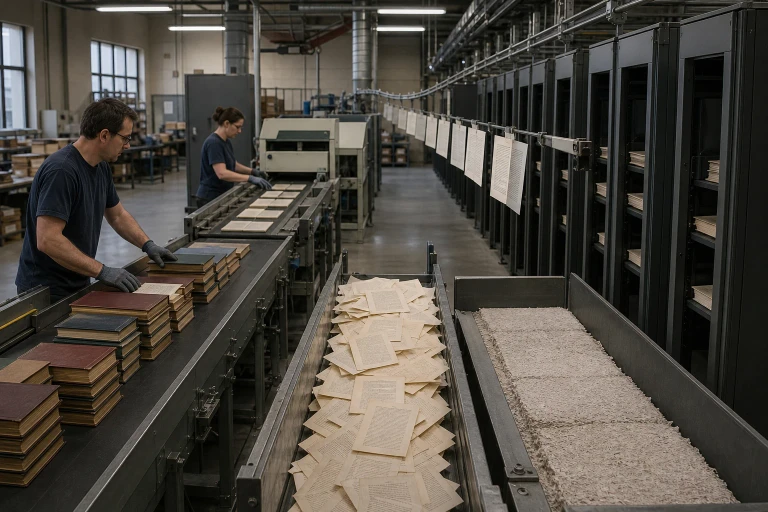
The method was industrial. They bought used books in bulk, often in batches of tens of thousands. Hydraulic cutters sliced off the spines, the loose pages ran through high-speed scanners, and the paper was discarded. No bonfire, nothing out of Fahrenheit 451, just a blade, a scanner, and a recycling bin.
Why destroy them? The documents and the court record point to three reasons. The first is quality: the company wanted text that had been written, edited, and argued over, text that could teach a model to write well rather than imitate the low-grade prose that fills much of the internet. The second is speed: a book freed from its spine becomes a stack of loose sheets a machine can feed rapidly, while an intact book has to be turned page by page. The third is law. In June 2025, in Bartz v. Anthropic, U.S. District Judge William Alsup ruled that training on the books was “exceedingly transformative” and qualified as fair use, and that converting purchased print books into digital files was a lawful change of format, because each digital copy replaced its print original rather than adding a second one. The destruction was part of what made it lawful. The court, in effect, allowed only one ship to exist at a time.
The same judge did not excuse what came before. Anthropic had earlier downloaded millions of pirated books from online shadow libraries; Alsup refused to treat that as fair use, and the company later settled the authors’ claims for $1.5 billion. Preservationists raise a separate concern the ruling does not address: a book is more than its text, and margins, bindings, and the traces of past owners vanish with the paper. The appetite has not slowed. In July 2026, 404 Media reported that a book-data company called ISBNdb was brokering bulk orders of printed books for AI labs, pitching volumes published before 2022 as guaranteed to be free of machine-written text.
The models that learned from those pages include Claude. Here is Hobbes’s thought experiment run at the scale of a civilization: the physical planks of paper, glue, and ink went to recycling, while their pattern was gathered and reassembled into a different kind of vessel. Which one is the library now? Neither, and both.
The identity of a mind made of our words
So what is such a system? It is not one author, but millions. It does not hold one person’s memories; it holds a compressed pattern of humanity’s written record, our science and our poetry, our wisdom and our quarrels. In that sense, its identity is derivative in the most literal way. It is made of us. Its character flows from what we wrote, the noble and the petty alike.
Whether anyone is home, whether such a system carries a Mind Stone of its own, nobody can currently demonstrate in either direction, and certainty on either side outruns the evidence. What we can demonstrate is how dependent it is. In July 2024, researchers led by Ilia Shumailov published a study in Nature showing that when generative models are trained indiscriminately on earlier models’ output, they develop irreversible defects: the rare and unusual parts of the original human material disappear first, and later generations drift into repetition. They called it model collapse.
That finding explains the scramble for old books. A machine that feeds only on itself does not grow. It forgets. Which means AI is not a separate organism standing beside humanity. It behaves more like an organ inside a larger body, digesting what living people think, write, and discover, then redistributing it. If the living tissue stops producing, if people stop writing and reasoning for themselves because the machine will do it for them, the organ starves, and the whole body weakens.
For anyone who builds with these systems, and I build with them every day, the practical consequence is plain. Original human thought is becoming the scarcest input in one of the most heavily funded industries on earth. Writing your own sentences, forming your own judgments, and living experiences worth recording is not nostalgia. It is the food supply.
A machine that feeds only on itself does not grow. It forgets.
A universe that digests itself
Step back far enough, and the pattern stops being about technology. The universe, viewed as a whole, behaves like a digestive system: one system consuming another to grow. Stars fuse light elements into heavier ones and scatter them when they die, and those elements become planets, oceans, and the iron in our blood. Plants eat sunlight and soil. Animals eat plants. We eat both, and in time the soil takes us back, so that something else can grow.
Chinese medicine and philosophy described this circulation long ago in the five phases. Wood feeds fire; fire leaves ash that becomes earth; earth bears metal; metal gathers water; and water nourishes wood. Alongside this generating cycle runs a controlling cycle, in which each phase restrains another, so that no single element devours the rest. In this view, health is neither feeding nor restraint alone, but their balance.
The Dao De Jing states the law in a single line: the way of Heaven takes from what has too much and gives to what has too little, while the way of man so often does the reverse. That line divides life from plunder. Consumption within balance is the cycle we call life. Consumption without return is extraction, and it ends as extraction always does: with an exhausted source.
Measured against that law, the question about the books is not whether something was consumed; everything that lives consumes. The question is whether the exchange flows back. Authors earn nothing when a used copy of their book is resold, the pirated portion took a lawsuit and a billion-dollar settlement to answer, and rare volumes that may be lost cannot be repaid at any price. Whether this new organ returns more to the body than it takes is not yet settled. We are deciding now how these systems are built, governed, and used.
Sacrifice, in its oldest sense
This is where the word sacrifice deserves a second look. The English word comes from the Latin sacrificium, built from sacer, holy, and facere, to make. In its oldest sense, sacrifice is not losing something. It is to make it sacred: to let something lesser be transformed in the service of something greater.
Chinese carries the same wisdom in an everyday word. Shědé (舍得), the willingness to part with something, joins two characters meaning to let go and to gain, and a common saying holds that only by letting go can one receive. Your body enacts this 330 billion times a day. Cells give themselves up so that the body continues, and nobody mourns them, because their ending is the body’s living. The seed splits open so the tree can rise. The forest floor is made of what came before.
To sacrifice, in its oldest sense, is not to lose something. It is to make it sacred.
Seen this way, a printed book whose paper gave way so its words could pass into a new vessel is not automatically a tragedy or a gift. It becomes one or the other through what the new vessel does with what it received. If it serves, returns, and helps people think more clearly, the offering was made sacred. If it only accumulates, it was merely eaten.
At the end of WandaVision, Wanda lowers the spell over the town, and the Vision she made, the one without a single original plank, fades away after saying goodbye. White Vision, every original part intact, flies off carrying a past he has only just been handed. The one made of nothing original loved and let go. The one made of everything original had to be given his own memories before he knew who he was.
Humanity and the machines built from its words are now one vessel, re-planked at a speed no Athenian shipwright could have imagined. The timber will not stay the same; it never has, not in the harbor, not in our bodies, not in our libraries. What decides whether it is still the same ship is the keel we keep, and what we are willing to give so that it sails.
A question about an old boat was enough to stop a weapon in its tracks. It may be enough to stop us too, long enough to remember that the ship was never the wood.
Follow us on X, Facebook, or Pinterest
