
People often say that children are angels who have descended to the human world. Some even claim these little angels choose their own mothers. “We picked you ourselves,” they say. “Before we were born, we already loved you.”
Some mothers have heard this from their young children and remembered a dream they had before pregnancy — a dream so vivid it felt like a message. When they describe it later, they realize it may have been a sign of the child’s arrival. Such experiences are called pregnancy dreams, and many mothers say they are astonishingly accurate.
How pregnancy dreams predict a baby’s gender
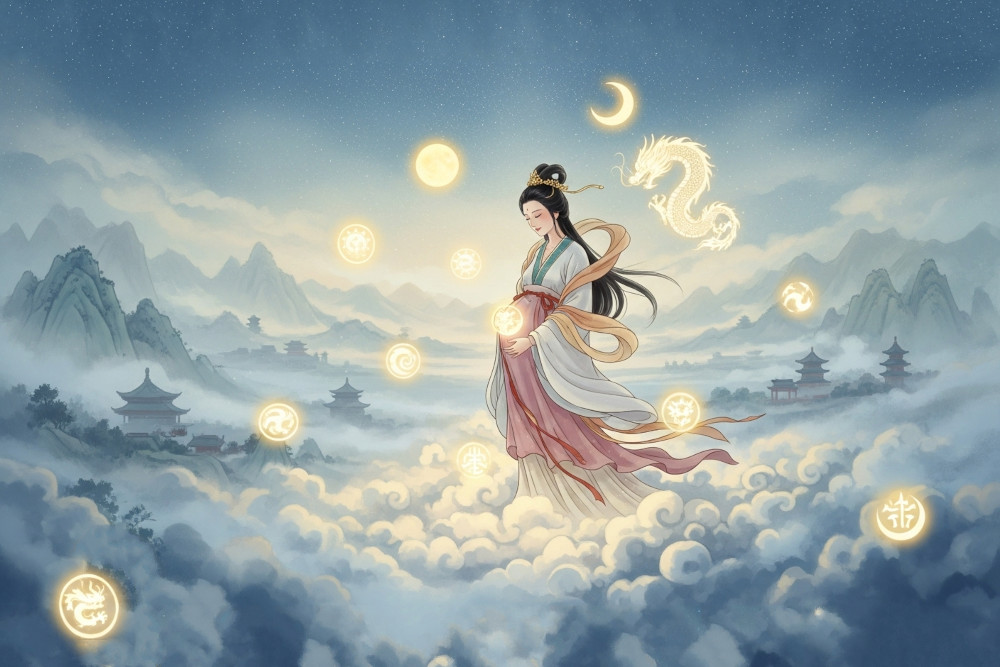
Ancient beliefs say that certain dreams can reveal a baby’s gender. Dreaming of the sun foretells a boy, and if the dreamer swallows the sun, the child will grow up to be wealthy and successful. Dreaming of the moon means a girl is coming; if the moon is large and bright, the daughter will be beautiful.
Dreaming of a dragon brings great fortune. Seeing its head clearly — and especially if it carries a pearl — signals a handsome boy. Seeing only the tail suggests a girl, and if both head and tail appear, the dreamer may have twins, one boy and one girl.
Dreaming of a vegetable garden with cucumbers, peppers, corn, or sweet potatoes means a boy. A garden full of flowers means a girl. If the mother stands among the blossoms, her daughter will be especially sweet; if cherries or apples appear, she will be both lovely and graceful.
These interpretations, often shared online, have a charming, whimsical quality. Yet such ideas are far from new. For thousands of years, our ancestors told stories of prophetic dreams that seemed to herald the birth of extraordinary children.
The pregnancy dreams of sages and heroes
When Queen Maya, the mother of Shakyamuni Buddha, was expecting, she dreamed of a white elephant entering her womb. Laozi’s mother dreamed of an elderly man riding a white deer.
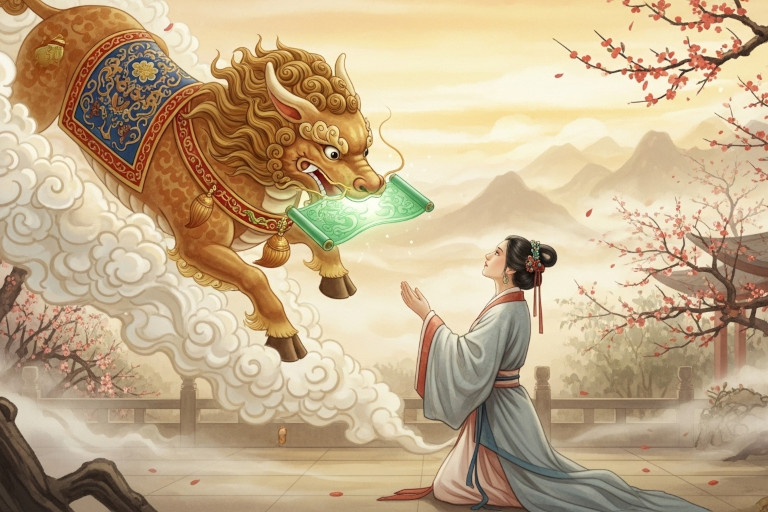
Confucius’s mother, Yan Zhengzai, dreamed of a qilin — the mythical creature of virtue — carrying a jade scroll from heaven. On the scroll were the words: “Descendant of the water spirit, as the Zhou Dynasty wanes, a plain king rises.” It foretold that her son would not rule from a throne, but would become a king among the people. Indeed, Confucianism later shaped Chinese civilization for two millennia, and Confucius was honored as “The Teacher of Ten Thousand Generations.”
Mencius’s mother dreamed of a great immortal descending from Mount Tai on a cloud. A wisp of cloud fell and struck her forehead, waking her. That very moment, she gave birth to Mencius. Neighbors reported seeing colorful clouds floating over their home, saying the child must be extraordinary.
Dreams that foretold the rise of emperors
During the Han Dynasty, Emperor Jing’s wife, Lady Wang, dreamed of the sun diving into her arms. The same night, Emperor Jing dreamed of a red dragon flying to the Chongfang Pavilion — Lady Wang’s quarters. When he ran there, he saw a red dragon circling above the roof. A sage later told him: “A wise ruler will be born here — one who will bring peace and prosperity to the nation.”
Their son, Liu Che, later known as Emperor Wu of Han, became one of China’s most powerful and accomplished emperors.
When Tang Dynasty founder Li Yuan’s wife gave birth to Li Shimin, two dragons were said to have circled above their house for three days. A scholar later told Li Yuan that his second son “has the bearing of a dragon and phoenix; by age twenty, he will bring peace to the world.” Li Yuan named him Shimin, meaning “to bring peace to the people.”
In 618 AD, Li Yuan ascended the throne, founding the Tang Dynasty. That same year, at age 20, Li Shimin fulfilled the prophecy and became Emperor Taizong — one of China’s most admired rulers.
The poet Li Bai was said to be heralded by a dream as well. His mother dreamed that Venus, the morning star, entered her womb. Soon after, she gave birth to a boy named Bai, with the courtesy name Taibai, referring to the planet. Li Bai’s lifelong fascination with the stars inspired generations, and people later called him the “Immortal Poet.”
Loyal ministers and dreams of destiny
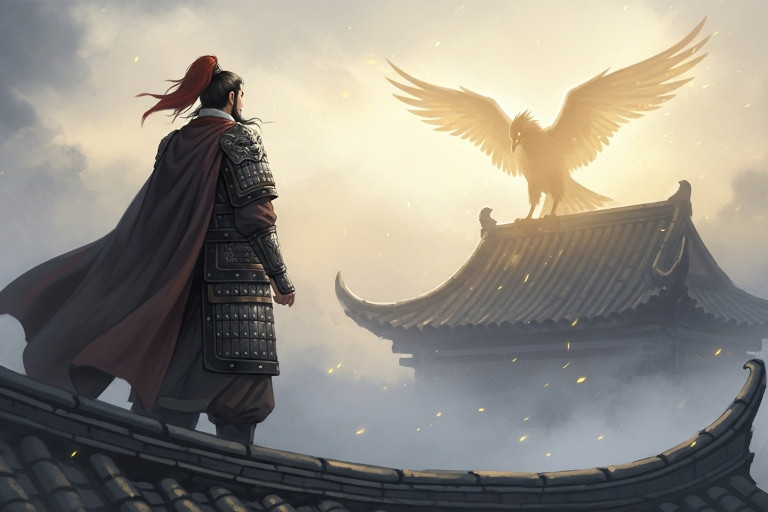
The Song Dynasty was known for its loyal ministers. Yue Fei’s mother dreamed of a golden-winged bird perching on their roof. In Buddhist tales, this divine bird feeds on dragons and protects righteousness. His father named him Fei, with the courtesy name Pengju, symbolizing great ambition. Yue Fei became a brilliant general, but he was betrayed and executed before realizing his dream of defending his country.
Wen Tianxiang’s father dreamed of a baby stepping on purple clouds and floating toward him. He named his son Yunsun, with the courtesy name Tianxiang. Years later, Emperor Lizong was so struck by Wen’s name and writing that he awarded him first place in the imperial exam. Wen later proved his loyalty beyond measure, refusing to surrender after the fall of the Southern Song. His famous line: “Since ancient times, who has not died? Let me keep my loyal heart shining in history,” still moves readers eight centuries later.
From emperors to ordinary mothers
Even the founders of the Qing Dynasty were said to have been foretold by dreams. Nurhaci’s mother dreamed of a white eagle with golden claws flying into her arms. In contrast, Empress Dowager Xiaozhuang dreamed of a heavenly deity handing her a baby and saying: “This child will unify the world.”
These are the dreams of emperors and heroes. But what about the dreams of ordinary mothers today? What signs do they see, and how often do their dreams come true?
To be continued.
Translated by Cecilia
Follow us on X, Facebook, or Pinterest
