

In the aftermath of World War II, peace arrived in Germany only briefly. By 1945, the fighting had ended, but the country — especially its capital — was quickly pulled into a new kind of confrontation, one without gunfire. Berlin, once the political heart of Europe and the capital of a defeated nation, was divided among the United States, Britain, France, and the Soviet Union. Before long, it became the most visible fault line of the emerging Cold War, split into two opposing systems: East Berlin and West Berlin.
In 1948, tensions escalated. The Soviet Union sealed off West Berlin, cutting rail, road, and water access in an effort to force the Western Allies to abandon the city. Overnight, a thriving metropolis became an isolated island. More than 2 million residents were trapped with dwindling supplies. Fuel ran short, food became scarce, and many families survived on little more than bread and potatoes. At night, weak lights flickered among the rubble, barely holding back the darkness.
To keep the city from collapsing under starvation, the United States, Britain, and their allies launched an unprecedented humanitarian effort known as the Berlin Airlift. Thousands of aircraft flew around the clock through narrow air corridors, landing every few minutes at Tempelhof Airport. Pilots referred to themselves as caretakers of an “air bridge,” delivering coal, flour, medicine, and other essentials piece by piece to a city under siege.
Among them was a young American pilot, Gail Halvorsen. One day, while waiting for his aircraft to be loaded, he noticed a group of German children standing quietly near the barbed wire by the runway. They were thin, their clothes faded, their shoes worn through. They didn’t shout or beg. Instead, they stood still, heads tilted upward, watching the planes pass overhead.
Halvorsen assumed they were hoping for food and walked over to speak with them. But the children didn’t ask for anything. They asked about airplanes, about flying, about what it felt like to be free in the open sky. They told him they had no candy, no toys, and little sense of a future. Yet when they heard the engines roar above them, it felt as though they were flying too — proof, they said, that the world had not completely given up on them.
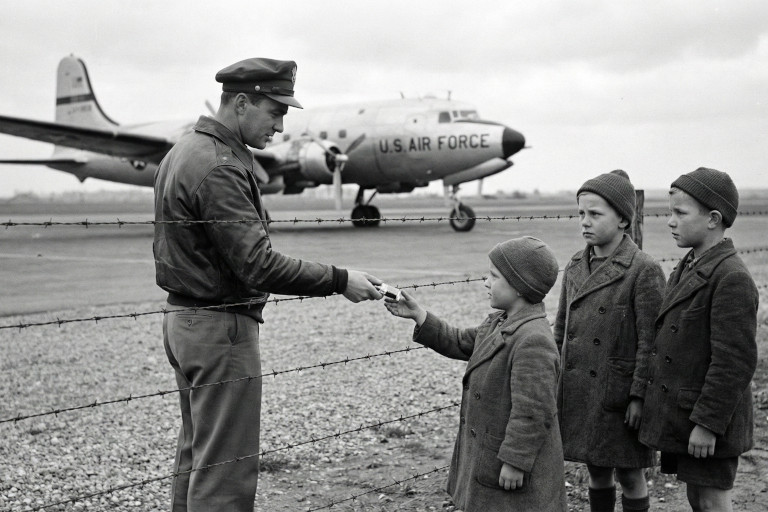
Halvorsen searched his pockets and found only a few pieces of chocolate he had been saving for himself. The children shared them carefully, breaking each bar into the smallest possible pieces. As he left, they thanked him sincerely. Walking away, Halvorsen realized that perhaps he could do more than deliver cargo.
Back at the base, he tied chocolates to small parachutes made from handkerchiefs. The next day, as his plane flew over Berlin, he gently released them from the aircraft without interfering with his mission. The white parachutes drifted down over the ruined city like dandelion seeds. Children ran through the streets, jumping and reaching for the small packages floating toward them. For a moment, the devastation around them seemed to disappear.
What Halvorsen hadn’t expected was the reaction that followed. An American journalist learned of the drops and published the story back home. The response was immediate. Across the United States, thousands of children began sewing their own handkerchief parachutes, filling them with candy and chocolate they had saved, and adding handwritten notes.
“To the children of Berlin, I hope you can smile again.”
“May this bring you a little sweetness.”
“May the world get better soon.”
Packages poured in from across the ocean. Halvorsen’s airlift squadron soon assigned specific flights to drop what became known as “candy bombs” alongside vital supplies. Berlin’s children called Halvorsen the “Candy Bomber,” and the planes that carried the parachutes earned the same affectionate name. Later estimates suggest that during the 15-month blockade, American pilots dropped roughly 250,000 candy packages over the city.

Even more striking was the reaction on the other side of the divide. Soviet forces, despite the intensity of the ideological conflict, quietly allowed the small parachutes to land. In front of hungry children, politics briefly gave way to something more human. Even in an era defined by hostility, no one chose to take that small joy away.
Every generation has its own form of barbed wire — sometimes physical, sometimes built from fear or prejudice. But history shows that walls are not dismantled by power alone. When the Berlin Wall eventually fell, it was not the work of a single leader, but the result of countless ordinary people holding onto dignity, warmth, and the desire to live freely.
Years later, the children who once watched the sky grew old. Many kept those faded handkerchiefs and yellowed notes for the rest of their lives. They were more than souvenirs. They were reminders that in the hardest years, someone far away had seen them, cared for them, and reached out. The candy may have fallen from the sky, but what truly remained was the knowledge that kindness can cross borders — and that being loved, even briefly, can light the darkest moments.
Translated by Patty Zhang
Follow us on X, Facebook, or Pinterest
