
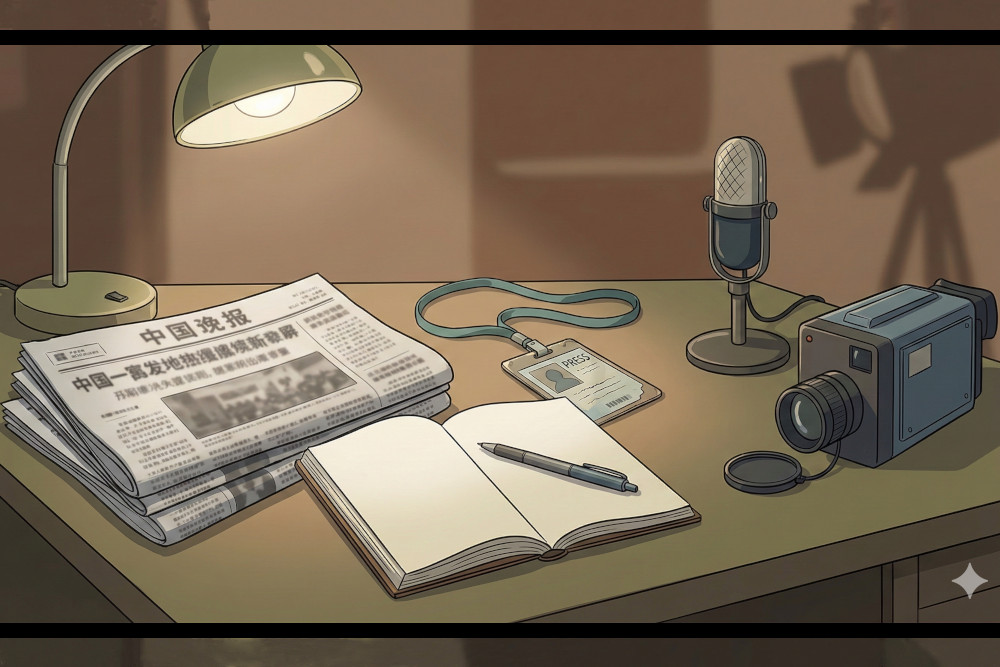
The following is an open letter from Chinese journalist Li Bo’an, who is currently living in exile. It was originally published in Chinese and later received the Grand Prize in the 2025 “Open Letters to All Sectors” Writing Contest organized by China Initiative.
We are publishing the letter in full, without commentary, as a primary document reflecting the author’s personal experience and perspective.
An open letter to fellow journalists
By Li Bo’an
October 9, 2025
Dear colleagues,
I know you are watching all of this unfold. Some of you are at People’s Daily; others work at local television stations, news websites, or regional outlets. You sit silently in editorial meetings. You hesitate when cutting or revising stories. And in your dreams, you still remember why you chose journalism in the first place.
It is not that you fail to understand the value of truth. It is that you are forced to pretend you do not.
Today, I write this letter as a journalist living in exile.
I am not here to condemn you. On the contrary, I want to tell you this: I believe your conscience is still intact. It has simply been buried for too long under fear.
I. Zhang Zhan and the price of speaking
You all know the story of Zhang Zhan. She was an ordinary citizen who, during the outbreak in Wuhan, used her phone to document what she saw on the streets. She once said: “Of course, we must seek the truth — no matter the cost.”
Truth has always been the most precious thing in this world. It is not an abstraction. It is our very life.
For pursuing that truth, Zhang Zhan was sentenced to four years in prison, her health nearly destroyed. After a brief release, she was detained again. She could have chosen silence. She did not.
Because she spoke the truth, history took another course. And the price she paid underscores an essential point: journalism is not merely a profession; it is a calling. Truth is not just words on a page; it is something lived, and sometimes suffered for.
I believe there is a Zhang Zhan in every newsroom. The only difference is that, for now, you cannot speak.
II. The Urumqi fire: The night truth burned
I will never forget that day.
In the winter of 2022, a high-rise residential building in Urumqi caught fire. The gates were sealed. Stairwells were locked. Firefighters were blocked. More than a dozen lives were lost in the flames.
And yet, coverage of the disaster was almost entirely suppressed.
Some reporters tried to write and were stopped. Some editors tried to publish and were told to “wait for unified guidance.”
That night, China’s internet was swallowed by silence until people took to the streets holding blank sheets of paper.
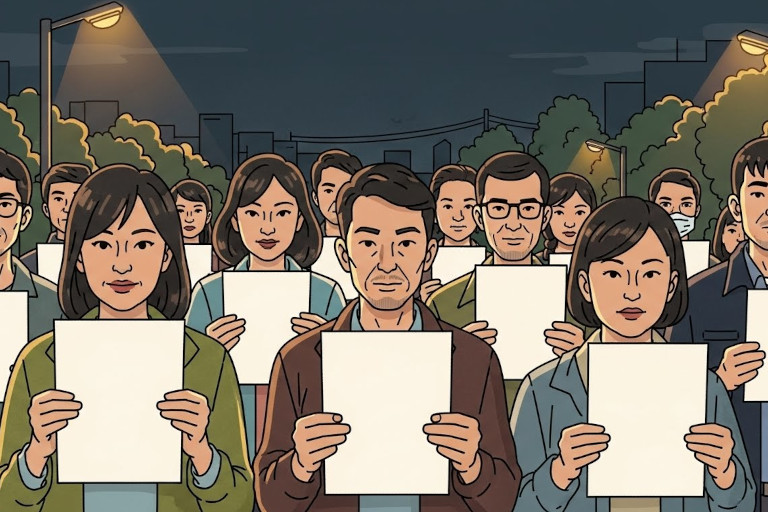
Those blank pages carried no words, yet spoke louder than any text. In an era where speech is forbidden, silence itself becomes a scream.
You saw it. You knew those protesters were not “foreign forces.” They were your fellow citizens — your neighbors, your families.
I believe that, in that moment, your hearts trembled.
III. Between conscience and fear
I left China years ago. I now report on China from London, having previously worked as a journalist at Voice of America. I want to be honest with you: exile does not mean freedom without cost.
I have been followed and photographed by strangers on British streets. Some nights, when everything is quiet, I still think of the lights of my hometown, of a street I can no longer return to.
Whenever I feel tempted to retreat, I think of you — those still working within the system, trying to preserve fragments of truth. I also think of the young people I have met abroad: Chinese students awakened by the White Paper protests and forced into exile.
Many were barely in their early twenties when they first raised blank sheets of paper. Some came from Tsinghua, Fudan, or Peking University. Others were studying overseas, standing in the streets wearing masks and chanting: “No nucleic acid tests — we want freedom.”
They told me: “We don’t know if we can ever go back. But we refuse to stay silent.”
In their eyes, I saw hope — and a reflection of myself when my belief in journalism first took shape.
I want you to know this: those of us overseas have not forgotten you. We are all persevering in the darkness, simply from different corners of the world.
While you safeguard fragments of truth inside China, we work to ensure the world hears them. We are not separate. We are resisting erasure together.
IV. The persistence of exiled journalists
Outside China, I have met many journalists living in exile.
They once published powerful investigations in Caixin, Southern Weekly, and Economic Observer. Today, they are scattered across London, New York, and Taipei, continuing to report with little more than modest donations and sheer determination.
One of them is Su Yutong. She was subjected to prolonged surveillance for reporting on human rights issues before fleeing to Europe. Even in Berlin, the harassment did not stop: her address was leaked, false police reports were filed in her name, and she was targeted with malicious advertising campaigns.
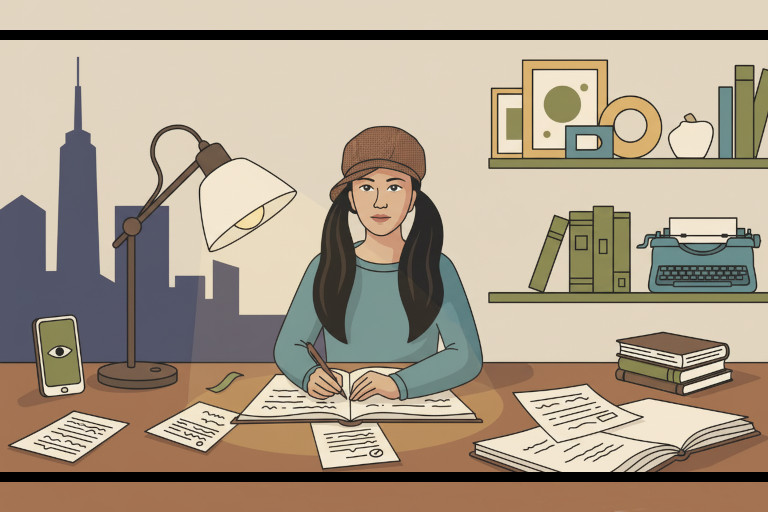
She told me: “They think they can scare me into silence. But I will only write more.”
Her courage made something clear to me. Authoritarian power can cross borders — but so can truth. Yes, we live in exile. But we keep writing.
Every report we publish reminds the world of something the authorities want erased: truth still exists in China, and the Chinese people are still resisting.
V. Nonviolent resistance
I understand that you cannot speak openly.
But there is still one thing you can do: preserve.
Preserve the footage that was never aired. Preserve the paragraphs that were deleted. Preserve the facts you know to be true. One day, these records may become the evidence through which China’s history is reconstructed.
Nonviolence is not cowardice. It is a more resilient form of resistance — memory standing against oblivion.
The moment you choose to preserve the truth, you are already resisting.
VI. Democracy is not punishment, but redemption
You are told that democracy would plunge China into “chaos.” But you know, in your hearts, that the real chaos is the chaos of lies.
Under democratic institutions, journalists do not need to fear telling the truth. There are no “forbidden zones,” no invisible “red lines” — only the weight of facts themselves.
A country with press freedom does not collapse under criticism. It grows stronger through transparency. A country without press freedom, no matter how high its GDP, will eventually decay from within.
Democracy does not seek to destroy journalists. It seeks to allow journalists to truly be journalists.
VII. Final words: Leaving traces for the future
Dear colleagues, I know you cannot respond publicly. You cannot repost this letter. You cannot like it. You cannot comment.
But I hope you remember this, quietly, in your hearts: you are not alone. Your conscience has not disappeared. Your silence is not surrender.
In every deleted article, every rejected manuscript, every late-night sigh, there is a belief — that one day, someone will know the truth.
That future may not be far away.
When the iron curtain falls, when archives are opened, when truth finally comes into the light, every document you preserved, every video you saved, every fact you held onto will become a cornerstone of a democratic China.
Then, we will once again stand in the sunlight as journalists and write:
“Every word here is free.”
Protect yourselves. And protect the truth.
We will meet again in the light.
May truth be with you,
and may you remain safe.
Translated by Eva
Follow us on X, Facebook, or Pinterest
