
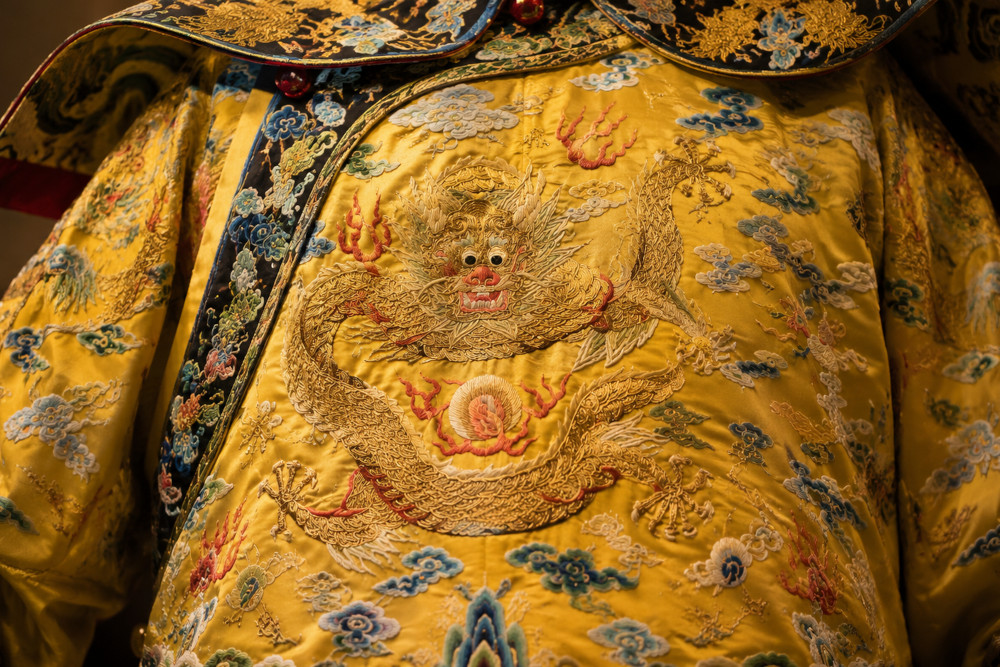
A Qing-era magistrate steps out of his courtyard in the soft light of early morning. His robe is a deep green. On his chest, a square panel of embroidered silk shows a single white egret stepping through reeds. To us, it is a beautiful image. To anyone who saw him that morning, ancient Chinese clothing ranked and signaled status with legible clarity. The color told them his civil grade. The bird told them his rank within it. The five-clawed dragon stitched along the hem of a cloud collar (had he been bold enough to wear one) would have told them whether he held the law in too high or too low a regard.
For much of 3,000 years, the code of cloth worked exactly like this. A person’s place in society was woven, dyed, and embroidered into what they wore, readable from across a courtyard, governed by sumptuary law, and rooted in something deeper than fashion. To understand it is to glimpse how a civilization once tried to make its values visible in daily life. The system was never about vanity. It was an extension of li (禮), the Confucian principle that outer order should mirror inner cultivation. To dress one’s place was to honor it.
In the sections that follow, we will trace how this code of cloth evolved from the Zhou court to the Qing palace: the colors reserved for emperors, the nine birds that ranked civil officials, the nine beasts that ranked military officers, the dragon robes that separated divinity from the merely powerful, the twelve cosmic symbols that ringed the emperor like a small universe, and the small acts of quiet rebellion that kept slipping past the censors.

Why was clothing never just clothing in ancient China
The earliest Chinese texts treat clothing as a moral instrument. The I Ching records that the legendary emperors “hung their clothes and ruled the world,” meaning that the very act of putting on a robe of state was, for the sovereign, an exercise of cosmic order. Dress was not separate from governance. It was governance, made visible.
The founding myth braids clothing into authority from the very beginning. Tradition credits the Yellow Emperor and his wife Leizu with inventing garments, and from that moment forward, what one wore was an outward sign of one’s place within the larger pattern of heaven and earth.
By the time of the Zhou Dynasty (1046-256 B.C.), this principle had hardened into a ceremony. The Zhou court appointed an officer called the Si Fu (司服), responsible for managing royal attire, not as a tailor, but as a master of ritual. Different crowns, different colors, and different patterns were prescribed for sacrifices, audiences, weddings, and funerals. Wearing the wrong crown at the wrong ceremony was not a fashion mistake. It was a breach of li.
This is the lens through which everything that follows must be read. When a Qing magistrate wore his egret square, he was not advertising his promotion. He was performing his place in a moral order that, in theory at least, ran from the cosmos down to the courtyard. The Confucian art of bowing carried the same logic. Clothing simply made the principle wearable.
The color code: Rank by hue
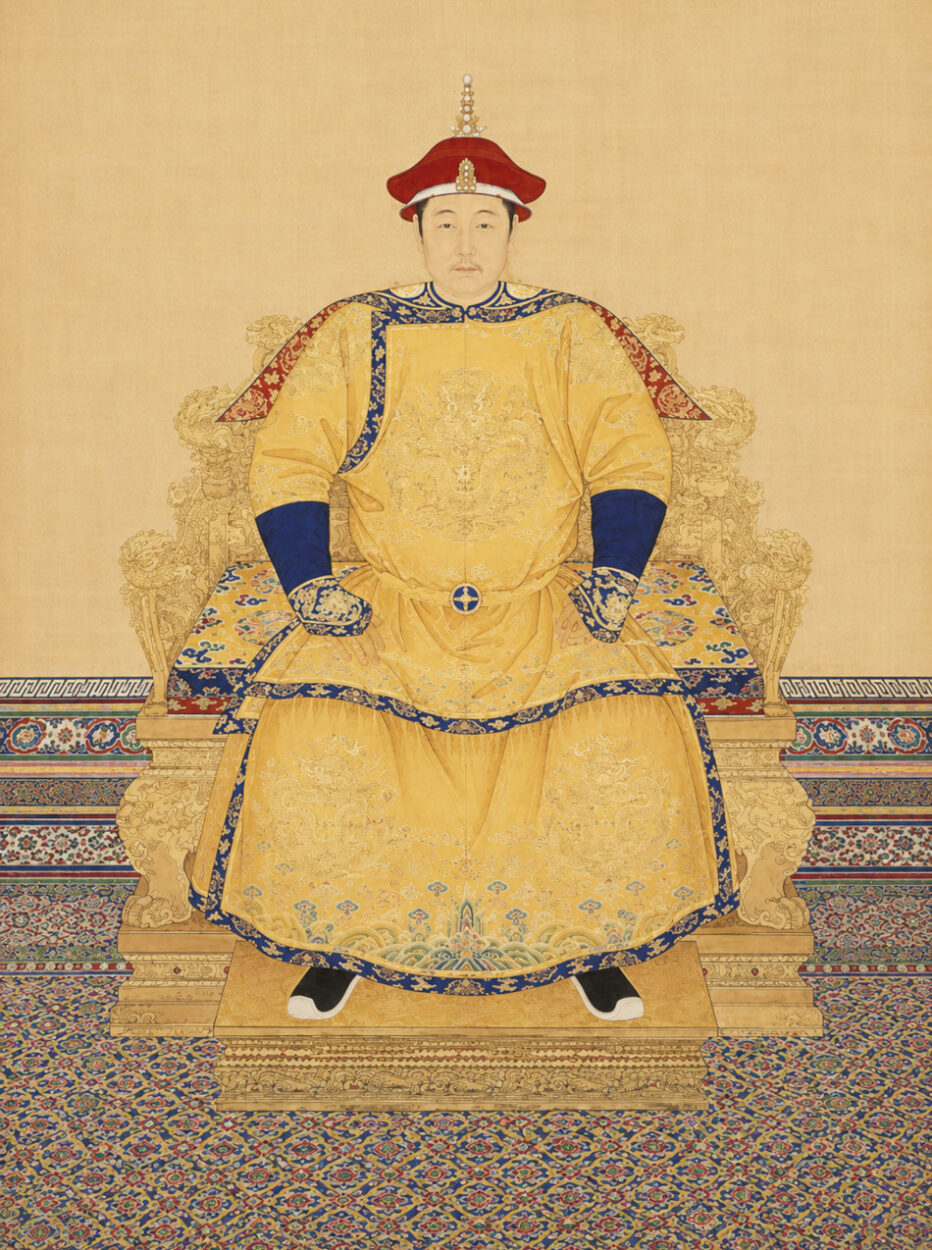
The system rested on the Five Elements (wu xing, 五行) and the polarity of yin and yang. Five colors are mapped to five directions: blue for the East, red for the South, white for the West, black for the North, and yellow for the Center. Yellow, occupying the center, belonged to the emperor, the still point around which the four directions turned.
From the Tang Dynasty (A.D. 618-907) onward, only the emperor could wear bright yellow (minghuang, 明黄). The rule held with remarkable consistency for more than a thousand years, all the way until the fall of the Qing in 1912. The yellow you see in museum photographs of imperial robes today is not a generic gold. It is a specific, regulated, restricted shade, a color that carried the weight of a throne. Below the emperor, color descended in clean tiers. The Tang and Song color hierarchy worked like this:
- Purple: Third grade and above, plus princes
- Red: Fifth grade and above
- Green: Sixth and seventh grades
- Blue (or cyan): Eighth and ninth grades
The wife of an official was required to wear the same color as her husband, a quiet acknowledgment that rank in imperial China was a household, not just an individual, condition. Peasants under several dynasties were restricted to dark cloth, often black or undyed blue, with only modest patterning permitted.
There is one wonderful detail buried in this story. When the founding Ming emperor, Zhu Yuanzhang, posthumously known as Ming Taizu, restored the Hanfu system in the late 14th century, he abolished purple as a rank color altogether. His reason was scriptural. Confucius had once warned that “evil purple seizes vermilion,” a complaint that an upstart color had pushed aside the proper one. The Ming emperor’s surname, Zhu (朱), happened to mean vermilion. Letting purple outrank red would, in his mind, have been a daily insult to his own house. So he removed the color from the court. Two and a half centuries later, the Qing kept the omission. This is what the color code looked like up close: an entire administrative palette built from cosmology, scripture, and a touch of imperial pride.
Mandarin squares: The embroidered résumé
In 1391, Ming Taizu signed a sumptuary law that gave the world one of the most elegant bureaucratic systems in human history.
What is a Mandarin square?
A mandarin square (buzi, 补子) is a large embroidered panel, roughly thirty centimeters across, sewn onto the chest and back of an official’s surcoat in imperial China. Civil officials wore birds. Military officers wore beasts. Both were ranked into nine grades, and the bird or beast on the square told any literate person, at a glance, exactly where the wearer stood in the imperial bureaucracy. The system was introduced during the Ming Dynasty and refined during the Qing Dynasty, when the badges were made smaller, decorative borders were added, and a few animals were adjusted.
The nine birds of the civil service
For the next five centuries, every civil official in China wore one of these birds on his chest:
- Crane: Longevity, wisdom, and elevated stature
- Golden pheasant: Beauty and refinement
- Peacock: Dignity and visible virtue
- Wild goose: Order, loyalty, and the return of the seasons
- Silver pheasant: Purity
- Egret: Purity in service
- Mandarin duck: Fidelity
- Quail: Modest courage
- Paradise flycatcher: Graceful diligence
Ming-era squares allowed some interchangeability between adjacent ranks, particularly the third and fourth, and the sixth and seventh. The Qing fixed the assignments and tightened the embroidery conventions. The choice of birds was not random. Each animal carried a symbolic meaning drawn from older layers of Chinese tradition, the same vocabulary that runs through Chinese flower symbolism, painted screens, ceramics, and poetry. To wear a crane was to claim a certain kind of life, not just a certain office.
The nine beasts of the military
Military officers wore one of nine animals chosen for their ferocity and command. Under the Ming, the highest ranks were marked by lions and tigers. Under the Qing, the system shifted slightly:
- Qilin (Qing) or Lion (Ming)
- Lion
- Tiger or Leopard
- Leopard or Tiger
- Bear
- Panther
- Panther
- Rhinoceros
- Sea horse (Qing addition)
The Qing replacement of the lion at the top with the qilin, a mythical chimerical beast often translated as “Chinese unicorn”, reflects a particularly Manchu sensibility: the preference for an auspicious mythological creature over a real predator at the apex of military rank.
Ming and Qing: Same idea, different style
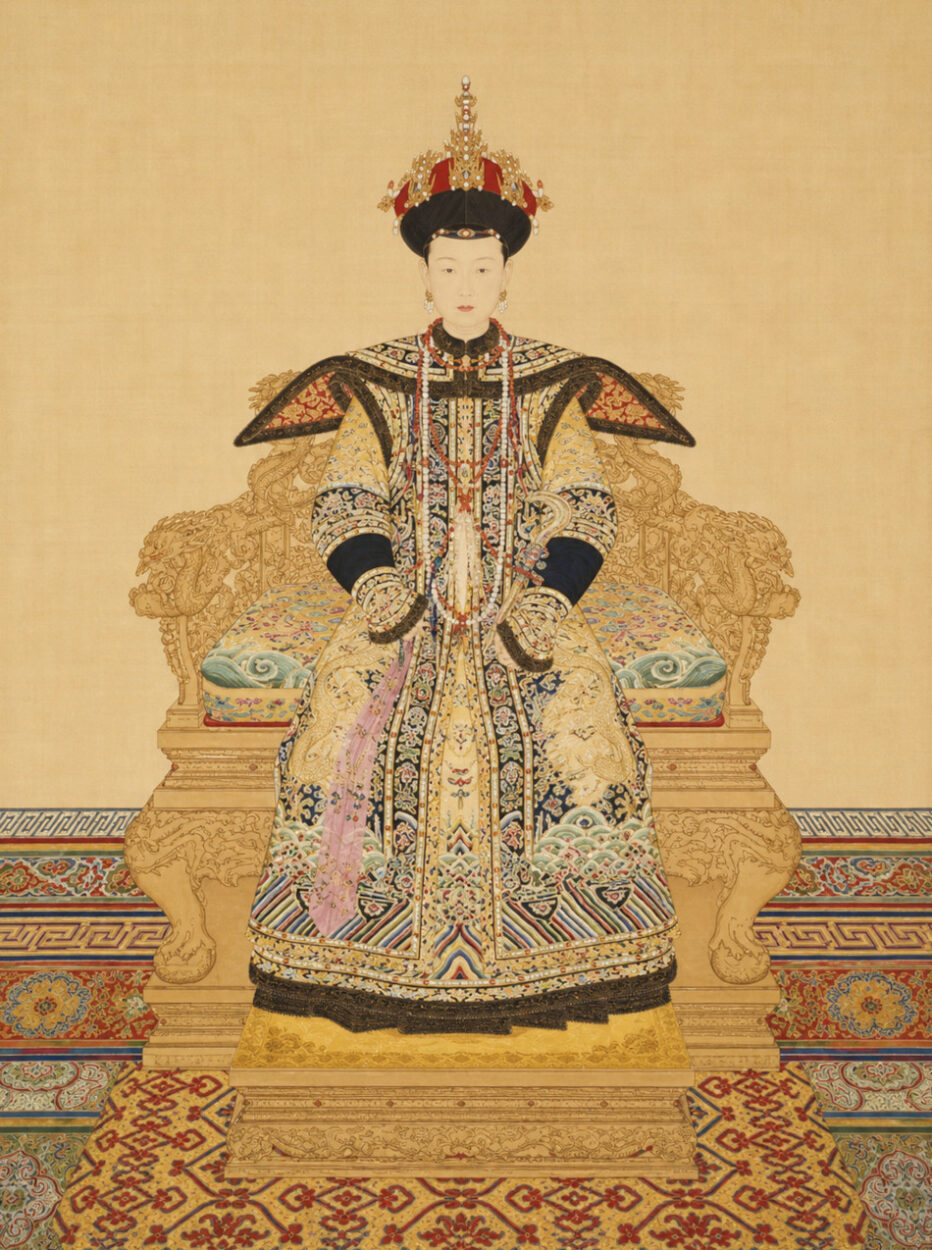
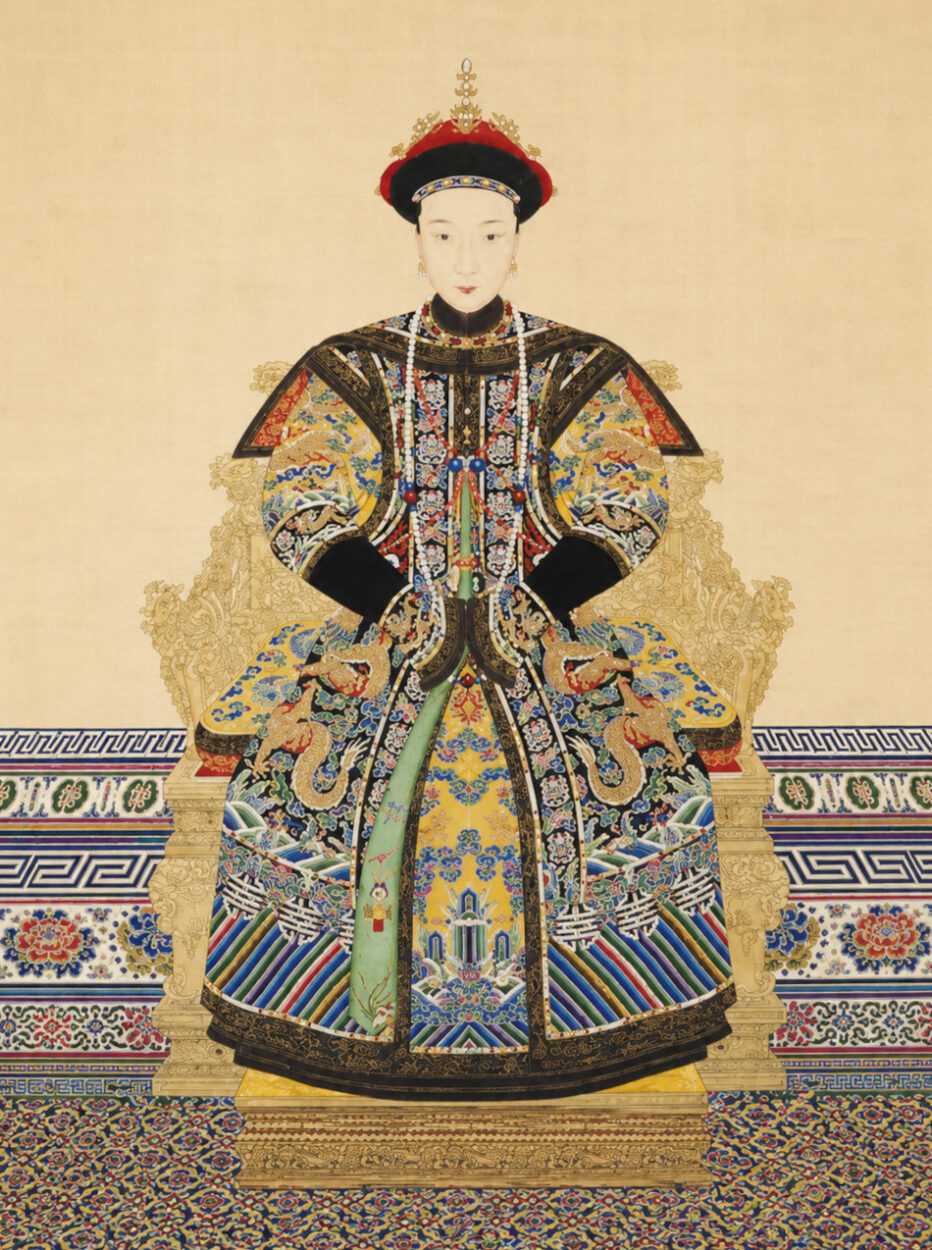
Ming-era badges were larger, embroidered onto full red robes covering the chest and back. Qing-era badges shrank, gained decorative borders, and were worn over Manchu-style surcoats with a vertical front opening, which split the chest badge in two when sewn. Qing officials are often pictured with a square that appears as two mirrored half-squares meeting at the centerline. The continuity between dynasties is more striking than the differences. Both held to the same essential logic: rank was something you wore.
(Image: Public Domain via Wikimedia Commons)
Dragon robes and the long vs. mang distinction
Above the bureaucratic squares stood a higher order of garment, the dragon robe.
Who could wear a dragon robe?
Dragon robes are first formally documented in A.D. 694, during the reign of Empress Wu Zetian, China’s only female emperor. Tang court records describe garments embroidered with dragons granted to favored officials and princes as a mark of imperial trust. By the Song Dynasty, the privilege had narrowed sharply. A decree in A.D. 1111 forbade any subject from wearing dragon patterns without explicit imperial permission.
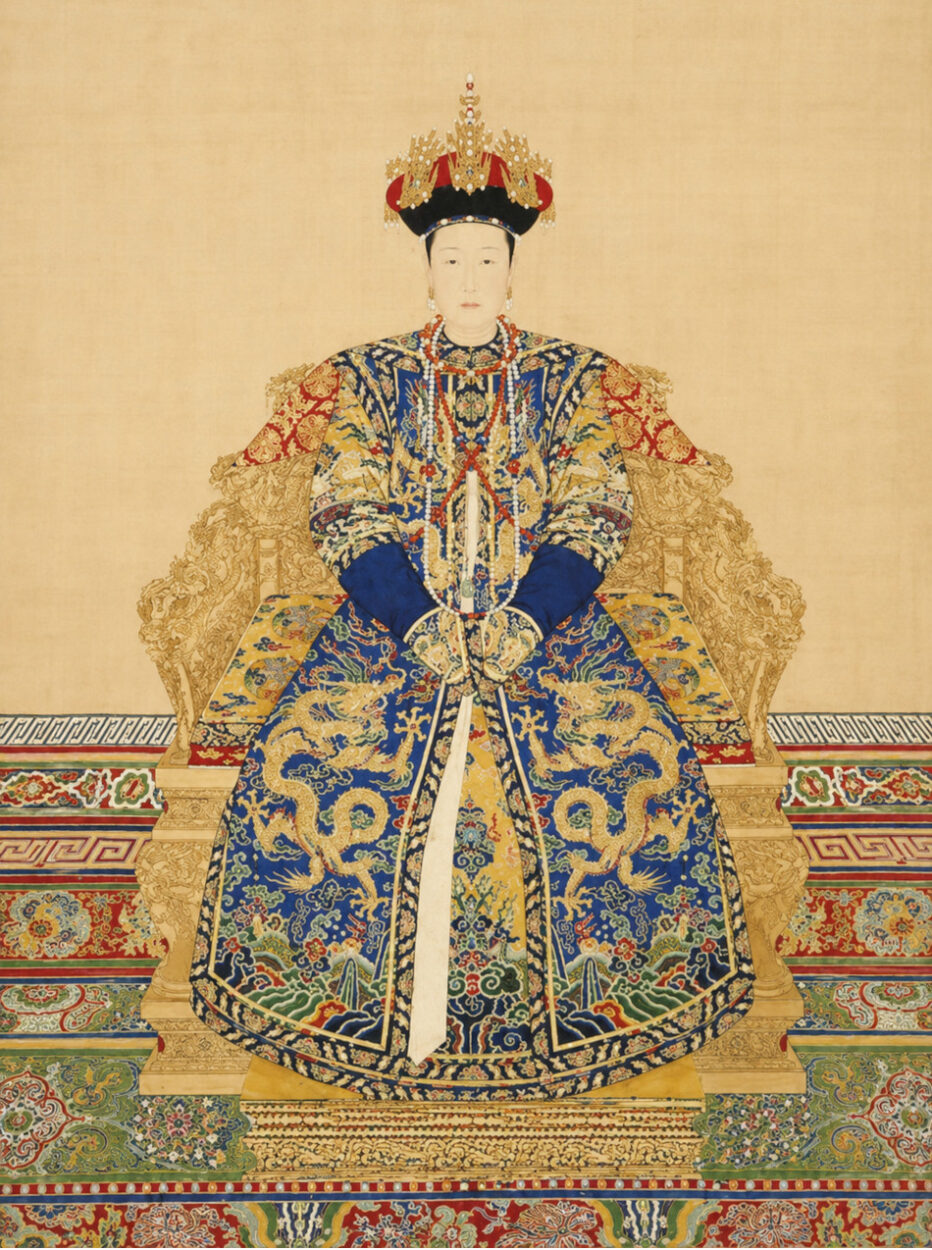
Under the Qing Dynasty (1644-1912), the rule reached its strictest form. True five-clawed dragon robes belonged to the emperor and select members of the imperial family. Other ranks could wear robes that displayed something close to a dragon, but not quite.
Five claws or four: The long and the mang
Here, the system became almost mathematical. The five-clawed dragon, long (龍), was reserved exclusively for the emperor and his immediate family. Any creature with one fewer claw was, by imperial decree, no longer a dragon at all. It was a mang (蟒), a word that literally means python. A mang robe (mangpao, 蟒袍) was permitted to high officials, princes of secondary rank, and the senior nobility. A contemporary Qing source put it bluntly: “the mang robe is a garment with an image close to a dragon, similar to the dragon robe of the top authority, except for the deduction of one claw.” A single missing claw, in other words, was the difference between sovereignty and service. Imperial Chinese symbolism rarely worked harder than this.
Other variants existed for officials of particular distinction. The feiyufu (飞鱼服), or “flying-fish robe,” was a Ming-court garment embroidered with a dragon-like creature that had fins instead of legs. The douniufu (斗牛服), the “dipper-capricorn robe,” carried a beast resembling a dragon but with curved horns. Each was a calibrated step away from the imperial long: close enough to honor, far enough not to encroach.
The color within a color
Even within imperial yellow itself, the Qing court drew finer lines. The emperor wore minghuang, bright yellow. The crown prince wore xinghuang, “apricot yellow.” Imperial princes wore jinhuang, “golden yellow.” Other princes and nobility wore blue or blue-black. To a trained Qing eye, a procession of yellow robes was not yellow at all. It was a series of distinct shades, each holding a precise rank.

The twelve symbols of sovereignty: A cosmic wardrobe
If a magistrate’s robe carried a single bird, the emperor’s robe carried the entire universe.
The Twelve Ornaments (十二章纹, shi’er zhang wen), also called the Twelve Symbols of Sovereignty, were a set of ancient embroidered designs that were eventually reserved for the emperor alone. Some scholars trace them as far back as the Zhou. They were debated, dropped, and revived from dynasty to dynasty until the Qianlong Emperor formally codified them in 1759 in the imperial regulations known as Huangchao liqi tushi. From that point on, all twelve appeared on the emperor’s most formal robes, and only on his.
The twelve symbols, with their meanings:
- Sun: A red disc holding a three-legged crow. Yang energy and imperial brightness
- Moon: A pale disc holding the legendary hare and his elixir. Yin energy and sacrifice
- Three-star constellation: Cosmic order, often identified with the emperor himself
- Mountain: Stability, and the fixed foundation of rule
- Dragon: Adaptability, strength, and the power to ride change
- Pheasant: (or fenghuang, the phoenix): Refinement and peace
- Two ritual cups: Sometimes painted with a tiger and a monkey, signifying faithfulness and respect
- Seaweed: Purity and clean leadership
- Grain: The emperor’s duty to feed his people
- Fire: Clarity, and illumination
- Axe head: Courage, and the executive power of justice
- Fu (亞): Discernment, the ability to tell right from wrong
Stitched onto a single robe, these twelve symbols turned the wearer into a small portable cosmos. He was, in literal embroidered fact, the Son of Heaven: the bridge between sky and earth, dressed in the order he was meant to maintain. The Metropolitan Museum of Art holds a stunning Qianlong-era twelve-symbol festival robe that lets a modern viewer read the entire system at a glance. This is how far the code of cloth reached at its apex. The emperor’s robe was not a uniform. It was a statement of cosmology.
When the rules bent: Sumptuary laws and quiet rebellion
Every elaborate rule system invites quiet resistance, and imperial Chinese dress was no exception. The Spencer Museum of Art at the University of Kansas holds six robes that once belonged to Han Chinese nobles under the Qing Dynasty. By Qing law, every one of these men was permitted only the four-clawed mang. Every single surviving robe, all six, wears a five-clawed long.
This is not a small detail. It is the visible record of a population reasserting itself, one stitched claw at a time, under a foreign-ruled court that had imposed not only its government but its hairstyles and its banner-style dress upon them. The Penn Museum’s bulletin on Chinese mandarin squares puts it plainly: officials “violated these laws all the time.” Enforcement was inconsistent. Tailors looked the other way. When they noticed, the censors often did not report it. The system was rigid in theory and porous in practice. Sumptuary law in imperial China was less a hard barrier than a moral grammar. People bent the grammar to say things they could not say out loud.
There were smaller rebellions, too. Song-era officials carried fish bags (yufu, 鱼符) at their belts: small pouches containing carved fish made of gold, silver, or copper, depending on rank. The fish were originally security tokens, tallies that proved an officer’s identity. By the late Tang, they had become rank insignia, almost ornamental. Records hint that these small metal fish sometimes circulated in informal trade, bought, borrowed, or lifted from a deceased official’s wardrobe. A higher-ranking fish at a lower-ranking belt was a quiet promotion no one had earned. What this tells us is human and a little tender. Even at its most codified, dress in imperial China was always, at the same time, lived in.
What ancient Chinese rank and status still teach us
The dynasties are gone. The mandarin squares hang in glass cases. But something of the older way of thinking about clothing has not vanished. In the past decade, the Hanfu revival has spread across China and its diaspora, with millions of young people choosing to wear the loose-sleeved robes of the Tang and Ming on weekends, at festivals, and at weddings. The movement is not merely nostalgic. It is a quiet reclamation: a generation deciding that what their ancestors wore was not a costume but a language, and that the language is worth speaking again.
The deeper lesson sits in li itself. In ancient China, clothing rank and status were never really about cloth. They were about the idea that visible order matters: that what we wear, how we present ourselves, the small daily choices of color and form, are part of how a society holds together. The egret on a magistrate’s chest told the world he had been entrusted with a particular work. The yellow on an emperor’s shoulder told the world he carried, or at least was meant to carry, the burden of the Center. In an age of fast fashion and disposable signals, this is a quietly radical thought. Clothing can be a daily practice of attention, a small act of dressing one’s place, whatever that place is, with care.
What the code of cloth leaves behind
For more than 3,000 years, the people of imperial China lived under a code of cloth. Yellow belonged to the emperor. Purple, red, green, and blue marked descending grades of the civil service. Embroidered cranes, geese, and quails counted off nine ranks of magistrates. Lions, tigers, and rhinoceroses counted off nine ranks of officers. Five claws meant sovereignty; four meant high service. Twelve cosmic symbols, stitched together on a single ceremonial robe, made the emperor himself a wearable universe.
It was a system rigid in its rules and surprisingly human in its execution. Porous to small rebellions. Capable of carrying a Confucian principle of inner cultivation into the ordinary streets. Elegant enough that we are still studying it centuries later.
The Qing fell. The robes went to museums. But the underlying idea, that clothing is a form of speech, and that what we wear is part of how we honor the place we hold, is still very much alive. Ancient Chinese clothing, taken as a whole, is one of the longest-running reflections in any culture on a simple question: what should the body say to the world?
Discover more about Chinese culture and traditions.
Follow us on X, Facebook, or Pinterest
