
Cancer remains one of the most feared diseases in the world. Modern medicine has made enormous progress in diagnosis and treatment, yet cancer still takes millions of lives each year and continues to challenge doctors, patients, and families alike.
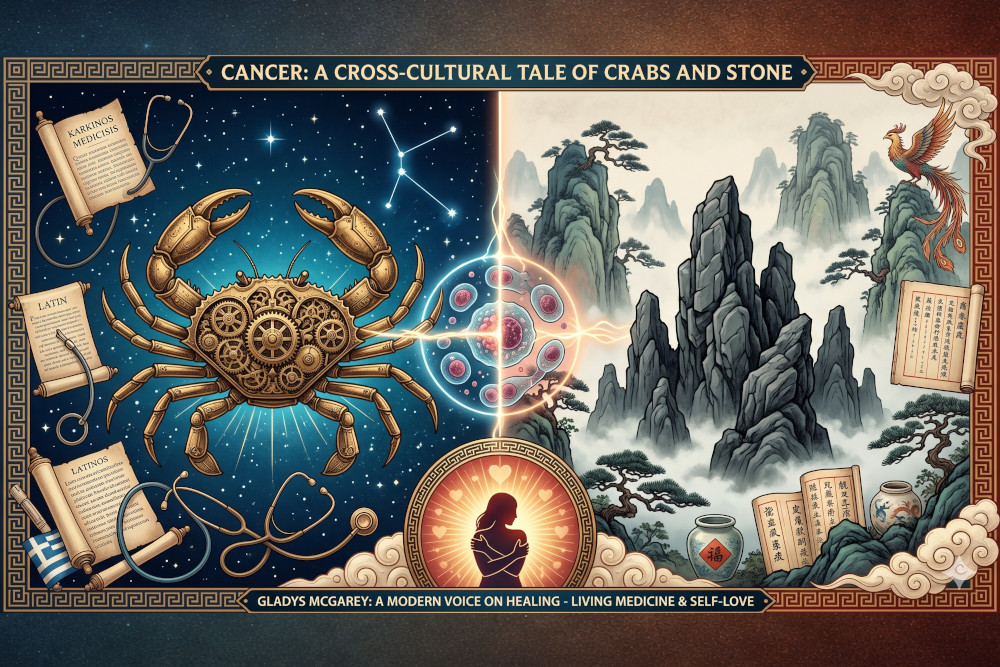
Because it is so serious and so difficult to fully conquer, people across cultures have not only tried to treat cancer, but also to understand it through language, imagery, and story. That has led to some fascinating differences between East and West. In the West, cancer came to be associated with a crab. In traditional Chinese thought, it was often linked to something more like jagged stone or rock. The two images are different, but both grew out of close observation and a shared desire to make sense of a frightening disease.
A modern voice on healing
Before looking at history, it is worth pausing on a modern figure whose ideas bring a more personal dimension to the subject.
Gladys McGarey, often called the “mother of integrative medicine,” has spoken publicly about being diagnosed with cancer twice, including once in her nineties. She has said that she approached the two diagnoses differently, using natural therapies in one case and conventional Western treatment in the other. In reflecting on those experiences, she often returned to one idea: learning to love herself.
That phrase can sound simplistic at first, but McGarey used it in a broader sense. She described what she called “living medicine” as an approach that includes medical knowledge while also recognizing the role of the patient’s inner life, attitude, and vitality. In her view, treatment matters, but so do the ways people support their own healing through hope, belief, and care for themselves.
Whether or not one agrees with every part of that philosophy, it raises an interesting point. The way people think about illness influences the way they respond to it. That is true not only for individuals today, but also for entire civilizations in the past.
Why the West called it cancer
At its most basic level, cancer is a disease of uncontrolled cell growth. Normally, cells in the human body grow, divide, and die according to tightly regulated processes. When those controls break down, cells may multiply abnormally, form tumors, invade surrounding tissues, and interfere with the body’s normal functions.
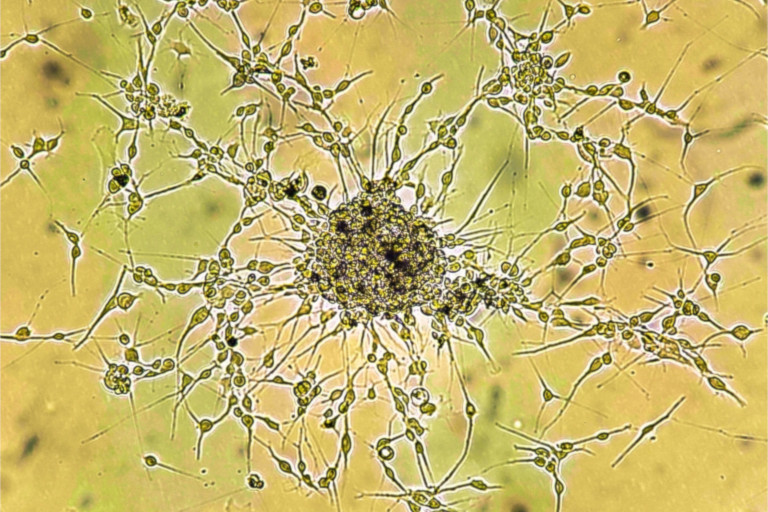
The English word cancer has a much older history than many people realize. It can be traced back more than 2,000 years to ancient Greece.
In the 4th century BC, Hippocrates, who is often called the father of Western medicine, is said to have observed certain malignant tumors and noticed a striking pattern. Some had a hard central mass with swollen veins spreading outward from it. To him, the shape suggested a crab, with a round body and legs extending in different directions.
He used the Greek word karkinos, meaning “crab,” to describe the disease. Later, when Roman scholars adopted Greek medical knowledge, they translated the term into Latin as cancer, which also means “crab.” From there, the word entered European languages and remained attached to the disease.
It is a vivid example of how medicine has always relied not just on technical knowledge, but also on metaphor. What physicians saw with their eyes became part of the language people still use today.
What Chinese physicians saw instead
Traditional Chinese medicine developed its own way of describing tumors, and the image it emphasized was very different.
Chinese medical writings have referred to tumors since ancient times. When physicians observed visible or surface growths, such as those affecting the breast or skin, they noted that these masses could feel extremely hard, uneven, and difficult to move when pressed. Rather than thinking of an animal, they were reminded of rock formations or rugged stone.

This helps explain why traditional Chinese descriptions of cancer often carry the sense of something hard, jagged, and mountain-like. If Western doctors saw something that looked like a crab, Chinese physicians focused on the stony hardness of the mass itself.
That difference is culturally revealing. Both traditions were studying the same frightening reality, yet each reached for a different image. One emphasized grasping movement and radiating veins. The other emphasized hardness, weight, and immovability.
In both cases, the metaphor reflected careful observation. And in both cases, it also conveyed something deeper: cancer was seen as a formidable and menacing condition, something that did not belong in the ordinary order of the body.
How the crab reached the stars
The Western association between cancer and a crab took on another layer through mythology.
In English, Cancer with a capital C refers to the zodiac sign of the Crab. That usage also comes from the Latin word for crab, but its place in the night sky comes from a story in Greek mythology.
According to the myth, the hero Heracles, known in Roman tradition as Hercules, was carrying out the famous Twelve Labors assigned to him after a tragic period in his life. One of those labors was to defeat the Hydra, a serpent-like monster with multiple heads. The creature was especially difficult to kill because when one head was cut off, more could grow back.
During the battle, the goddess Hera, who hated Heracles, sent a giant crab to interfere. The crab seized his foot with its claws, trying to hinder him as he fought the Hydra. The effort failed. Heracles crushed the crab and then defeated the monster.
Yet the story does not end there. In recognition of the crab’s service, Hera placed it in the heavens, where it became the constellation Cancer.
This myth has nothing to do with medicine in a scientific sense, yet it shows how deeply the image of the crab entered Western imagination. The same word that named a disease also named a constellation, linking medicine, language, and myth in a way that still survives today.
Different images, shared human instinct
The contrast between East and West is striking. In the Western tradition, cancer became a crab, a creature with a hard shell and grasping limbs. In traditional Chinese thought, it was more like stone, hard, uneven, and resistant to pressure.
These are different ways of seeing, but they come from the same human impulse: to look closely at something frightening and give it a form that can be named and understood.
That impulse is still with us. Even now, people do more than search for treatments. They search for meaning, for language, and for ways to face illness with courage. Across cultures and across centuries, that part of the human response to cancer has not changed.
Translated by Joseph Wu
Follow us on X, Facebook, or Pinterest
