
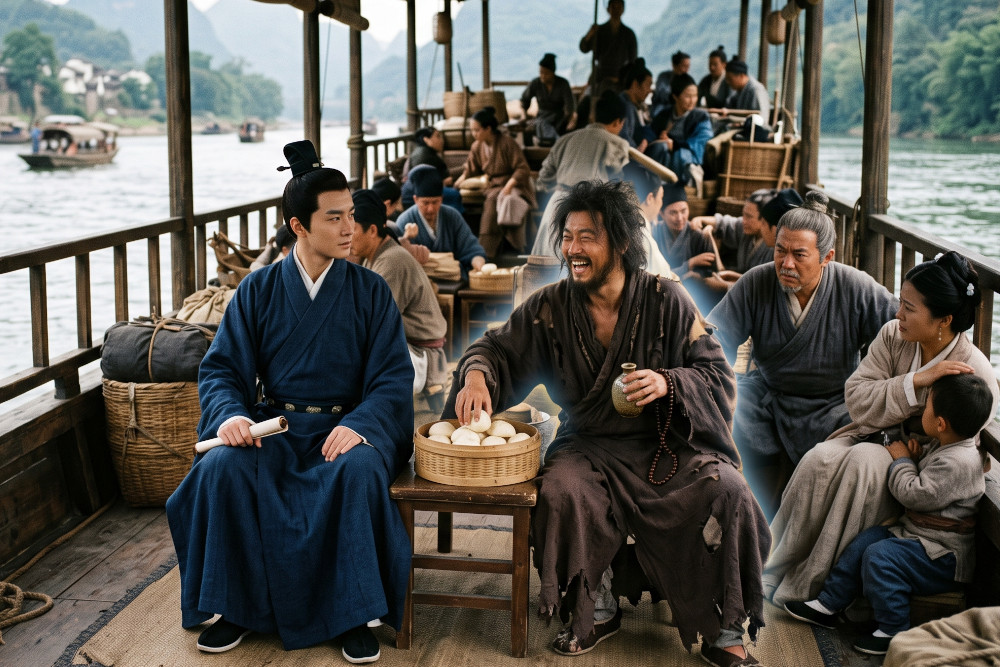
Yang Yi, courtesy name Qianzhi, was a native of Huayang in Chengdu. Known for his honesty, kindness, and integrity, he appears in a story from the Ming Dynasty collection Stories Old and New (Yu Shi Ming Yan), titled “Yang Qianzhi Meets a Monk with Extraordinary Powers on a Passenger Boat.”
One year, the imperial court appointed Yang as magistrate of Anzhuang in Guizhou. While traveling to take up his post, he encountered a monk aboard a boat. The monk behaved wildly and without restraint, yet he was said to possess extraordinary spiritual powers.
From the moment he appeared, the monk caused trouble. He snatched buns from other passengers, drank heavily, became thoroughly intoxicated, and deliberately behaved in ways that others found offensive.
Yang, however, did not look down on him. Nor did he put on airs because he was an imperial official. He continued to treat the monk with patience and kindness, even personally caring for him while he was drunk and staying awake through the night without complaint.
Having seen Yang’s character for himself, the monk concluded that he was an unusually good man and decided to help him.
Only later did it become clear that the monk’s outrageous behavior had been a test.
True kindness is not merely something displayed in public. It is revealed in how a person treats others when no one is watching and when there is nothing to be gained. It shows in how we treat strangers, the vulnerable, and even people who irritate or inconvenience us.
The monk also understood something else about Yang. Although Yang was upright and well educated in the teachings of the sages, he was too inexperienced in the ways of the world. He understood loyalty, righteousness, integrity, and honor, but not the complicated relationships of a frontier region. He knew how to judge a case fairly, but not how deeply local interests and rivalries could be entrenched. He knew the principles by which a good person should live, but he was less skilled at adapting his methods to difficult circumstances.
So the monk arranged for his younger sister, Li Shuzhen, to accompany Yang to his new post.
Li understood the customs of the Miao frontier, the local power structure, and the complicated ways people dealt with one another. In the monk’s view, her strengths complemented the areas where Yang lacked experience.

Li could read signs in the weather and helped the travelers avoid a violent storm on the Zangke River. Her knowledge of local customs allowed her to recognize suspicious tribute goods and prevent Yang from becoming entangled in a legal dispute. She also understood the personalities of local chieftains and knew how to respond to schemes by powerful families and officials.
Careful and farsighted, she often recognized danger before it fully emerged and prepared accordingly.
With Li’s guidance, Yang reached Anzhuang safely. Once there, he remained an upright official, but he still had much to learn about governing the region. Li helped him understand when to stand firmly on principle and when circumstances called for a more flexible approach.
Over the next several years, Yang became increasingly capable of handling local affairs. The region grew more stable, and its people could live and work in peace.
Principles are not enough
The story suggests that honesty and integrity alone do not automatically give a person the practical wisdom needed to navigate difficult circumstances.
A kind person who lacks experience and sound judgment may find that others take advantage of that kindness. An upright person who does not understand local realities may end up isolated, even while acting with good intentions.
Li’s role was therefore not to change Yang’s principles, but to help him apply them wisely. He needed both a firm moral foundation and the judgment to choose effective ways of handling the problems before him.
That distinction lies at the heart of the story.
Many people hope someone will come into their lives and make things easier — opening doors, providing resources, removing obstacles, or solving difficult problems.
But the monk Yang met did not do that for him.
He did not remain at the magistrate’s office to decide cases in Yang’s place. He did not use supernatural powers to destroy Yang’s enemies or remove every difficulty from his path. Instead, he arranged for someone with knowledge Yang lacked to accompany him, advise him, and help him learn.
The goal was not to make Yang dependent on help. It was to make him more capable.
What the monk ultimately gave Yang was not a life without difficulties, but better judgment, broader experience, and the confidence to face future difficulties on his own.
If someone can no longer move forward once the person helping them is gone, then they have not truly become stronger. Genuine help should leave a person better equipped to stand on their own.
When help has served its purpose
When Yang’s three-year term came to an end, the monk appeared again to take Li away.
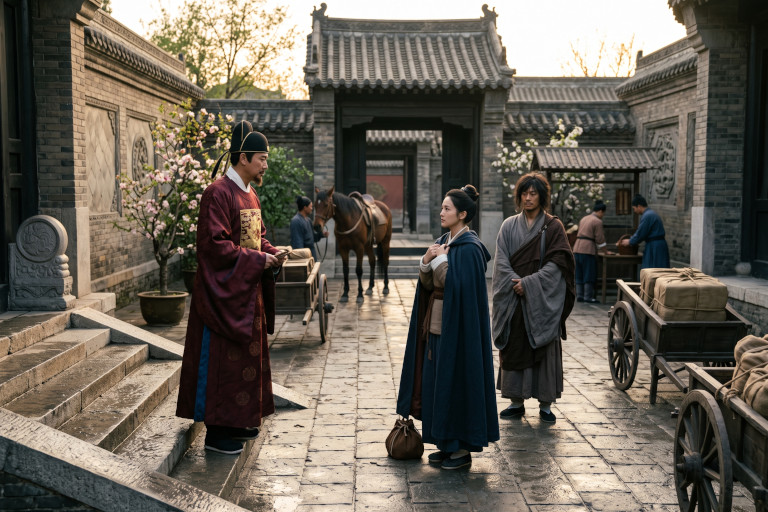
He explained that Li already had a husband and had only been sent to accompany Yang temporarily while he completed this part of his mission. Now that her task was finished, she had to return to her former life.
Yang was devastated. He was losing not only the woman who had shared three important years with him, but also a relationship that had become deeply meaningful.
Yet despite his grief, he eventually accepted what had happened. He left with the experience, judgment, and understanding he had gained during those years.
By then, he had learned another lesson: life does not give us everything we want, nor does every valuable relationship stay with us forever. Sometimes we must accept what we have gained even as we let something precious go.
Some of the most important people who enter our lives do not remove every obstacle or stay beside us forever. They may appear at a crucial moment, teach us something we could not have learned alone, help us through a difficult period, and then move on.
The monk and Li Shuzhen did not walk Yang’s entire path with him. They accompanied him through a particularly dangerous stretch and helped him acquire the wisdom he needed to continue without them.
Perhaps that is one sign of someone who truly changes the course of our lives: they do not give us a permanent source of dependence. They help us become capable of moving forward on our own.
Translated by Chua BC
Follow us on X, Facebook, or Pinterest
