

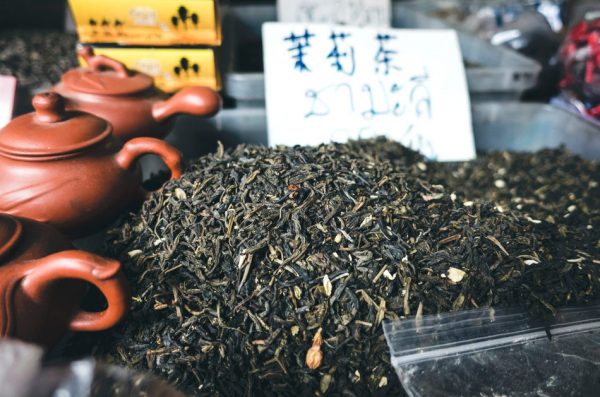
Jasmine tea (茉莉花茶) carries the poetic title “the spring scent of China.” For centuries, this beloved drink has combined the clean taste of green tea with the intoxicating fragrance of fresh jasmine blossoms, creating something greater than either ingredient alone. But behind every cup of jasmine tea lies a legend, one rooted not in royal courts or ancient emperors, but in a simple act of human kindness.
The most cherished jasmine tea legend tells of a Beijing tea merchant whose generosity toward a stranger sparked the creation of China’s most famous scented tea. Known as the tale of the “Gratitude Fairy,” this story has been passed down through generations. It carries a timeless reminder: acts of kindness, given freely and without expectation, often return to us in ways we could never have imagined.
The legend of the Gratitude Fairy
Long ago in Beijing, there lived a tea merchant named Chen Guqiu. Chen was known throughout the northern capital for his discerning palate and his honest dealings. Each spring, he traveled south to purchase the finest teas from the lush growing regions of China, where the warm climate and fertile soil produced leaves of exceptional quality.
During one of these southern journeys, Chen encountered a young woman in deep distress. Her father had recently died, and she had no money to give him a proper burial. In Chinese culture, honoring one’s parents through a dignified funeral was a sacred duty, and the girl’s inability to fulfill this obligation weighed heavily on her heart.
Chen was moved by her grief. Without hesitation, he gave her money from his own purse to cover the funeral expenses. But he did not stop there. He spoke with her neighbors and relatives, arranging for the community to look after her and provide her with a place to stay. Having done what he could, Chen continued his tea-buying journey and eventually returned to Beijing, thinking little more of the encounter.
The mysterious gift
Three years passed. Chen made his annual spring trip south once more, and upon arriving at his usual inn, the innkeeper presented him with a small, carefully wrapped package of tea. It had been left for him, the innkeeper explained, by the young woman he had helped years earlier.
Chen tucked the package away and, in the busyness of his travels, forgot about it entirely. Months later, during the cold Beijing winter, he invited a renowned tea master from the north to his home for a private tasting. The two men spent the afternoon sampling Chen’s finest selections, discussing the subtle differences in flavor, aroma, and body of each brew.
As they neared the end of their session, Chen suddenly remembered the unopened package. Curious, he prepared the mysterious tea for his guest.
The vision in the steam
The moment Chen lifted the lid of the brewing vessel, waves of fragrance filled the room. The tea master straightened in his seat, his eyes wide. This was no ordinary tea. As the steam rose from the cup, it seemed to take shape, forming the delicate image of a beautiful young woman holding a bunch of jasmine flowers in her arms. The vision hovered for just a moment before dissolving into the air.
The tea master, deeply moved, recognized the tea at once. “This is what they call the Gratitude Fairy,” he said quietly. He had heard legends of such a tea but had never tasted it himself. The quality was beyond anything either man had experienced.
As Chen brewed the tea a second time, the vision appeared again, and this time, Chen understood the message. The girl he had helped was showing him something: the secret lay in combining tea leaves with jasmine blossoms.
Chen and the tea master began experimenting, layering fresh jasmine flowers with green tea leaves to infuse the leaves with the flowers’ scent. The result was extraordinary. Word spread quickly among tea drinkers in the north, and by the following year, jasmine tea had become a beloved staple. The fragrant, gentle flavor won hearts across Beijing and beyond, eventually becoming the most popular scented tea in all of China.
The history of jasmine tea in China: From the Silk Road to the world
The jasmine tea legend may be set in Beijing, but the jasmine plant itself did not originate in China. Botanists and historians believe jasmine originated in the ancient Roman Empire, traveled along the Silk Road through Persia and into India, and arrived in China during the Han Dynasty (206 B.C. to A.D. 220). In India, jasmine became a sacred flower in Buddhism. It was through Buddhist influence that the plant eventually made its way to Fuzhou, the capital of Fujian Province on China’s southeastern coast.
Fuzhou’s subtropical climate proved ideal for growing jasmine. The warm, humid summers allowed the flowers to bloom abundantly, and the region’s long tradition of tea cultivation made it a natural home for experimentation with flower-scented teas.
The art of scenting tea with flowers
The practice of scenting tea with flowers began during the Song Dynasty (960 to 1279), a period of great artistic and cultural innovation in China. Tea culture flourished during this era, and artisans began exploring ways to enhance the natural flavor of tea leaves with botanical additions.
By the Ming Dynasty (1368 to 1644), the art of jasmine tea production had reached a level of true mastery. Tea makers in Fuzhou developed a meticulous scenting process called xun zhi. Layers of fresh jasmine blossoms were placed among tea leaves, allowing the flowers to release their essential oils overnight. The spent blossoms were then removed and replaced with fresh ones. This process was repeated multiple times to achieve the desired depth of fragrance.
This labor-intensive craft transformed jasmine tea from a regional specialty into a nationally celebrated drink. During the Qing Dynasty (1644 to 1912), jasmine tea became one of China’s key tea exports, shipped to Europe and beyond. Today, Fuzhou remains the most important center of jasmine tea production in China. The Food and Agriculture Organization of the United Nations has recognized Fuzhou’s Jasmine and Tea Culture System as a Globally Important Agricultural Heritage System. Understanding the history of jasmine tea helps explain why a single cup carries the weight of centuries.
What does jasmine tea symbolize in Chinese culture?
In Mandarin, the word for jasmine, mo li (茉莉), sounds remarkably similar to a phrase meaning “no profit” (莫利). This linguistic connection gave the jasmine flower an association with selflessness and the idea that one should not be consumed by the pursuit of wealth or fame. The Gratitude Fairy legend embodies this principle perfectly: Chen Guqiu’s kindness was given freely, and the reward that found its way back to him was one he never sought.
During the Tang Dynasty (618 to 907), jasmine was celebrated as a symbol of yu gu bing ji, a Chinese idiom meaning “jade bones and ice muscles.” The phrase described a person of fair complexion and inner integrity, and jasmine came to represent both physical beauty and moral purity among scholars and officials.
In Buddhist tradition, jasmine symbolizes compassion, empathy, and kindness toward all living beings. Its pure white petals and delicate fragrance have made it a favored offering in temples across Asia for centuries. Those interested in the cultural significance of jasmine will find that its symbolism extends into nearly every aspect of Chinese social life.
In southern China, particularly in Fujian and Guangdong provinces, offering jasmine tea to a guest is a traditional gesture of welcome and respect. The act of preparing and serving tea is itself an expression of care; the host demonstrates thoughtfulness through the quality of the tea, the warmth of the water, and the attention given to each cup.
Jasmine tea also plays a role in Chinese wedding ceremonies and celebrations. In the broader context of Chinese tea culture, the act of offering tea carries deep symbolic meaning. When a younger person serves tea to an elder, it expresses respect. When tea is offered as an apology, it conveys sincerity. And during weddings, the bride and groom serve tea to their parents as a gesture of gratitude for a lifetime of love and sacrifice.

Other Chinese tea legends worth knowing
The Gratitude Fairy is just one of many legends woven into China’s rich tea heritage. Tea has been part of Chinese life for nearly 5,000 years. Over that time, numerous stories have emerged to explain how different varieties came into existence. Each Chinese tea legend carries its own moral lesson.
Emperor Shennong and the discovery of tea
The most ancient legend attributes the discovery of tea to Emperor Shennong around 2737 BC. According to the story, Shennong was boiling water in the shade of a wild tea tree when a gust of wind blew several leaves into his pot. The emperor tasted the infused water and found it refreshing and invigorating. In another version, Shennong possessed transparent skin that allowed him to directly observe the effects of plants on his body. After consuming 72 different herbs, some of them poisonous, he chewed tea leaves and watched as they cleansed the toxins from his system.
The Goddess of Mercy and Tieguanyin tea
Tieguanyin, one of China’s most prized oolong teas, takes its name from Guanyin, the Buddhist Goddess of Mercy. Legend has it that a poor farmer named Wei faithfully tended a crumbling temple dedicated to Guanyin. He swept its floors and burned incense despite having little to spare. One night, the iron statue of the goddess came alive and whispered to him: “The key to your future is just outside this temple. Nourish it with tenderness, and it will support you and yours for generations.” Outside, Wei found a withered bush. He cared for it patiently, and it grew into a magnificent tea plant whose leaves produced an extraordinary brew. He named the tea Tie Guan Yin, “Iron Goddess of Mercy,” in honor of his benefactor.
The Dragon Well (Longjing) legend
Near the city of Hangzhou, the famous Longjing, or Dragon Well, tea has its own origin story. Local folklore tells of a mythical dragon that watched over the misty mountains, ensuring perfect growing conditions for the tea plants below. The dragon collected rainwater in a sacred well, and the tea grown near this well was prized above all others for its sweetness and clarity.
What connects each of these legends is a common thread: virtue, patience, and care are rewarded. Whether it is Shennong’s curiosity, Wei’s devotion, or Chen Guqiu’s generosity, the stories remind us that the best things in life often grow from humble, selfless beginnings. China’s tea traditions extend well beyond jasmine. If you enjoy learning about legendary Chinese beverages, you may also appreciate the story of Eight Treasures Tea, an elixir from ancient China.
The deeper meaning behind the jasmine tea legend
The Gratitude Fairy legend is, at its heart, a story about the quiet power of generosity. Chen Guqiu did not help the grieving girl because he expected something in return. He helped her because it was the right thing to do. The mysterious tea that found its way back to him years later, and the vision that revealed the secret of jasmine tea, were not transactions. They were expressions of gratitude from someone whose life had been touched by kindness.
In Chinese culture, this idea runs deep. The phrase bao en (报恩), meaning “to repay a kindness,” reflects a belief that genuine acts of generosity create bonds that transcend time and circumstance. Tea itself is a vehicle for this principle. Every time we pour a cup for someone we care about, we participate in a small ritual of gratitude and connection.
For modern readers, the legend offers a simple but powerful reminder. In a world that often measures value in terms of profit and return, the jasmine tea story suggests a different way of seeing things. Sometimes the most meaningful rewards in life are the ones we never asked for.
Every cup of jasmine tea carries within it the history of a flower that traveled the Silk Road, the artistry of tea masters in Fuzhou, and the memory of a merchant whose kindness changed the course of Chinese tea culture. The jasmine tea legend of the Gratitude Fairy has endured for generations because its message is universal: small acts of compassion create ripples that reach far beyond what we can see.
The next time you raise a cup of jasmine tea to your lips and breathe in that familiar, sweet fragrance, consider the story behind it. And perhaps consider, too, the small kindnesses in your own life that have come back to you in unexpected ways.
Follow us on X, Facebook, or Pinterest
