
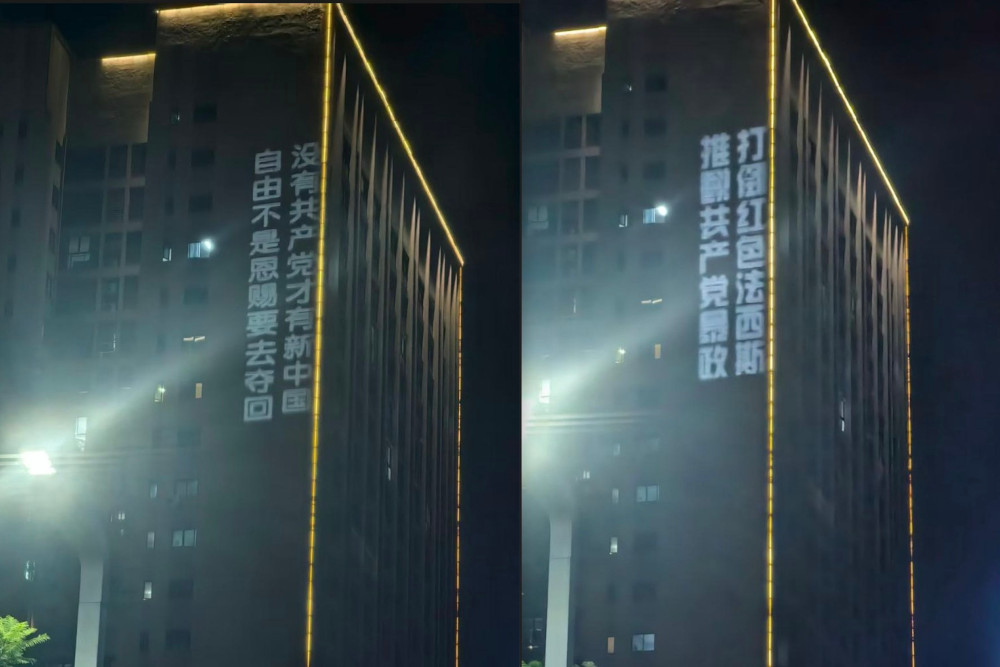
In late August, an unusual act of defiance shook China and caught international attention. A massive anti-Communist slogan was projected onto the wall of a building in Chongqing’s University Town, despite the country’s tight surveillance. The man behind it, Qi Hong, later revealed that even the most sophisticated monitoring system has its flaws.
A daring protest under watchful eyes
On August 29, bold slogans lit up the side of a high-rise, declaring messages such as:
- “Down with Red Fascism, overthrow Communist tyranny.”
- “Only when the Communist Party is gone can a new China arrive. Freedom is not a gift; it must be taken back.”
- “Rise up, those who refuse to be slaves. Rise up and reclaim your rights.”
- “No lies, we want truth; no slavery, we want freedom. The tyrannical Communist Party must step down.”
Police took nearly 50 minutes to trace the projector to a hotel room. Surveillance cameras caught officers rushing in, fumbling to shut down the machine. There, they also found a note Qi Hong had left behind: “Perhaps you are a beneficiary now, but one day in this land you will surely be a victim. Do not aid and abet evil.”
The video spread quickly on overseas social media, though discussion inside China was censored. Some independent outlets, however, managed to post brief tributes with titles such as “Salute to the Warriors.”
Loopholes in the system
Now living in the UK, Qi Hong explained in an interview that he executed the projection remotely after moving abroad with his wife and two children. Even his own family was unaware of his plan. “If anyone knew, it would have only increased the danger,” he said.
He emphasized that his methods were not high-tech: “I only used a laser engraving machine to make slides and some remote-control equipment. These are ordinary products anyone can buy.” He argued that no matter how advanced surveillance becomes, it can never be airtight. “If the authorities monitor us, then we can monitor them too.”

Qi Hong believes the government will tighten rules in response, perhaps with stricter hotel registration checks. Still, he said: “Unless they ban hotels, stop people from traveling abroad, forbid knives, and stop selling projectors, they cannot completely prevent such acts.”
From oppression to resistance
Born in a rural village in 1982, Qi Hong dropped out of school at 16 to work. Without a temporary residence permit, he was repeatedly detained and beaten by police in Guangdong and Beijing. Later, in Beijing, he came into contact with scholars such as Xu Zhiyong and several human rights lawyers who pressed the government to follow its own laws. That exposure gradually shifted his outlook.
Qi Hong recalled that as a youth, he often felt helpless and sometimes even thought about revenge. Over time, however, learning about rights defense and studying Buddhism led him to reject hatred. “I believe that in normal times, people who lash out don’t actually want to hurt others,” he said, commenting on recent violent incidents in Chinese society.
For him, the deeper reason behind his action was suffocation under China’s system. “I feel like I can’t breathe. This kind of life is in conflict with what I want and with life itself. It feels hopeless,” he explained.
Inspired by others, but not seeking fame
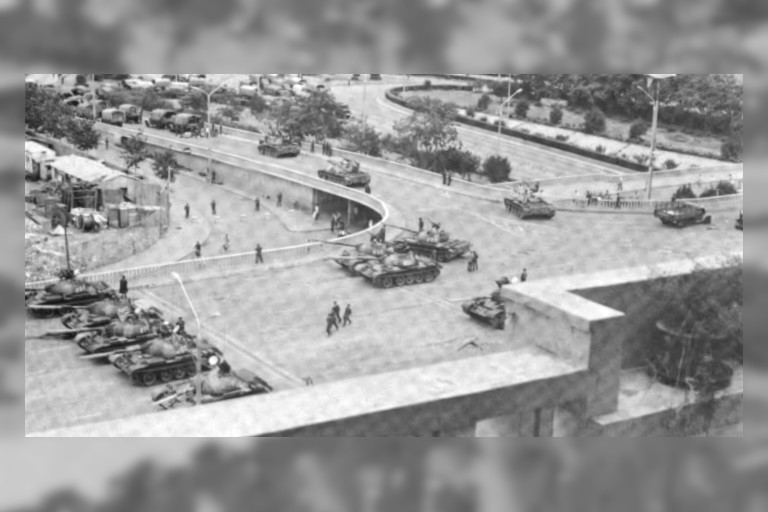
Qi Hong admitted that he was inspired by Peng Lifa, known as the “Sitong Bridge protester,” who hung a banner in Beijing in 2022. Still, Qi Hong insists he does not see himself as a hero. “I didn’t expect such a huge response. I’ve always spoken out. Every year on June 4 [the anniversary of the Tiananmen student protest for democracy], I post on WeChat about the anniversary, but no one dares to like it.”
He added that the key to protest is determination: “Why worry so much? I don’t like to endure. What angers me most is how people from all walks of life are treated.”
Studying Buddhism, he said, has deepened his compassion and his understanding of how the Communist system harms people’s body, mind, and spirit.
Reflections on Taiwan and the future
Qi Hong has also observed Taiwan’s society from afar. He admires how ordinary people there can speak freely without bowing to officials. At the same time, he is realistic. “Taiwan generally does not grant asylum to mainland Chinese, and many Hong Kong people haven’t received the treatment they expected. Plus, cross-strait tensions make it difficult for someone like me,” he noted.
Still, Qi Hong feels kinship with Taiwanese people, pointing to shared language and culture. His grandfather was a Kuomintang officer. “There’s no reason for Taiwanese to hate mainlanders. Some have been misled, but they are victims too,” he said, stressing his opposition to sowing hatred.
For now, he and his family remain in the UK. “I absolutely cannot return to China. Even if I were allowed to, I would not go back. Living or dying there is the same,” he said. Instead, he looks forward to learning new things in his new environment, though their future remains uncertain.
An act of defiance with global resonance
German broadcaster Deutsche Welle reported that Qi Hong’s protest came just before the Chinese Communist Party’s (CCP’s) largest-ever September 3rd military parade. The slogans projected in Chongqing, the outlet noted, became a stark commentary on the regime’s show of force.
The report concluded that while the CCP once rose as an armed opposition, today resisting tyranny in China has become extraordinarily difficult. “In this context,” it said: “the Chongqing protest is particularly valuable.”
Translated by: Chua BC
Follow us on X, Facebook, or Pinterest
