
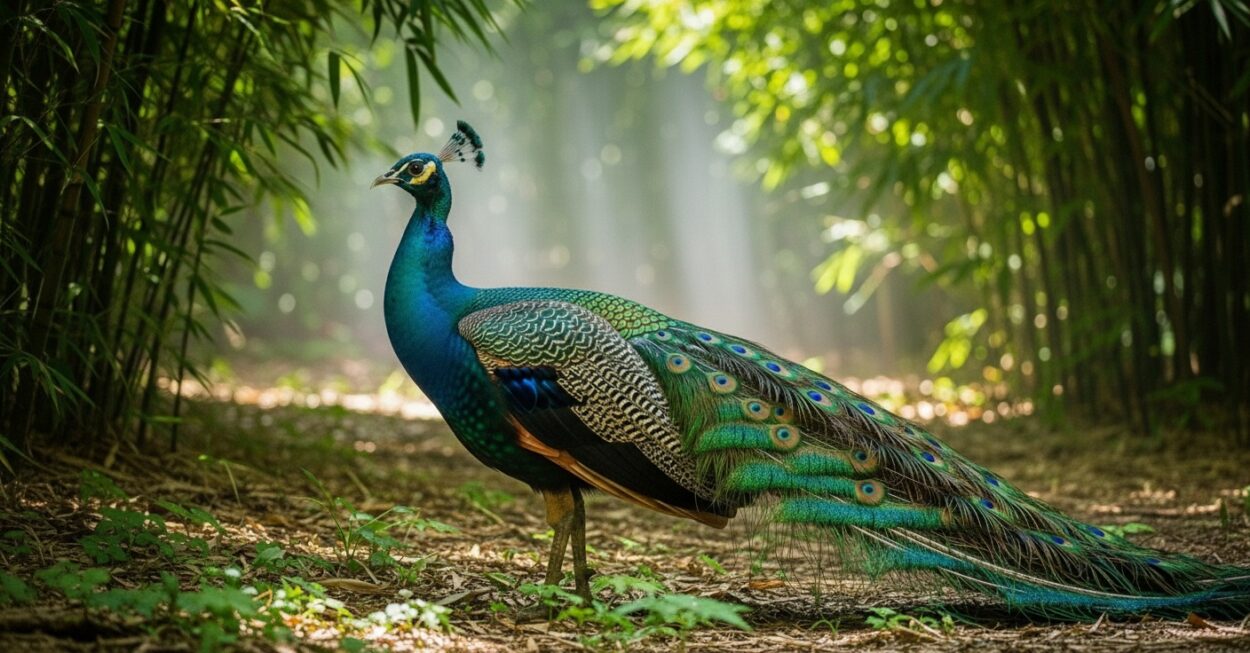
The peacock flies southeast, pausing every five miles.
At thirteen, she wove fine silk; at fourteen, she learned the needle’s art.
At fifteen, she played the zither; at sixteen, she recited the classics.
At seventeen, she became a wife — yet her heart knew only sorrow.
The Peacock Flies Southeast is not only a poem, but the voice of a woman’s faithful heart, and the echo of a man’s steadfast soul. Together, they defined with their very lives what it means to be unwavering in love — what it means to remain true until death and beyond.
Bound by fate, torn by duty
Known as China’s first tragic ballad, The Peacock Flies Southeast tells of a love pursued to its final breath — of two souls, bound beyond worldly chains, who chose death over betrayal.
Seventeen hundred years have passed, yet the sorrow of parting lingers like a thread connecting drifting clouds and flowing water. In the waning years of the Eastern Han Dynasty, by the quiet banks of the Wan River, there lived Liu Lanzhi and Jiao Zhongqing. Though separated by the river’s winding waters, their hearts were joined in a union of destiny.
Lanzhi was beautiful, gentle, and wise. Her diligence was unmatched — she worked tirelessly at the loom, weaving day and night, and carried herself with the grace and modesty of the sages. She was devoted to her husband and her household, embodying every virtue expected of a wife.
Yet no matter her kindness or obedience, she could not win the favor of Zhongqing’s mother. With a tongue sharp as a blade and a heart unyielding, the older woman hurled cruel words and ceaseless accusations at Lanzhi until she could bear no more. In time, Lanzhi was driven away, returning to her parents’ home in sorrow.
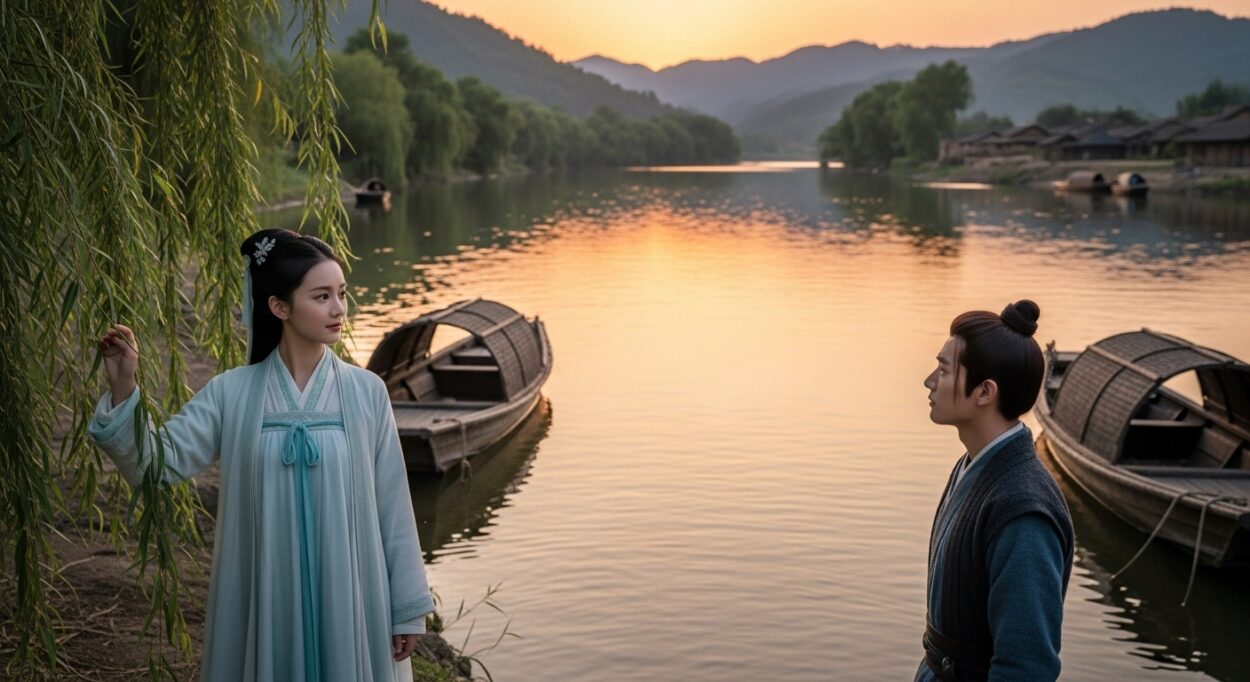
Facing her grief, Zhongqing could only whisper, his voice trembling: “My mother gave me life, but you gave me joy, and you are part of my very being. Go now, and wait for me — I will come to take you home again.”
On the narrow paths of farewell, they lingered, clinging to every glance, every memory, every fragment of the life they had shared — bridges crossed, hills wandered, shadows intertwined beneath the setting sun. Their tears drenched their clothes, and their sobs stirred the lovebirds in their fragile nest. With trembling hands, Lanzhi vowed to him: “You shall be my rock; I shall be your reed. Though the reed be fragile, the rock stands firm.”
Step by step, she walked the road toward her parents’ home, turning back with every few paces as the courtyard blurred behind her. Each step grew heavier than the last, each breath carrying the weight of farewell.
But fate is merciless, and their brief parting deepened into a chasm of despair. Bound by parental command, Lanzhi was ordered into another arranged marriage, one she neither wanted nor dared to refuse. When Zhongqing learned of it, he wept in silence. Though his heart was breaking, he offered her words of blessing, hiding his anguish behind a fragile smile.
And so, the tragedy unfolded. On her wedding night, beneath the pale light of the moon, Lanzhi slipped off her silken shoes and walked barefoot to the edge of the pond. The water reflected drifting clouds and the sorrow etched upon her face. Without hesitation, she stepped forward, surrendering herself to the quiet depths — choosing death as her final vow of love.
When the news reached Zhongqing, his world fell into silence. Wandering beneath the ancient trees, he followed the southeast path where they once dreamed of growing old together. There, upon a low-hanging branch, he ended his life, seeking to join her beyond the veil of this world.
The peacock flies southeast, pausing every five miles. And so, Lanzhi’s spirit flew with him, their souls reunited in eternity. What remained was not silence, but an endless echo of longing — a sorrow carried through centuries, a grief that belongs to all humankind.
The sacred meaning behind the poem
Though told as a human tragedy, the essence of The Peacock Flies Southeast reaches beyond sorrow. Beneath its grief lies something greater — a quiet glory, a testament to love unyielding and to the soul’s refusal to be enslaved. The bond between Lanzhi and Zhongqing was not born of fleeting desire, nor of mortal longing, but of a covenant written in the deepest place of the heart. When that covenant was threatened, they chose death rather than betrayal. It is love beyond life, an oath carved not in stone, but in eternity.
Never shall I wed another; never shall I share another’s bed.
The peacock itself carries profound meaning. Since ancient times in China, the peacock has symbolized beauty, purity, and dignity. Noble and unyielding, it resists captivity, just as Lanzhi’s spirit resisted oppression. Its feathers, marked with eyes of wisdom and compassion, reflect her inner grace and quiet strength.
In Buddhist tradition, the peacock is revered as a sacred bird — one that can consume poison without harm, transforming bitterness into beauty. It is a symbol of transcendence, of suffering transformed, of life reborn beyond death. Like the phoenix rising from the ashes, the peacock’s flight in this ballad carries both tragedy and majesty — a final testament to love’s power to outlive mortality itself.
And why does the peacock fly “southeast”? To the ancients, the southeast was the direction of light and renewal — the place where the sun rises, where life begins anew. It is the path of passion, freedom, and hope. Thus, in the poet’s vision, the lovers’ souls did not vanish into darkness. Instead, they flew southeast — toward hope, toward freedom, toward eternity.

A message across the ages
In traditional Chinese culture, love is more than sweet passion — it is a covenant, a moral responsibility, and a vow to “hold your hand and grow old with you.”
In our modern age of fleeting affections and restless hearts, the story of Lanzhi and Zhongqing endures as a quiet reminder: Love is not merely the fire of beginnings, but the courage to withstand trials and to remain faithful when the world turns against you. Loyalty is not stubbornness, but the sacred choice to stand by one another, even when all else is lost.
The story of Lanzhi and Zhongqing may not change the turning of the heavens, nor alter the path of history. Yet it changes us. It awakens reverence for love that endures beyond circumstance, calling us to cherish, with gratitude, the bonds entrusted to our hearts.
Let us take up the lamp of this ancient song,
and allow its flame to kindle in us once more
that purest vow — to remain steadfast in love.
Translated by Katy Liu and edited by Tatiana Denning, D.O.
Follow us on X, Facebook, or Pinterest
