
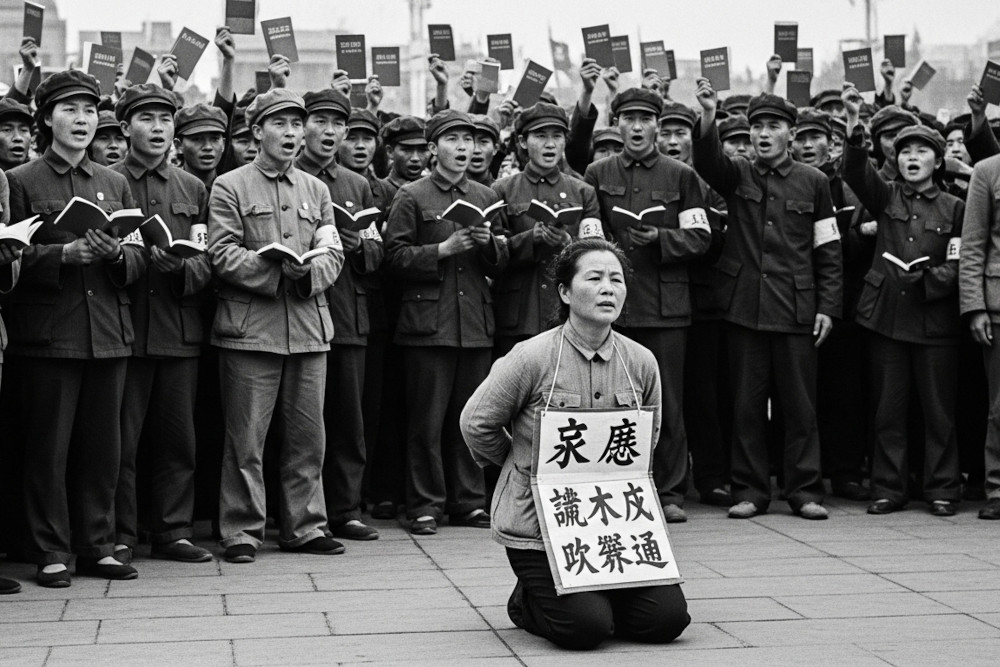
In modern Chinese history, some events have been deliberately erased by the Chinese Communist Party (CCP) because they expose the regime’s dark nature. The story of Zhang Hongbing denouncing his own mother, Fang Zhongmou, is one such case.
Zhang Hongbing was a fiery teenager and a Red Guard leader at a Beijing high school. He idolized Mao Zedong and reveled in criticizing and denouncing classmates, teachers, and anyone labeled a “counter-revolutionary.” His zeal did not stop at school — he even turned against his own mother.
Fang had casually voiced concerns about Mao’s policies at home. Zhang saw her words as “counter-revolutionary speech.” Without hesitation, he wrote a denunciation letter and submitted it to the Party organization. Fang was quickly dragged out, subjected to endless struggle sessions, and humiliated in public. In that era, when “revolution erased family ties,” a mother’s fate could be sealed by her son’s “loyalty” to the Party.
Betrayal was not accidental, but inevitable
The story shocks modern readers: How could a son betray his own mother? Yet under the CCP’s totalitarian system, this was not an isolated tragedy but an inevitable outcome. By promoting slogans like “class struggle” and “dictatorship of the proletariat,” the Party divided society into “enemies” and “allies.” Family bonds, friendship, and basic trust were all forced to yield to Party loyalty. Children denounced parents, students attacked teachers, and spouses informed on one another — not as rare exceptions, but as part of daily life.

The CCP created an extreme political atmosphere where loyalty to Mao Zedong outweighed everything. Sacrificing family ties was praised as a “great revolutionary act.” Under this mix of indoctrination and fear, betrayal became a badge of honor and a tool for survival.
From filial devotion to Party loyalty
For over two thousand years, filial piety — honoring and respecting one’s parents — formed the core of Chinese moral life. After taking power, the CCP worked relentlessly to destroy this foundation. It demanded that individuals place the Party above their families and Mao above their parents.
Zhang’s denunciation of his mother epitomized this twisted morality. In a normal society, such an act would have been condemned as a grave betrayal. But during the Cultural Revolution, it was celebrated as “revolutionary spirit.” The Party’s ideology turned right and wrong upside down and stripped away humanity itself.
The human cost of loyalty to the Party
Fang Zhongmou’s ordeal was not unique. During the Cultural Revolution, countless families were torn apart. Parents were denounced by their children, couples became enemies through mutual accusations, and children were left orphaned when parents were persecuted to death.

This is the chilling truth about the CCP’s rule: it does not stop at controlling people’s bodies. It seeks to dominate their thoughts and souls. It forces them to raise the knife against their dearest ones to prove absolute loyalty.
A warning for today
Some argue that the Cultural Revolution’s madness is a thing of the past. But the CCP continues to use similar tactics to this day.
In Xinjiang, children are forcibly separated from their parents and sent to state-run boarding schools where they are taught not their native language and traditions, but gratitude and praise for the Party. Across China, a culture of informing still thrives — ordinary people are arrested after being reported by friends or neighbors for posting complaints in private chat groups.
Zhang Hongbing’s story is a warning: the CCP’s nature has not changed. Its methods have simply evolved with the times.
Conclusion
A son sending his own mother to the struggle session stage is humanity’s greatest tragedy and undeniable evidence of how the CCP turns people against each other. The Party’s crimes go beyond causing countless deaths and disasters — it robs people of their most basic instincts: affection, kindness, loyalty, and love.
Fang Zhongmou’s fate reminds us that as long as the CCP exists, family bonds can be torn apart and humanity itself can be destroyed. Exposing these stories is not about sensationalism, but about waking people up. Totalitarianism is the real plague — it can make a son betray his mother and an entire nation betray its conscience.
Translated by Elaine
Follow us on X, Facebook, or Pinterest
