
Throughout history, people have stood at the crossroads between reverence and arrogance, faith and disbelief. Though separated by centuries, their choices reveal a shared truth: our inner attitude determines the forces we invite into our lives. Some find grace and guidance; others meet downfall and despair.
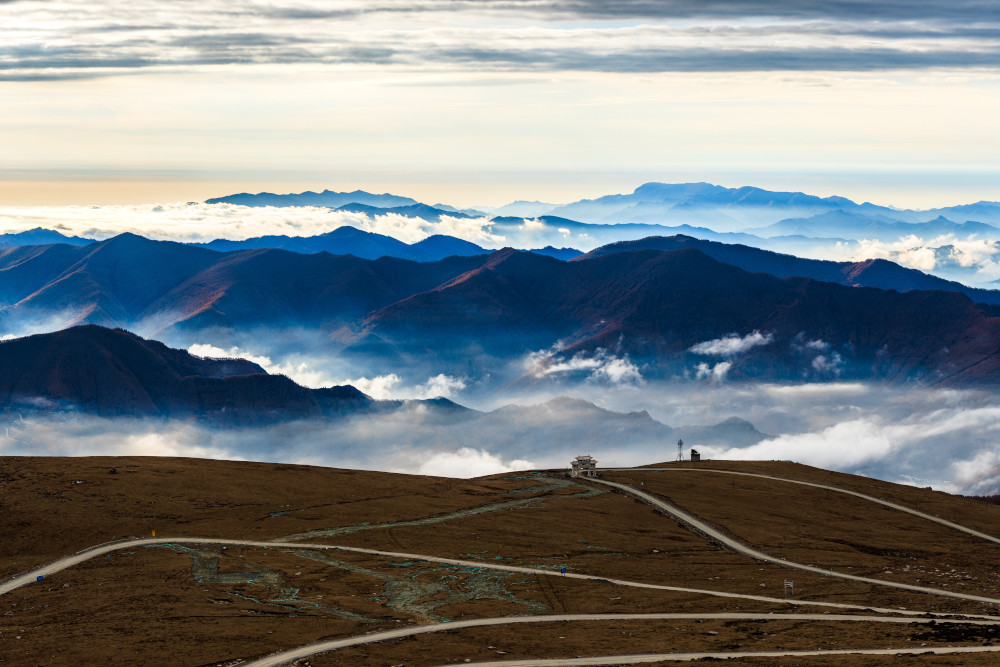
The following two accounts — one modern, one from the Song Dynasty — both center on Mount Wutai, one of China’s most sacred Buddhist sites. There, wisdom and warning have revealed themselves in strikingly different ways.
The price of arrogance
In the late 1960s, Lin Biao (1907-1971) stood at the height of power in China. A brilliant military strategist and key figure in the Communist victory, he was second only to Mao Zedong. Yet at the peak of his influence, Lin made a fateful decision — to build a villa on sacred ground.
In 1969, he chose a site at Mount Wutai, long revered as the earthly abode of Bodhisattva Manjushri, the embodiment of transcendent wisdom. His chosen location was Wulang Temple and Vajra Cave — places where monks had meditated for centuries.
Following his orders, the Beijing Military carried out the demolition, blasting apart the temple and scattering relics that had been venerated for generations. But amid the explosions and swirling dust, something extraordinary occurred. A military photographer, documenting the demolition, captured an image that seemed to defy reason: Through the smoke, the calm, radiant form of Bodhisattva Manjushri appeared. The figure looked lifelike and serene — a reminder that even when temples fall, the sacred endures.
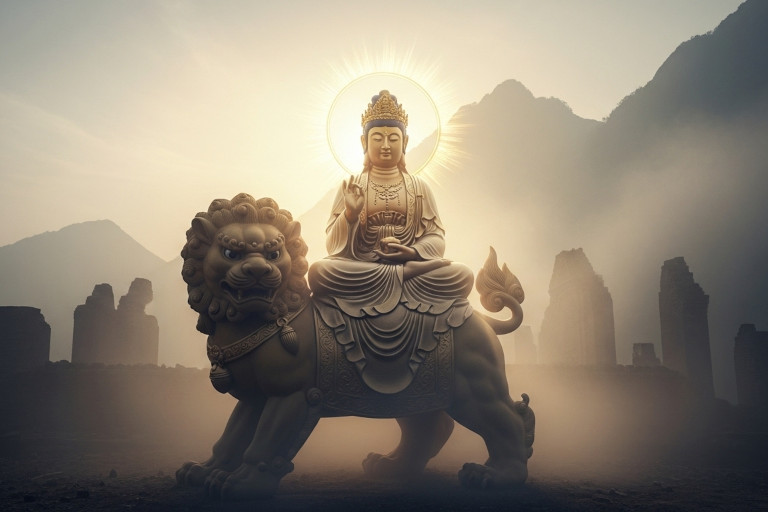
Few dared to speak of the photograph openly. It circulated quietly, dismissed by some yet regarded by others as a warning from the spiritual realm. Lin’s villa was completed as planned, but his family stayed there only once. Two years later, in 1971, he died in a mysterious plane crash in Mongolia while attempting to flee China.
Many saw his tragic end as karmic retribution — a lesson that pride before the sacred leads not to glory but to ruin. Today, the photograph said to capture Manjushri’s manifestation is enshrined at Xiantong Temple on Mount Wutai. Those who visit say the Bodhisattva’s face seems almost alive, his eyes filled with compassion and quiet warning — a silent testament that reverence preserves, while arrogance destroys.
The rewards of a humble heart
During the Song Dynasty (960-1279), a minor official named Zhang Shangying (1043-1122) once dismissed Buddhism as superstition. One day, while visiting a colleague, he picked up a Buddhist scripture and was struck by a single sentence that felt deeply profound. He borrowed the book, and after finishing it, his doubts began to fade.
In February 1087, Zhang was promoted to a judicial post in Kaifeng. That spring, he dreamed of traveling to Vajra Cave on Mount Wutai, seeing wondrous sights beyond the reach of ordinary eyes. When he awoke, he was astonished. Months later, he journeyed to Mount Wutai and found that what he saw matched his dream exactly.
The following year, Zhang returned to the mountain and witnessed something even more miraculous. From within a drifting white cloud, a golden bridge appeared, and inside it turned a glowing golden wheel — the Golden Wheel Treasure, symbol of the Chakravartin, the sovereign of wisdom whose light guides all beings toward enlightenment. As the sun set and darkness fell, the golden wheel’s brilliance grew stronger, illuminating the entire night sky and filling Zhang’s heart with awe.
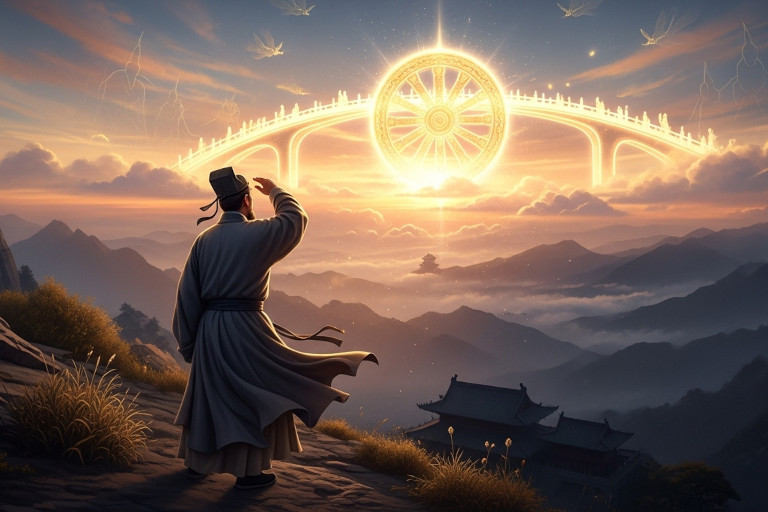
The next day brought even greater marvels: golden steps descending from the heavens, countless Buddhist lamps shimmering like stars, and Manjushri’s golden-maned lion accompanied by celestial beings — the Eight Legions of Devas and Nagas — arrayed in divine formation. Among them were figures in flowing purple robes, some seated in serene meditation, others holding gleaming swords that radiated sacred light.
These visions dispelled Zhang Shangying’s remaining doubts, and he became a devoted Buddhist. That July, he returned to Mount Wutai with his family, where they were greeted by an even more magnificent sight. In the northwest sky unfolded a golden realm filled with countless pavilions, palaces, and thrones suspended in the air. Then came a grand celestial procession — tens of thousands of Heavenly Kings, Arhats, lions, and elephants moving in majestic harmony. Music echoed through the heavens as Bodhisattva Manjushri appeared, riding his golden-maned lion, radiant with wisdom and authority.
The experience left Zhang deeply moved. He carefully recorded every vision he had witnessed, determined that these miracles would not be forgotten. Later, he wrote On Protecting the Dharma, a treatise refuting the anti-Buddhist views of scholars such as Han Yu (768–824) and Ouyang Xiu (1007-1072). Zhang’s sincerity and insight were rewarded — his career flourished, and twenty-two years later, he rose to the position of prime minister.
Reflections
Mount Wutai offers a timeless reminder: The way we approach the sacred, the unknown, and even the ordinary moments of life shapes the path we follow. Reverence, humility, and openness invite clarity and guidance, while arrogance and pride often bring unseen consequences.
In the end, our attitudes are not mere thoughts — they are seeds. How we nurture them shapes the course of our lives — sometimes in quiet ways, sometimes in profound ones.
Translated by Patty Zhang
Follow us on X, Facebook, or Pinterest
