
On November 25, a previously unseen video from the 1989 Tiananmen Square protests went viral on overseas social media. The footage captured the secret trial of Major General Xu Qinxian, commander of China’s 38th Group Army, who defied direct orders from the Chinese Communist Party (CCP) and refused to turn his weapons on unarmed civilians. For nearly 36 years, the CCP kept this trial hidden from the public.
The full recording runs over six hours and exposes details of how the CCP mobilized the military to crush peaceful student demonstrators before the massacre on June 4, 1989 — details that Beijing has spent decades trying to erase.
A general who refused to participate in bloodshed
According to the CCP’s own indictment, on May 18, 1989, senior Beijing Military Region officials conveyed an order from the Central Military Commission directing Xu to deploy his troops to Beijing to enforce martial law. Xu immediately refused.
He told his superiors: “Actions like this must withstand the test of history. People may not see clearly in the moment, but history will judge whether fulfilling such an order is an achievement — or a permanent stain.” He emphasized that he could not carry out a mission that required armed troops to confront the citizens they were supposed to protect. If the Central Military Commission insisted, he said: “Please find someone else.”
During his testimony, Xu explained why he could not obey. On a battlefield, he said, enemy and friendly lines are clear. But in Beijing, during a political crisis, civilians and soldiers were intermingled. “Who would we be fighting?” he asked. “Who is the enemy?”
Xu knew the consequences of his decision. Obedience would bring promotions, privileges, and a higher rank — rising from major general to lieutenant general, perhaps even full general. Defiance meant dismissal, investigation, imprisonment, and the loss of everything he had built in his career. Yet when faced with a choice between personal gain and moral principle, Xu chose principle.
He insisted that political issues must be resolved through political means, not through armed force against the population. And he refused to be responsible for the deaths of innocent people.
A secret trial kept hidden for decades
Xu was later brought before a closed military court and secretly sentenced to five years in prison for “disobeying martial law orders.” In the video, the presiding judge states plainly that the case “will not be tried in public because it involves state secrets.”
The “state secret,” of course, was that a senior military commander had refused to carry out the CCP’s order to fire on students. The regime concealed this for nearly four decades while promoting the false narrative that the military had acted in unity and necessity.
Commentator Wang Youqun noted that many officials pursue personal gain at any cost, but Xu willingly sacrificed his status rather than participate in the killing of his own people. “He would rather lose everything,” Wang said, “than open fire on the public.”
In the leaked recording, Xu sits in the defendant’s chair, but he is not a criminal. To many Chinese who know the truth about June Fourth, he is a rare figure — a military officer who stood tall in the face of political terror and paid the price for doing what was right.
Why the CCP fears the truth about June 4
Throughout the 1980s, China experienced an uncommon period of intellectual openness. The CCP encouraged “learning from the West,” but primarily meant adopting Western science, technology, and economic models to modernize the nation. Students and scholars, however, interpreted that encouragement far more broadly.
University campuses were filled with literary salons, public discussions, and academic debates about China’s future. Influential figures such as physicist Fang Lizhi openly discussed political reform. Television programs like the celebrated 1988 documentary River Elegy questioned aspects of traditional Chinese culture and suggested that modernization required deeper change. To many young people, “learning from the West” meant not just better machines, but better governance.
The CCP, which never intended to liberalize its political system, quickly grew alarmed. The spread of democratic ideas among the educated youth — ideas the Party itself had inadvertently helped expose them to — became one of the forces behind the Tiananmen movement, and one of the reasons the Party ultimately resorted to violence.
When the army entered Beijing
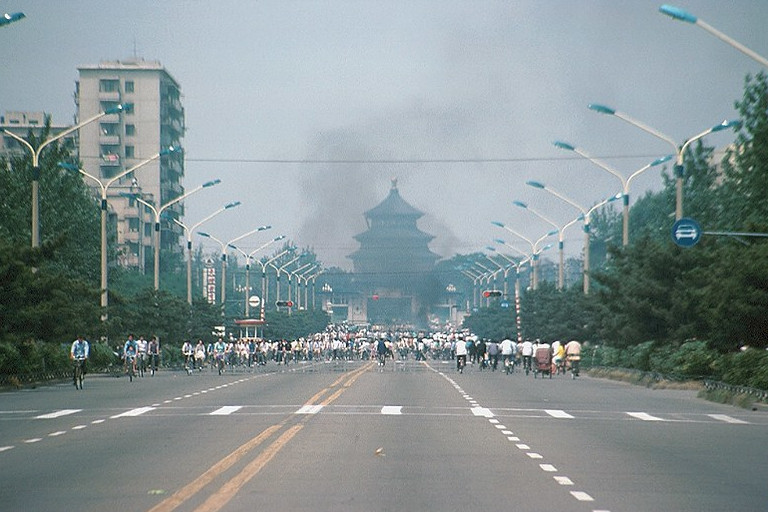
On the night of June 3 and the early hours of June 4, the CCP deployed the army, armed police, and civilian militia units to forcibly clear Tiananmen Square. Countless civilians were killed. To this day, the exact number remains unknown because the regime has silenced every effort to document it.
A truth the CCP still tries to bury
Thirty-six years later, any mention of June 4 remains forbidden inside China. Online posts are deleted instantly. Books, articles, and commemorative events are banned. Journalists who speak honestly about the massacre are persecuted, and citizens who memorialize the victims are detained.
The leaked trial of Xu Qinxian does more than reveal the conscience of one man. It exposes how deeply the CCP fears its own history — and how far it will go to keep the Chinese people from learning what their government has done to them.
As more courageous insiders step forward, the truth may continue to break through the cracks.
Translated by Patty Zhang
Follow us on X, Facebook, or Pinterest
