
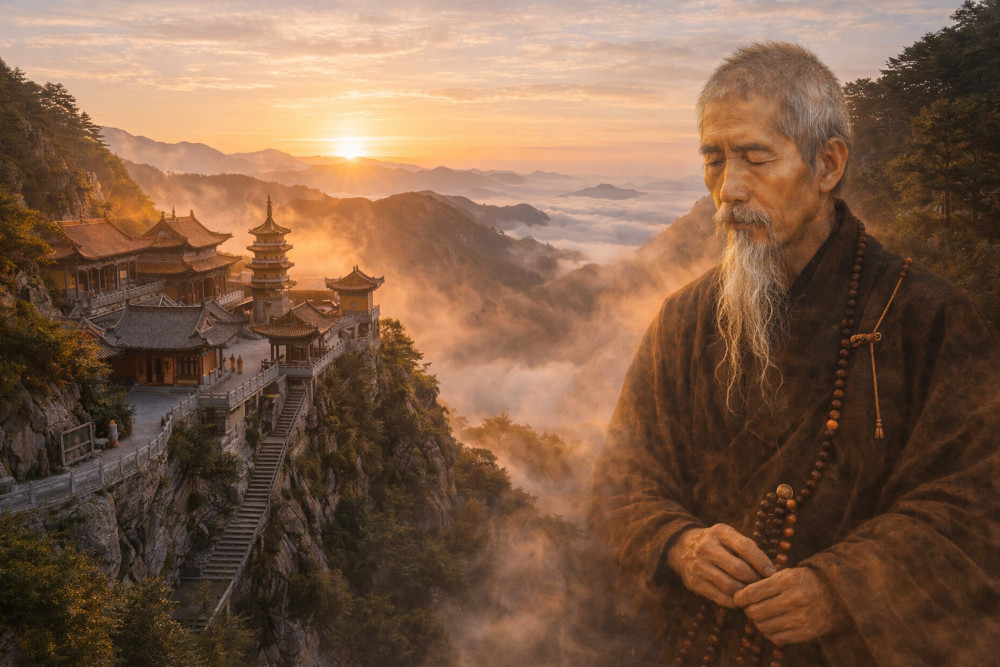
After the disaster-relief ceremony at Wolong Temple in Xi’an made Master Xuyun famous far and wide, devotees from many places came to see him. The once-quiet temple grew so crowded that it became impossible for him to practice in peace. Seeing the temple filled with noise and visitors, Xuyun quietly left again.
He went alone to the Zhongnan Mountains in Shaanxi, where he built a small thatched hut and changed his Dharma name from Shideqing to Xuyun. From then on, he lived an ascetic life in the mountains, surviving on wild vegetables and devoting himself to spiritual cultivation.
More than 20 years passed. By then, Empress Dowager Cixi was long dead, the Qing Dynasty was nearing its end, and China had entered the chaotic era of warlord rule. Among the major military factions of the time was the Yunnan clique, which would later become closely connected to Xuyun’s story.
Strange weather in Yunnan
In 1920, Yunnan experienced highly unusual weather. Rain began in February and continued for months. In Kunming, the floodwaters rose so high that people could travel by boat through the city, and ordinary residents were in deep distress.
At that time, the governor of Yunnan and commander of the Yunnan Army was Gu Pinzhen. He had only recently seized power by forcing out the previous governor, Tang Jiyao. Facing unending rain almost as soon as he took office, Gu regarded it as a terrible sign. Hoping to drive away the storm clouds, he even ordered soldiers to fire cannons into the sky each day. But after more than a month, nothing changed.
The rain finally stopped in June, but relief did not last. Beginning in July, Yunnan entered a severe drought. For months, not a drop of rain fell. Rivers dried up, dust filled the air, and on top of that, diphtheria began spreading widely across the province.
The disease could spread through the air and through physical contact. Patients developed white or gray patches in their throats, and it was especially deadly for children. Within just a few months, several thousand people in Yunnan died.
Floods, droughts, and plagues together caused panic among Yunnan’s military and political leaders. Many concluded that Heaven did not favor Gu Pinzhen and that he was unfit to remain governor. Before long, he was pushed out, and Tang Jiyao was brought back to govern Yunnan once again.

Tang Jiyao seeks Xuyun’s help
After returning to power, Tang Jiyao’s first act was to visit a respected monk at Huating Temple. That monk was Master Xuyun, who was already 83 years old. Huating Temple was later renamed Yunqi Temple, a name said to be connected to Xuyun’s residence there.
Tang’s first purpose in visiting him was to express thanks.
Two years earlier, when Gu Pinzhen launched his coup, Tang had been uncertain whether to resist or step aside. He and Gu had once studied together in Japan, and both graduated from a Japanese military academy. Because of that past connection, Tang hesitated and went to seek Xuyun’s advice.
Xuyun told him: “Do not fight him. Give him the position of governor. Otherwise, if conflict breaks out, both sides will suffer, and the people will bear the consequences. Do not worry. He will not remain there for long, and in the end, you will return.”
Events unfolded just as Xuyun had said. Tang came to Yunqi Temple sincerely grateful for that guidance. At the same time, he asked Xuyun to once again use his spiritual power to pray for rain and help drive away the plague in Yunnan.
Xuyun did not refuse.
Rain, snow, and the end of the plague
Xuyun first set up a rain altar at Yunqi Temple and prayed and chanted for three straight days. Rain soon fell, easing the drought.
Tang Jiyao was relieved that the drought had broken, but he still worried about the epidemic. Xuyun told him that as governor, the welfare of the people was closely tied to his own sincerity. If Tang could truly pray on behalf of the people, Xuyun said, he would do his utmost to help.
Tang agreed at once. He observed three days of fasting and ritual cleansing, after which Xuyun established a Dharma platform at Yunqi Temple. Xuyun ascended the platform first, followed by his disciples. Then, Tang and Yunnan’s military and political leaders also went up to pay their respects. After everyone had bowed, they all withdrew, leaving Xuyun alone on the platform chanting scriptures without food, water, or rest.
By evening, Tang ordered torches lit around the platform. Xuyun sat there as motionless as a carved statue. The crowd watched in complete silence, not daring to make a sound.
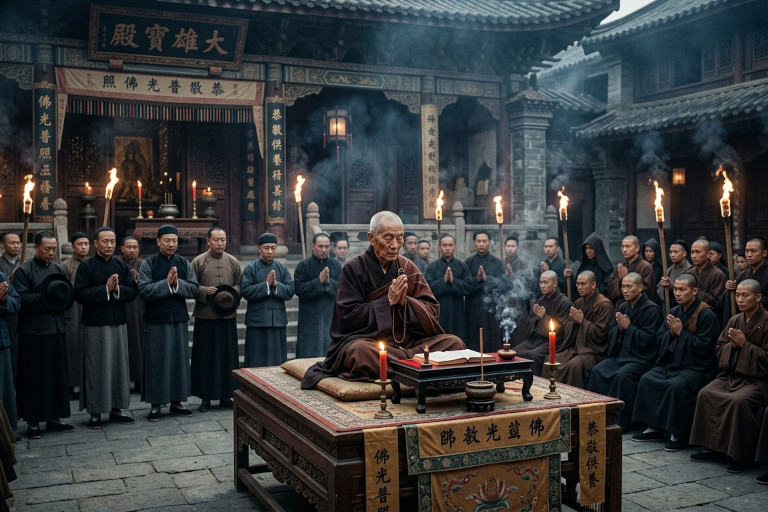
Around midnight, a cool breeze began to blow. People looked up and saw snowflakes falling from the sky. The snow grew heavier and continued through most of the night. In Yunnan, snowfall in May was an extraordinary event. The snow piled several feet deep on the ground, and soon afterward, the diphtheria that had spread across Yunnan disappeared.
This was said to be the second time Xuyun had helped calm a plague, the first being in Xi’an years earlier.
Persecution at Yunmen Temple
In the spring of 1951, Xuyun was 112 years old and serving as abbot at Yunmen Temple in Shaoguan, Guangdong, where he was transmitting Buddhist precepts. At that time, the Chinese Communist Party was carrying out the campaign known as the “Suppression of Counter-Revolutionaries.”
The Guangdong provincial authorities and public security officials claimed that “undesirable elements” had infiltrated the community at Yunmen Temple. They suspected the temple of harboring counter-revolutionaries, as well as hidden weapons, gold, and silver. Using this as a pretext, they entered the temple and began a violent campaign of destruction and looting.
On April 5, 1951, more than a hundred cadres, militia members, and military police surrounded Yunmen Temple. They searched the entire compound, tearing off roof tiles, breaking bricks, and smashing Buddhist statues and ritual objects, but they found nothing.
More than 100 monks were confined in different halls of the temple. Twenty-six monks were abducted and tortured. Many were beaten to death or permanently maimed.
Xuyun himself was detained alone in the abbot’s quarters. The doors and windows were sealed. He was denied food and water and was not even allowed to go outside for basic bodily needs. Only a single oil lamp was left in the room.
During the persecution, he was beaten repeatedly. First, his attackers used wooden clubs, then iron rods, demanding that he surrender the supposed gold, silver, and weapons. Xuyun answered only: “There is none.”
He sat with his eyes closed in meditation, neither looking at them nor speaking further. Blood flowed from his face and head. Several ribs were broken. His breathing nearly ceased, and for eight or nine days he lay barely alive, yet he did not die. His attackers, frightened, did not dare continue beating him as before.
The persecution lasted nearly three months. Monks fled in fear. When news of the events spread, the Buddhist community in China and abroad was shaken, and Xuyun’s disciples made desperate efforts to rescue him.

His final years
Xuyun responded to the persecution with extraordinary tolerance. He did not hold anyone personally responsible and even said: “This is due to karmic retribution; one cannot blame others.”
Still, the losses were severe. Many of his writings, including Essentials of the Śūraṅgama Sūtra and Commentary on the Lotus Sūtra, were almost completely destroyed in the disaster.
Xuyun lived until 1959, when he passed away at Zhenru Temple on Yunju Mountain in Jiangxi at the age of 120. According to Buddhist accounts, hundreds of colorful relics were found after his cremation.
The story of Master Xuyun’s life was later compiled into a chronicle by his disciple Kuanxian at Gushan Yongquan Temple in Fujian.
See Part 1 here
Translated by Joseph Wu
Follow us on X, Facebook, or Pinterest
