
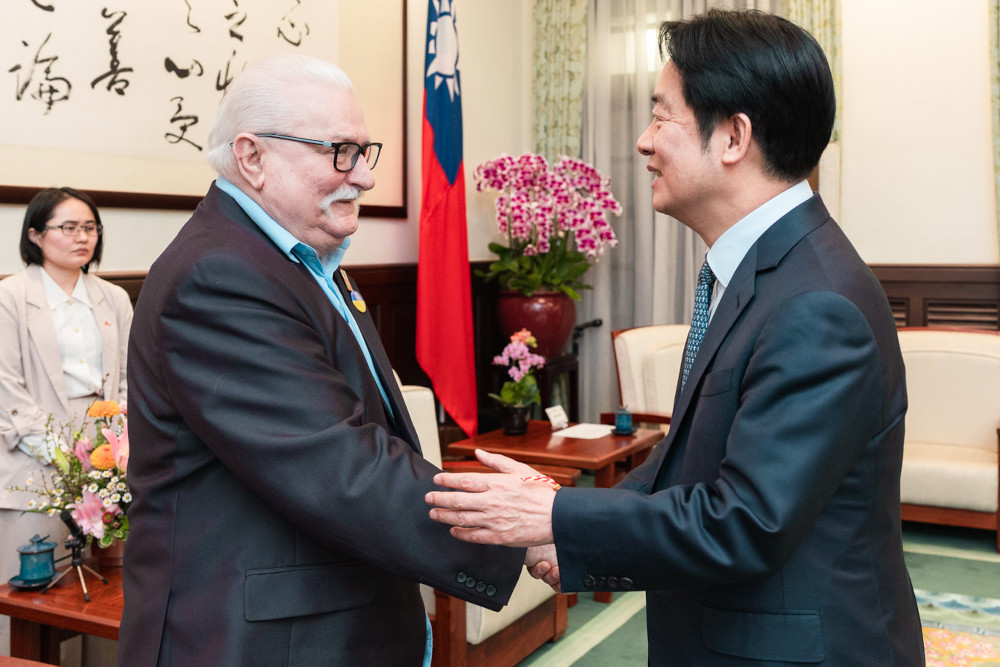
On March 17, 2026, President Lai Ching-te of the Republic of China welcomed former Polish president and Nobel Peace Prize laureate Lech Wałęsa to Taiwan. During the meeting, Lai said Taiwan would remain a force for good and continue to contribute to the resilience of democracy worldwide.
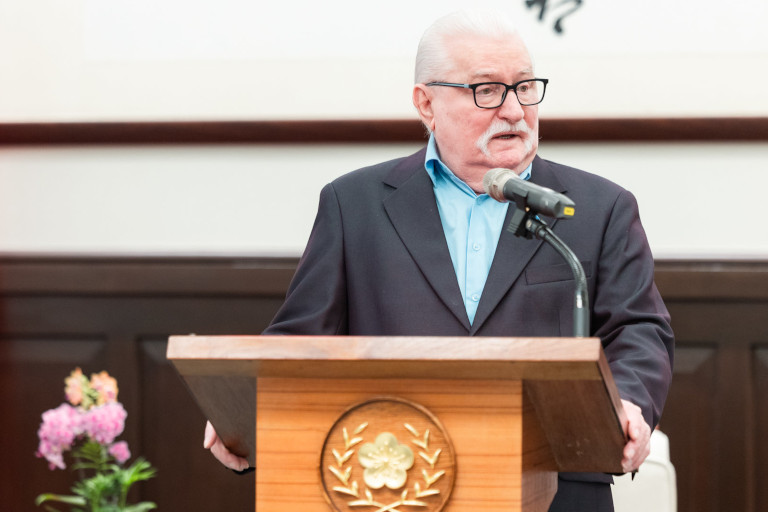
But it was Lech Wałęsa’s remarks at the Yushan Forum in Taipei that drew particular attention.
Now in his eighties and widely regarded as one of the key figures in Poland’s democratic transformation, Lech Wałęsa did not speak in the cautious language often used when Taiwan and China are discussed. Instead, he offered a striking reversal of Beijing’s preferred narrative. Rather than suggesting that Taiwan must make concessions to avoid pressure from the Chinese Communist Party (CCP), he argued that Taiwan’s political and social model offers it something valuable to the wider Chinese-speaking world.
A voice shaped by history
Lech Wałęsa’s words carried weight because of his own history.
In the 1980s, when Poland was still under communist rule and heavily influenced by the Soviet Union, he was an electrician at the Gdańsk shipyard. Many dismissed him when he helped found the Solidarity trade union. At the time, it seemed almost impossible that an ordinary worker could challenge a system backed by overwhelming state power.
Yet Lech Wałęsa believed unity and moral courage could break even the most rigid political order. History proved him right. Poland’s political transformation in 1989 was followed by the fall of the Berlin Wall and, not long after, the collapse of the Soviet Union itself.
That experience shapes how he sees today’s tensions in East Asia. Speaking at the forum, Lech Wałęsa reflected on the lessons of confronting authoritarian power. If he and others had relied on force, he said, they would never have defeated the Soviet system. Peaceful means, in his view, achieved far more lasting results.
The message was clear. Military threats may look intimidating, but history shows they do not guarantee victory. Even regimes that appear powerful can weaken from within.
Why Taiwan impressed him
Lech Wałęsa reserved special praise for Taiwan, noting its ability to thrive under constant political and military pressure from Beijing.
In his view, Taiwan has done something remarkable. It has built a vibrant economy, preserved political freedom, and maintained a high standard of democratic life despite years of intimidation from the CCP. That, he suggested, reflects not just resilience, but skill.
The world order is shifting, with growing rivalry among the United States, China, and Russia. But Lech Wałęsa argued that the decisive question is not simply which country is strongest; it is which system offers a better path forward.
For him, Taiwan stands as proof that a Chinese-speaking society can be prosperous, modern, and democratic at the same time. That example, he suggested, carries significance far beyond the island itself.
A different kind of influence
Some would immediately object that Taiwan is too small to play such a role. How could an island of 23 million people influence the future of a much larger China?
Lech Wałęsa’s answer challenges the logic of authoritarian power. The importance of a nation, he implied, is not measured only by territory, population, or military force. It is also measured by the principles it defends and the kind of society it builds.
By that standard, Taiwan matters greatly. Freedom of speech, respect for the rule of law, and a culture of innovation are not minor achievements. They are the foundations of a healthy civilization.
At the same forum, former Fijian Prime Minister Mahendra Chaudhry also voiced support for Taiwan. He said Taiwan’s New Southbound Policy has brought Pacific island nations more than funding. It has also offered stability and practical support. That contrast matters. Beijing is often criticized for using economic pressure, military threats, and “wolf warrior” diplomacy, while Taiwan has won goodwill through technology, medical assistance, agricultural cooperation, and democratic values.
The deeper point behind Lech Wałęsa’s remarks is that influence built on trust is stronger than influence built on fear.
What his message means
Lech Wałęsa also rejected the idea that force can produce genuine unity. Peaceful dialogue, he said, is what leads to sound solutions, while coercion ultimately fails.
That cuts directly against one of Beijing’s central claims: that Taiwan’s future must be decided through “unification” on the CCP’s terms. Lech Wałęsa instead suggested that Taiwan’s democratic experience may be exactly what the Chinese-speaking world needs most.
He even joked that if he knew the exact formula for how Taiwan could lead such a transformation, he might win a second Nobel Peace Prize.
Behind the humor was a serious point. A government that depends on threats against its own people to preserve “unity” has already revealed its weakness. Real legitimacy cannot be built on fear alone.
For Taiwan, Lech Wałęsa’s visit was more than a symbolic gesture. It was a reminder that democratic societies do not need to measure themselves by the standards of authoritarian states. Their strength lies elsewhere: in freedom, dignity, and the ability to offer the world a better example.
Translated by Patty Zhang
Follow us on X, Facebook, or Pinterest
