
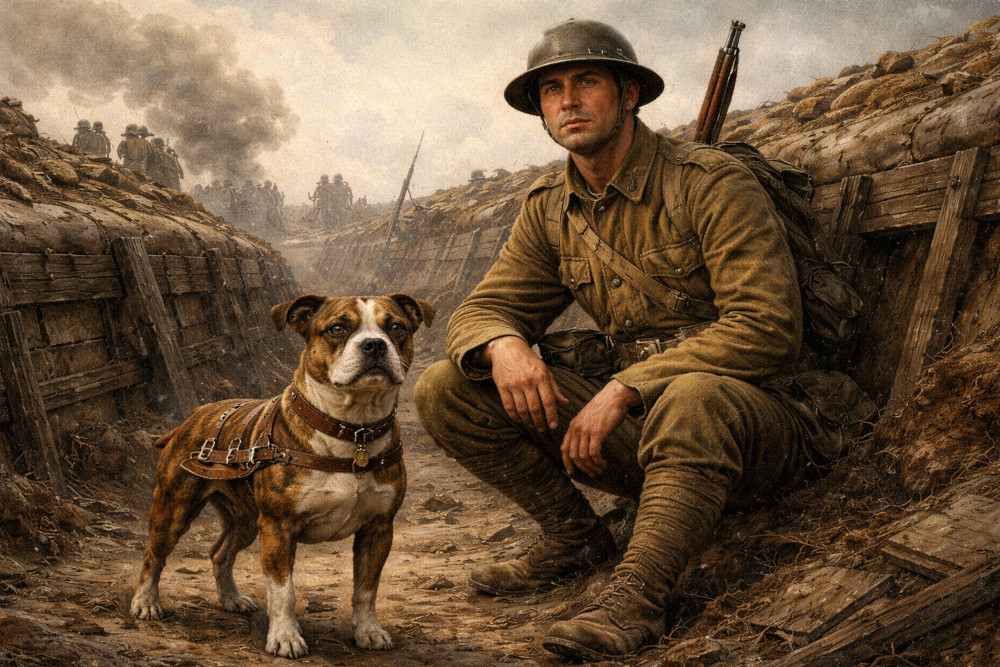
Long before military working dogs became a familiar part of modern warfare, armies were already discovering how valuable dogs could be on the battlefield. During World War II, the Soviet Union even trained special anti-tank dog units, sending dogs carrying explosives against German armor. In that brutal campaign, hundreds of dogs were used, and their actions helped make military dogs famous around the world.
But some of the most memorable canine stories came even earlier.
One of the best-known war dogs was Stubby, a small stray who rose to fame not in World War II, but during World War I. His story has been remembered for more than a century because it combines loyalty, courage, and the unlikely bond between a homeless dog and the soldiers who took him in.
How Stubby joined the army
In the summer of 1917, Stubby was just a stray wandering the grounds of Yale University, looking for food and a place to survive. At the time, the U.S. Army’s 102nd Infantry Regiment was training there. The dog often lingered near the camp, and before long, he caught the attention of Corporal Robert Conroy, who grew fond of him and decided to take him in.
Stubby soon became a familiar presence around the soldiers. During his time at camp, he learned basic commands, such as sitting, standing, and responding to drills. He even learned to raise a paw in something like a salute.
When Conroy later went overseas, he secretly brought Stubby aboard the troop ship headed for France. According to the story, the dog stayed hidden until the men disembarked. When Stubby was finally discovered, he won over Conroy’s commanding officer by raising his paw in salute. The officer allowed him to remain with the unit, and Stubby’s military life officially began.
A dog with remarkable instincts
Dogs were widely used in World War I by countries including Britain, Germany, and France. They served in many roles, from tracking enemies and guarding supplies to carrying equipment and helping move the wounded. Stubby proved he could do far more than simply boost morale.
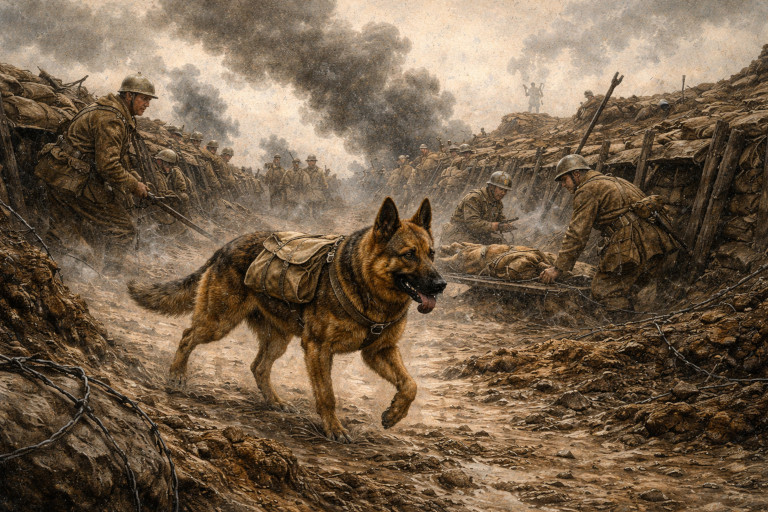
On the battlefield, he became known for his sharp senses and quick reactions. Soldiers learned to trust him. When Stubby became alert and pricked up his ears, they knew danger might be near and often took cover immediately.
During one German gas attack, Stubby himself was injured. After recovering, he reportedly became especially sensitive to poison gas. From then on, he was able to warn nearby soldiers before they fully realized what was coming, giving them precious time to protect themselves.
Stubby was also credited with other acts of battlefield service. Stories say he bit enemy soldiers, helped locate men trapped by shellfire, and lifted the spirits of exhausted troops. In war, morale can matter almost as much as strategy, and Stubby became a symbol of courage for the men around him.
The honors that followed
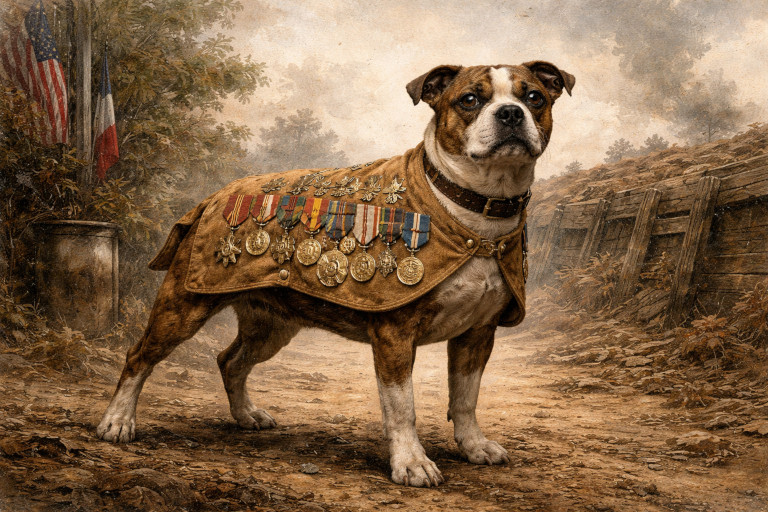
Stubby’s reputation continued to grow as the war went on. After American forces recaptured the French town of Château-Thierry, local women made him a suede cape to display the honors he had received. It became one of the most enduring images associated with him: a small dog wearing a cape crowded with medals and decorations.
When World War I ended, Stubby returned to the United States with Conroy and was welcomed home as a hero. Over the following years, he was credited with 17 acts of merit and was received by three U.S. presidents: Woodrow Wilson, Warren G. Harding, and Calvin Coolidge. He was also given the rank of sergeant, an extraordinary distinction for a dog and one that helped secure his place in military lore.
By then, Stubby was no longer just a former stray from a university campus. He had become a national celebrity and a living reminder of the many unexpected ways courage can appear in wartime.
A legacy that outlived the war
Stubby died in the United States in 1926. By then, he had already become something more than a mascot or a camp companion. He was remembered as a loyal partner to soldiers, a dog whose instincts and bravery had helped save lives, and a wartime figure whose story continued to inspire long after the fighting ended.
Many military dogs have served with distinction, but few have left behind a legend as lasting as Stubby’s. From a hungry stray on the streets of New Haven to a decorated war hero honored by presidents, his life remains one of the most remarkable animal stories to come out of the First World War.
Translated by Cecilia
Follow us on X, Facebook, or Pinterest
