
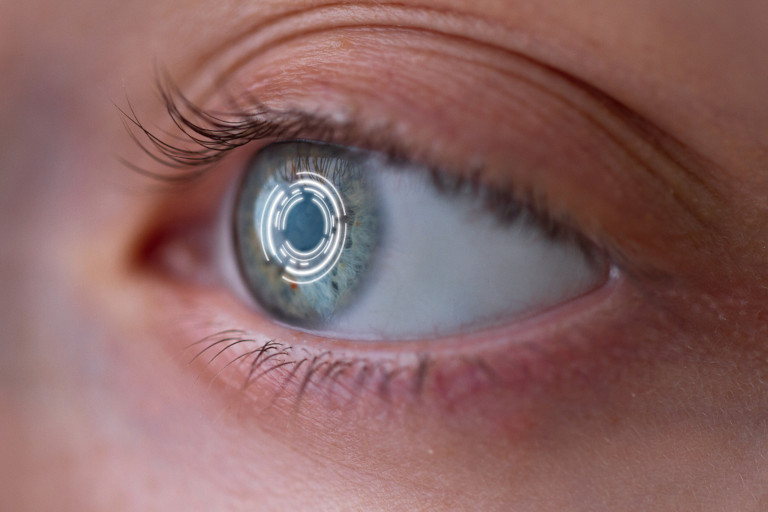
Somewhere in a London clinic, AI chip implants restore sight. A woman who had not seen the center of a page in years picked up a crossword puzzle and filled in a word. Her retina had been destroyed by a condition called geographic atrophy — the late, untreatable stage of dry age-related macular degeneration, where the central macula simply ceases to function, cell by cell, until the world loses its middle. The chip now sitting beneath her retina is two millimeters square, roughly the size of a grain of salt. It contains nearly four hundred light-sensitive pixels. It was powered by the infrared beam from a pair of augmented-reality glasses. Her brain did the rest.
AI chip implants that restore sight represent one of the most consequential intersections of neuroscience and machine intelligence in clinical history. But to understand why they work — and why the potential reaches far beyond vision — you have to start with a stranger, more fundamental fact: the brain does not particularly care where its sensory signals originate.
What the PRIMA trial showed the world
In October 2025, results from a landmark European clinical trial were published in the New England Journal of Medicine. The study, co-led by researchers at the University of Pittsburgh, Stanford, and the University of Bonn, enrolled 38 patients across 17 hospitals in five countries. Every participant had lost central vision in the treated eye due to geographic atrophy. Some could not even detect that a vision chart existed before surgery.
After receiving the PRIMA implant from Science Corporation, 84 percent of participants could read letters, numbers, and words again. On average, they recovered five lines of a standard vision chart. Some went further: they could read from books, play cards, and fill in crossword puzzles. The implant that made this possible is a wireless microchip placed surgically under the retina in an 80-minute procedure. Paired with AR glasses that capture the visual scene and beam it to the chip via infrared light, the system works like a rebuilt eye: camera captures the image, chip converts it to electrical pulses, brain interprets the signal.
The brain is agnostic about the origin of visual signals. What it demands is coherence — and coherence, it turns out, can be engineered.
This is the first implant of its kind to restore the ability to read through an eye that has lost its sight entirely. Not to approximate reading. Not to detect light and shadow. To actually read. That distinction matters enormously, because it tells us something precise about the nature of the interface between artificial systems and living neural tissue.
How do AI chip implants restore sight? The brain as a world model
To understand why a chip the size of a grain of salt can give someone their reading back, you need to understand what the visual cortex actually is. It is not a passive receiver. It is an active prediction engine — a world model that constructs a representation of visual reality from whatever electrical signals arrive at its input layers. The primary visual cortex, a patch of roughly 50 square centimeters at the back of the skull, contains millions of neurons each tuned to specific features of the visual field: edges, orientations, motion directions, and spatial frequencies.
What those neurons do not do is verify that the signal arrived via a biological retina. Research from ScienceDirect’s review of neuroplasticity in adult visual cortex confirms that when retinal implants begin delivering artificial visual stimulation, the primary visual cortex slowly reactivates in response — even in patients who have been blind for extended periods. The cortex’s wiring, laid down during the years when the person could see, remains structurally intact. What atrophies is not the architecture. What atrophies is the input. Restore the input, and the architecture comes back online.
Harvard’s Brain Science Initiative published research in 2025 showing that the visual thalamus — the relay station between the eyes and the cortex — is not merely a passive conduit. It actively reshapes what information passes through to the cortex based on experience. The thalamus, in other words, is part of the learning system. It participates in the brain’s ongoing project of building a stable model of the world from unstable sensory input. That project does not require organic eyes to function. It requires organized electrical pulses arriving in the right spatial and temporal patterns.
The cochlear implant field discovered this earlier and more dramatically. The earliest cochlear implants produced auditory signals so degraded that speech perception seemed impossible. Over months to a year, patients adapted. The brain retrained itself to extract meaning from an impoverished, unfamiliar signal. What was once noise became language. Researchers studying retinal implants are watching the same process unfold in the visual domain — slower, and subject to different constraints, but following the same fundamental logic.
The brain is not a fixed decoder. It is an adaptive one. Training is not a rehabilitation workaround — it is how the system was always designed to work.
The PRIMA results are striking not just because the technology works, but because of what they reveal about training timelines. Patients did not regain reading ability overnight. The improvement followed a learning curve — the cortex building its internal model of how to interpret the chip’s pixel-level electrical language. One patient described the early experience: knowing what objects should look like from memory, then using the device to slowly verify the boundaries, checking and rechecking. The camera does not move like a natural eye. The pixels are coarser than the fovea. The brain learned to compensate for all of it.
This is the architecture of the system. The chip does not restore vision. It restores the conditions under which the brain can reconstruct vision. The distinction is not semantic. It is the difference between understanding the technology as a replacement organ and understanding it as a neural conversation starter.
Neuralink’s Blindsight and the cortical bypass
Where PRIMA works at the level of the retina, Neuralink’s Blindsight chip takes a more radical route: bypassing the eye and the optic nerve entirely, and writing directly to the visual cortex. This approach is designed for people whose blindness results not from retinal degeneration but from damage to the optic nerve or earlier in the visual pathway, while the cortex itself remains intact.
Neuralink began moving toward the first human implantation of Blindsight in the second half of 2025. The initial resolution will be low — described as comparable to early Atari graphics, a rough grid of phosphene points rather than a coherent image. But the trajectory is clear. As electrode density increases and AI decoding improves, the resolution potential of cortical stimulation extends in principle beyond what a biological retina can achieve. Stimulating at infrared wavelengths that the eye cannot detect is not a hypothetical. It is an engineering target.

The research foundation for this approach has been building for decades. A 96-channel electrode array implanted in the occipital cortex of a blind human volunteer allowed the patient to perceive individual phosphenes and recognize shapes. The phosphene locations in the visual field corresponded predictably to electrode positions in the brain’s retinotopic map — the spatial layout of the visual cortex that mirrors the structure of the visual field. That map, crucially, is robust. It persists through blindness. It does not require ongoing visual experience to maintain its organization.
What this means in practice:
The infrastructure for vision is preserved in most blind people. The cortex is waiting. The map is intact. What has been missing is not the hardware but the connection.
The same principle, applied everywhere the body has lost its voice
The logic that makes sight restoration possible does not stop at the visual cortex. It applies wherever the brain has been severed from the body it is trying to control. Paralysis, limb loss, speech impairment — these are, at a systems level, variations on the same problem: the brain’s motor signals cannot reach their destination, or the sensory signals cannot complete their return journey. Brain-computer interfaces are building the missing connections.
In March 2025, UC San Francisco researchers published results in Cell showing that a paralyzed man — who had been unable to speak or move following a stroke — could control a robotic arm through thought alone. Not for a session. Not for a day. For seven months without the system needing recalibration. The breakthrough was not the implant itself but the AI layer: a model that tracked the small day-to-day drift in the brain’s neural representations and compensated for it in real time. The brain’s signal for “grab” does not produce identical neural firing every time. The AI learned to recognize the pattern across its variations, the way a language model recognizes intent across different phrasings.
That principle of adaptive decoding — the AI and the human learning together — is now being described by researchers as the defining feature of the next generation of brain-computer interfaces. The human user and the AI share autonomy. They refine each other through use.
Sensation is following the same path. Research published in Science and Nature Biomedical Engineering in early 2025 by teams at the University of Chicago, Pittsburgh, and Northwestern demonstrated that electrical stimulation of the somatosensory cortex could recreate nuanced tactile feedback — not just the on/off signal of contact, but the geometry of an edge, the direction of a moving stimulus across the skin of the hand. A prosthetic user who can feel what they are holding does not just grip more precisely. They experience something closer to ownership of the limb.
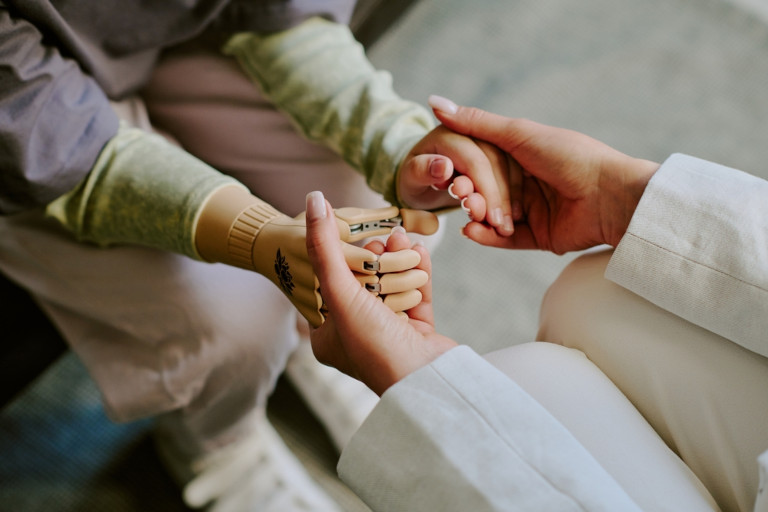
In Switzerland, researchers integrated a thermal feedback system called MiniTouch into a commercially available robotic prosthetic hand, allowing a 57-year-old participant to feel the warmth of another person’s hand — the first time that kind of thermal prosthetic sensation had been achieved. This is not a performance metric. This is a father being able to hold his child’s hand and feel that it is warm.
Walking is following. Earlier research from UC Irvine established that brain waves from a person with complete paralysis could bypass the spinal cord entirely, traveling via EEG electrodes through a computer algorithm to stimulate the leg muscles directly. Months of mental training were required before the participant could take steps. The brain’s walking circuits had been dormant for five years. They were not gone. They were ready.
Paralysis is not an absence of the brain’s intention to move. It is a disconnection between intention and execution. The bridge is being built.
Speech is already there. UC Davis researchers reported in June 2025 that a man with ALS could speak again through a brain-computer interface that decoded intended speech in real time. Earlier work from UCSF enabled a paralyzed woman to communicate via a digital avatar at 80 words per minute — a quantum leap from the 10–15 words per minute of previous systems. The brain’s language circuits, it turns out, remain active and expressive even when every motor output has been silenced.
What is actually being restored
There is a temptation to frame these technologies as mechanical repairs — broken parts replaced by better-engineered alternatives. That framing is too small. What is actually being restored is participation. The ability to read the morning paper. To hold something and know its weight. To walk across a room toward the people you love. To say their names out loud.
The brain’s plasticity — its willingness to rewire, adapt, and build new functional maps around artificial input — is not a feature that was designed in. It is a feature that was always there, waiting for the technology to be precise enough to use it. The PRIMA chip is two millimeters square. The training period is weeks to months. The outcome is someone filling in a crossword puzzle.
These are early days. The resolution of current retinal implants is nowhere near natural foveal vision. Robotic arms still require deliberate mental effort to control with full dexterity. Speech interfaces have vocabulary constraints. Thermal feedback is a single channel in what should be a rich sensory stream. Every one of these limitations is an engineering target, not a ceiling.
What is not a limitation is the brain itself. The brain is already doing its part. It is taking the signal, whatever the signal is, and building a world from it. It has been doing this since before we had language to describe it. The only thing that has changed is that we have finally learned to speak to it in a language it understands: structured electrical pulses, delivered with precision, at the right time, in the right place.
The woman with the crossword puzzle knew the words were in there. She had always known. She just needed something to tell her where the letters were.
Follow us on X, Facebook, or Pinterest
