
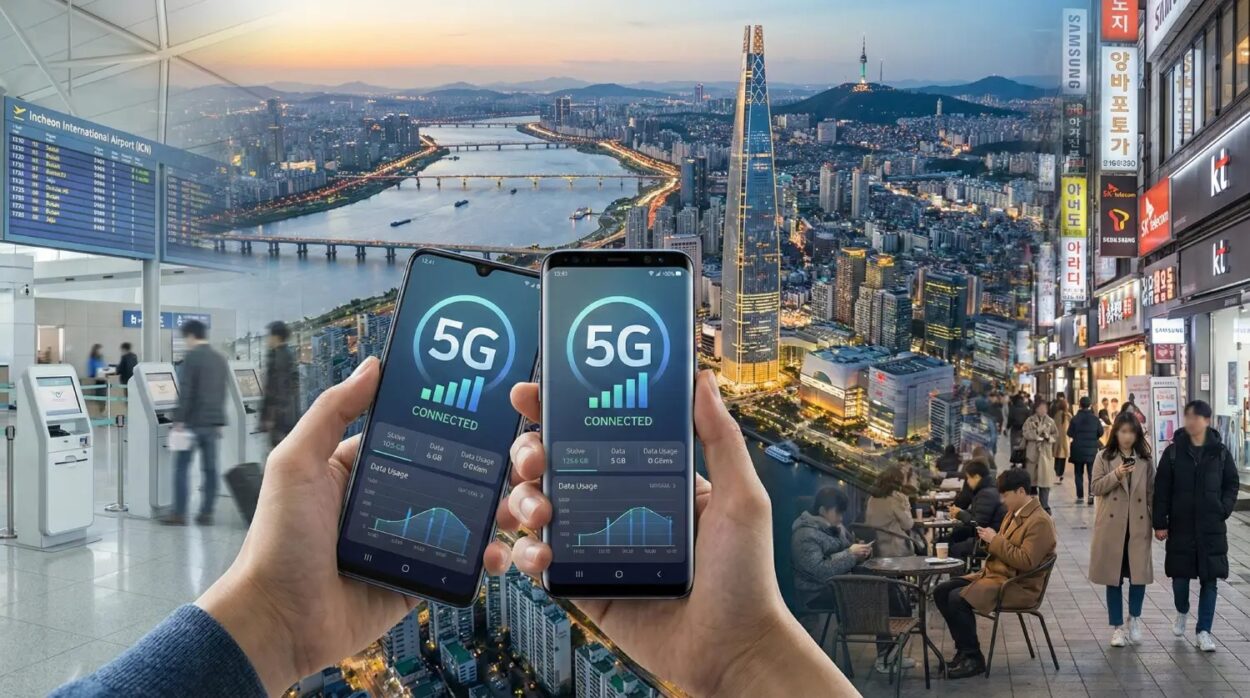
A man in Seoul finishes his paid data plan at 11 p.m. on a Tuesday. Under the old system, the screen goes dark — or rather, it doesn’t go dark, but the sensation is the same. The loading bar hangs. The map freezes. The message thread stops delivering. He is physically in one of the most connected cities on earth, surrounded by fiber-optic lines so dense they could lace the building he is standing in, and he cannot send a text. That is the condition that South Korea just decided to end.
In April 2026, South Korea’s Ministry of Science and ICT announced an arrangement with the country’s three dominant carriers — SK Telecom, KT, and LG Uplus — to provide a minimum baseline of mobile Internet to all subscribers whose paid data plans have run out. Rather than cutting service, the carriers will throttle to 400 Kbps. Not fast. Not comfortable with video. But enough. Messaging apps work. Maps load. Emergency services can be reached. News articles open. The country’s reasoning, stated plainly by the Ministry: access to online services has become a basic necessity for citizens.
It is worth slowing down there. Basic necessity. Not luxury. Not premium tier. Necessity. That is a philosophical claim embedded in a policy announcement, and it reframes everything that follows. South Korea is not giving its citizens anything new. It is refusing to take something away.
A country that already won the connectivity race
The numbers on South Korean Internet infrastructure stop being impressive after the third statistic and become almost surreal. As of December 2023, the country had approximately 55.1 million active smartphone subscribers — against a total national population of 51.7 million. More SIM cards than people. The OECD reported that 99.96 percent of Korean households had Internet access in 2022, a figure that outpaced that of every other advanced economy on the planet. Median mobile download speeds reached around 205 Mbps by early 2025. In Seoul’s 5G hotspots, peak speeds regularly breach 1 Gbps.
The infrastructure delivering all of this runs on three carrier pillars: KT, which holds roughly 40 percent of the fixed-line broadband market; SK Telecom, which controls approximately 44 percent of mobile subscriptions; and LG Uplus, which accounts for the remainder. These three companies do not merely provide a service to South Korea — they are, in meaningful ways, the nervous system through which Korean civic, commercial, and social life flows. Their collective commitment to the baseline throttle plan is therefore not a minor customer-service adjustment. It is a structural renegotiation of what connectivity means at a national level.
South Korea has also been investing aggressively forward. The government’s Digital New Deal poured tens of trillions of won into digital infrastructure and services, with a 2.0 update in 2021-2022 that expanded the mandate to include AI, blockchain, and cloud-native public services. The country ranks sixth on Omdia’s 2024 Fiber Development Index. Starlink received regulatory clearance to operate in South Korea between 2023 and 2025, establishing Starlink Korea LLC — though the practical need is modest in a country with complete terrestrial coverage.
The point is not simply that Korea has good Internet. The point is that Korea built this infrastructure quickly, deliberately, and with a specific understanding of what would happen when citizens could absolutely rely on it. The free baseline initiative is the logical conclusion of that understanding.
How Koreans actually live online
To understand what the baseline throttle means, you have to understand how deeply the Internet has already been embedded into the texture of Korean daily life — not as a utility people use, but as a medium through which Korean culture genuinely operates.
Begin with PC bangs. The term literally means “PC room”, and they have existed since around 1998, when StarCraft arrived and transformed what had been stock-monitoring cafes into specialized high-speed gaming environments. There were an estimated 25,000 PC bangs operating in South Korea at the industry’s peak. Today, there are still somewhere between 12,000 and 15,000 venues. They are open 24 hours. They offer high-performance machines, gaming peripherals, food service, and fiber connections that would make many offices envious. For less than the cost of a cup of imported coffee, a person can sit for an hour with processing power that’s faster than most people’s.
What is most often misread about PC bangs by outside observers is the assumption that they exist because people lack access to good Internet at home. This is not true. South Korean home connectivity is exceptional. PC bangs persist because they are not primarily Internet venues — they are social infrastructure.
Researchers studying Korean digital culture have noted that PC bangs function as ‘porous spaces constructed of online and offline dynamics,’ places where Korean youth can ‘meet friends, have dates, or blow off steam from a demanding school day,’ outside the surveilled domestic environment. They are where esports talent has historically been discovered and developed. They are where the social rituals of competitive gaming get enacted in shared physical space. The Internet in Korea is not something people use alone at home. It is where Korean social life takes place.
The gaming culture enabled by this infrastructure has produced extraordinary economic outcomes. South Korean gaming revenues reached 14.3 trillion KRW in 2024. The country’s esports sector is not a niche industry — it is a professional ecosystem with 14 dedicated arenas, internationally touring teams, and prize pools that generated $US11.8 million for Korean players in 2024 alone. South Korea has been the dominant force in titles like StarCraft, League of Legends, and Overwatch for most of the past two decades. This is not coincidental. It is the direct result of a country that built fast, reliable, affordable Internet before most of the world understood why that mattered.
But gaming is the visible surface. Beneath it, the Internet in South Korea carries commerce, education, healthcare scheduling, government services, social welfare coordination, and real-time civic life. The pandemic accelerated this further — remote work, telehealth, digital education, and e-commerce all scaled dramatically, with online retail accounting for approximately 20 percent of South Korean sales by 2023. A person whose data runs out in South Korea is not missing entertainment. They are being cut off from participation in modern civic life.
What 400 Kbps of South Korea’s free Internet actually means
The baseline connection being provided is 400 Kbps. This deserves honest analysis. 400 Kbps is not a comfortable speed in 2026. Streaming video at a meaningful quality is not possible. HD video calls will drop. Heavy web applications will load slowly. It is a speed that was considered reasonable in the early 2000s and is now firmly in “functional minimum” territory.
What it does support: text messaging, voice calls over data, basic maps, email, simple web browsing, emergency service contact, and access to most government digital portals. In a medical emergency, 400 Kbps is the difference between reaching a dispatcher and standing in the dark. In a logistical moment — the bus route that ran late, the schedule that changed — it is enough to recover. In a moment of genuine distress, for an elderly person navigating a city or a student who cannot afford to top up a plan, it closes the gap between connected and abandoned.
The Ministry’s framing was precise. This is not about enabling Netflix. It is about ensuring that no South Korean citizen is ever completely cut off from the digital infrastructure that now mediates their daily existence. The 400 Kbps floor is not generous. It is exactly calibrated to the minimum required to remain a functioning participant in Korean society.
Alongside the throttle guarantee, the same carriers committed to launching affordable 5G plans priced at up to 20,000 KRW — approximately $US13.50. For context, entry-level 5G plans in South Korea had previously started at considerably higher prices. The two moves together — a floor for those who run out of money, and a lower ceiling for entry — represent a coordinated compression of the cost curve for digital access.
The prosperity calculus
The argument for this initiative, stated plainly, is that universal connectivity produces compounding returns across an economy that already runs on digital infrastructure. When small businesses can rely on their customers always having basic access to data, mobile commerce becomes more dependable. When students in lower-income households are not entirely cut off from educational platforms, the knowledge gaps that accumulate over a school year narrow. When remote workers have a guaranteed connection floor, the risk calculus for distributed work shifts. When citizens can always reach government services digitally, the administrative infrastructure becomes more efficient for everyone.
These are not speculative gains. South Korea has a documented history of extracting large-scale economic value from connectivity investments made before the rest of the world could see the return. The 1990s broadband infrastructure buildout, which seemed expensive and premature at the time, became the foundation for the gaming industry, the e-commerce sector, the entertainment streaming platforms, and the technology export economy that today generates significant national GDP.
Samsung, LG, and Kakao are not accidents. They are what happens downstream of a country that decided the Internet was infrastructure before most governments recognized it as interesting. South Korea has already proven the thesis: invest in connectivity ahead of demand, and demand and value follow. The free baseline initiative is the final tile on that floor.
There is also a subtler argument about social cohesion. South Korea is an aging society facing significant demographic pressures. The elderly population is growing, and older citizens are disproportionately reliant on digital services for healthcare coordination, welfare administration, and social connection. Ensuring that the aging population can always reach these services — even when a monthly plan lapses — is not charity. It is an investment in reducing the downstream costs of disconnection: missed medical appointments, delayed welfare coordination, and late emergency responses.
The initiative has also been noted as a potential model for other nations. The structural mechanics are replicable: three dominant carriers, a government ministry with a clear mandate, and a regulatory agreement that makes throttled-but-uncut access the industry baseline rather than a premium add-on. The technical cost to the carriers is modest at scale. The social cost of not doing it, at scale, is measurable and growing.
The thing this reveals about what connectivity actually is
There is something worth sitting with here. South Korea’s free Internet initiative is arriving in a country that already leads the world on most relevant metrics. This is not a developing nation extending first-generation broadband to remote provinces. This is the country with 205 Mbps median mobile speeds, deciding that 400 Kbps is the floor no citizen should ever fall beneath.
That gap — between 205 Mbps and 400 Kbps — is the space where the argument lives. South Korea is not making the Internet free at the speed it runs at. It is making the Internet free at the speed required to remain human in a digitally organized society. It is recognizing that when a society has organized its civic, commercial, medical, and social life around a medium, access to that medium is no longer optional. You do not charge citizens for the right to exist inside the society they already live in.
This is the reasoning that will eventually apply everywhere. The Internet is now infrastructure, in the way that roads and electrical grids are infrastructure — not because it is convenient, but because removing it from someone’s life deprives them of access to the full range of civic participation. South Korea’s government said this plainly, in a ministry announcement, as the stated justification for a carrier agreement. That plainness is itself the story.
Other governments will eventually face the same question. Their citizens already use digital infrastructure the way South Korean citizens do — for healthcare, education, commerce, government service, and the texture of social life. When a data plan runs out in Berlin, or Nairobi, or São Paulo, the same conditions obtain: the map freezes, the message stops, the connection between a person and their society goes dark.
South Korea decided that it is not acceptable. The speed it chose for its floor is not impressive. The decision to have a floor at all is. The man in Seoul tops up his plan in the morning. But last night, when the data ran out, the map kept loading. The message delivered. He got home.
Follow us on X, Facebook, or Pinterest
