
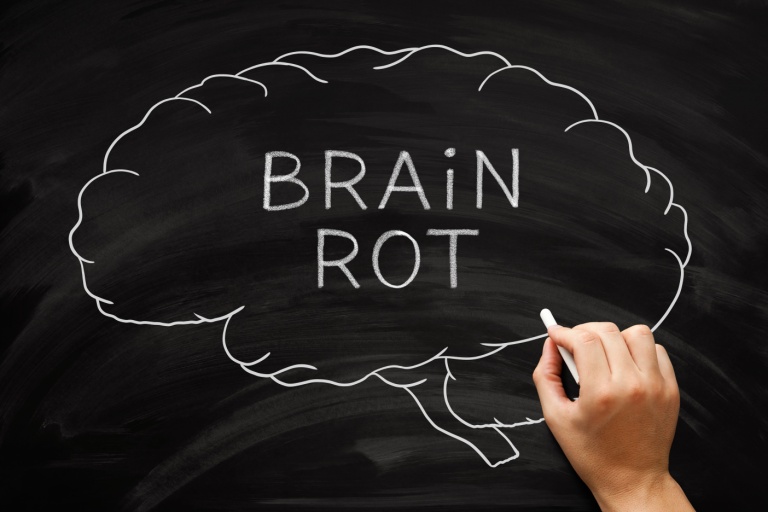
Brain rot has become the defining phrase of this digital era — not because someone invented it, but because millions of people felt it first and later needed a word for it. It arrived in the body before it arrived in the dictionary. A heaviness behind the eyes after two hours of short-form video.
A restlessness when nothing is playing. A creeping inability to sit through a book, a conversation, a thought that requires more than eleven seconds to resolve. In December 2024, Oxford University Press made it official, naming brain rot its Word of the Year — a term that had grown 230 percent in usage in a single calendar year. But the feeling it names is older than the hashtag, and the damage it describes is not a metaphor.
This is an article about what brain rot actually is, what kinds of content produce it, what it does to the human mind at a neurological level, and why adolescents — children whose brains are still actively being constructed — face a fundamentally different and more serious risk than adults scrolling through the same feed.
What brain rot actually is — and where the term came from
The first recorded use of the phrase comes from an unlikely source: Henry David Thoreau. In his 1854 book Walden, Thoreau observed that a culture’s willingness to consume trivial ideas without resistance was a sign of intellectual decay — a preference for shallow stimulation over demanding thought. He compared it to the potato blight of 1840s Europe. Not dramatic. Not sudden. A slow rot was spreading through something people depended on for their survival.
One hundred and seventy years later, the metaphor found a new host. In 2024, Oxford University Press defined brain rot as ‘the supposed deterioration of a person’s mental or intellectual state, especially viewed as the result of overconsumption of material — now particularly online content — considered to be trivial or unchallenging.’ The definition does two things at once: it acknowledges the phenomenon, and it hedges with the word ‘supposed.’ That hedge is closing fast. Research is catching up with what people already know in their bodies. Brain rot is not a diagnosis. It is a description. But descriptions matter — they are the first step toward understanding what is actually happening.
In Internet culture, the term has two layers of meaning. First, it describes the type of content itself: low-quality, high-stimulation digital media designed not to inform or challenge but simply to capture and hold attention. Second, it describes what that content does to the viewer over time: cognitive fatigue, reduced attention span, emotional numbness, and a growing inability to engage with anything that requires sustained focus. Cause and effect compressed into the same two words.

What brain rot content looks like
Not all online content produces brain rot. Long-form documentary, investigative journalism, educational video, serious drama — these demand something from the viewer. They require patience, inference, and the willingness to hold an idea in mind long enough to see where it goes. That demand is precisely what brain rot content eliminates.
Brain rot content is defined by a cluster of consistent features, identified by researcher Alexander Serenko and others studying digital consumption patterns. It is brief — typically under sixty seconds, often under fifteen. It is emotionally intense, engineered to produce an immediate reaction: surprise, disgust, amusement, arousal, outrage. It relies on familiar characters and recurring formats, which reduces the cognitive effort required to process it. And it is designed for ease of understanding — there is no ambiguity, no subtext, no patience required.
The most representative examples include: short-form video platforms like TikTok and YouTube Shorts; AI-generated content stitched together without authorial intent or coherence; viral meme formats recycled in endless variation; doomscrolling news feeds; reaction content where someone watches other content and reacts; and absurdist video series like Skibidi Toilet — humanoid toilets in combat — which became so embedded in youth culture that Oxford specifically named it as a representative example of brain rot content.
What these formats share is not simply their mindlessness. It is that they are engineered. Each is the product of an algorithm optimized for one metric above all others: time spent. Not learning. Not satisfied. Not wellbeing. Time. The content that keeps attention the longest gets amplified. The content that produces the strongest dopamine response survives. Everything else is filtered out. The feed is not a mirror of culture. It is the output of a machine trained to find the weakest points in human attention and push through them.
What brain rot does to the human mind
To understand why brain rot content has the cognitive effects it does, it helps to understand what happens in the brain during consumption — and what continues to happen long after the screen goes dark.
Every short video that captures attention triggers a small release of dopamine — the brain’s motivation and reward chemical. The brain anticipates something stimulating, receives a brief hit of satisfaction, and then the algorithm delivers the next clip before the feeling has time to resolve. This is not accidental. It is the direct application of what researchers call variable reward scheduling — the same psychological mechanism that makes slot machines difficult to walk away from. The interval between stimuli is unpredictable. That unpredictability is what makes the loop compulsive.
Over time, this pattern produces a measurable change in the dopamine system. Receptors become less sensitive to lower levels of stimulation. The brain, trained to expect rapid-fire reward, begins to find ordinary reality — reading, conversation, nature, silence — not merely dull but genuinely unrewarding. The bar for what counts as interesting has been raised by a system that cares only about the person’s continued engagement, not their well-being.
A September 2024 review published in Psychological Bulletin examined 71 studies involving nearly 100,000 participants. It found that heavy consumption of short-form video was associated with poorer cognition — particularly reduced attention spans and weakened impulse control — as well as increased symptoms of depression, anxiety, stress, and loneliness. These are not correlations to dismiss. They represent, in aggregate, the largest study to date of the effects of short-form videos on the human mind.
The specific brain region most affected is the prefrontal cortex — the area responsible for planning, focus, decision-making, working memory, and self-regulation. When dopamine receptors in this region are repeatedly overstimulated, neurologist Dr. Susan Lotkowski has noted that the prefrontal cortex begins to fatigue. The individual becomes less capable of sustained thought, less able to resist impulse, and less equipped to engage with anything that does not deliver immediate reward.
Research published in Frontiers in Human Neuroscience found real, measurable changes in executive control among heavy short-video consumers. Studies have also linked excessive Internet use to alterations in the brain’s grey matter — the physical substrate of cognition — particularly in areas associated with attention and decision-making. These are not theoretical risks. They are documented changes in brain structure. The brain is plastic. It changes in response to what we repeatedly ask it to do. When we ask it to do nothing but react, it reorganizes itself around that demand.
Why do adolescents face a categorically different risk?
Everything described above applies to adults. For adolescents, the equation is fundamentally different — not in degree, but in kind. The human brain does not finish developing until the mid-twenties. The prefrontal cortex — the seat of judgment, impulse control, long-term thinking, and ethical reasoning — is the last region to mature. During adolescence, it is a construction site. Nerve pathways are forming. Synaptic connections are being pruned and reinforced based on what the brain is being asked to do. This period of neurological restructuring is one of the most sensitive windows in human development.
Through that window, brain-rot content arrives with the force of a highly engineered stimulant. The adolescent dopamine system is already primed for intensity — the teenage brain requires more stimulation than an adult brain to achieve the same level of pleasure. This is not a flaw; it is what drives adolescents toward the risk-taking and novelty-seeking that, historically, served their development. But it also makes them disproportionately vulnerable to anything that delivers high-frequency dopamine hits at low cognitive cost.
As researchers at New Dimensions Day Treatment Centers have described, adolescents’ neural reward pathways are highly sensitive, and low-effort, high-frequency stimulation can condition the brain to seek only immediate, superficial rewards — reducing tolerance for the delayed gratification that complex learning, academic achievement, and emotionally demanding relationships require. The prefrontal cortex deficit is not a metaphor. It is a neurological reality. One researcher has termed the adolescent condition prefrontal cortex deficit disorder — not a clinical diagnosis, but a precise description of what the underdeveloped prefrontal lobe actually produces: impaired judgment, weakened impulse control, and heightened susceptibility to external reward.
The most vulnerable demographic, according to current data, is young females aged 16 to 24, who average nearly three hours of social media use daily — more than any other group. But the risk does not track by gender alone. It tracks by neurological development. Any child or teenager consuming several hours of brain- otting content daily is training an unfinished brain to expect a kind of stimulation that reality — school, conversation, reading, creative work, and the long effort of building a skill — cannot provide.
The danger is not that they will become stupid. The danger is that they will become incapable of tolerating the conditions under which intelligence develops: boredom, patience, frustration, the slow accumulation of understanding over time. A child trained by an algorithm to expect a reward every 8 seconds does not lack intelligence. They lack the neurological architecture to deploy it.

Tell-signs of brain rot — in yourself, your children, and the people you care about
Brain rot does not announce itself. It accumulates quietly, mistaken for tiredness, stress, or a vague sense that something is off. These are the patterns worth noticing.
- Inability to sit with boredom: The immediate reach for a phone the moment there is nothing to do — waiting in a queue, sitting in a car, lying in bed before sleep — is a sign that the nervous system has lost its tolerance for unstimulated time. Boredom is not a problem to be solved. It is the precondition for creativity, reflection, and consolidation of thought. When it becomes unbearable, the dopamine system has been recalibrated.
- Difficulty finishing anything long-form: A book started and abandoned. A film watched in fragments. An article scrolled to the first paragraph and closed. A conversation drifted away from before it resolved. These are signs that the attentional system has been conditioned against sustained engagement.
- Emotional flatness outside of screens: Desensitization is a documented effect of doomscrolling and high-stimulation content. When the reward threshold has been raised by algorithmic content, ordinary pleasures — a meal, a walk, a face-to-face conversation — register as insufficient. The world begins to feel grey in the gaps between feeds.
- Language that references online culture in all contexts: The adoption of Internet-specific vocabulary — terms like ‘skibidi’, ‘rizz’, ‘no cap’, and cascades of niche meme references — into all conversation is one marker of deep immersion in brain rot culture. Oxford noted this explicitly. The language of the feed colonizes the language of real life.
- Sleep is disrupted by the pull of the feed: Lying awake scrolling. The phone is in the bed. The inability to put it down, even when tired. The dopamine loop does not respect the body’s need for rest. Sleep deprivation compounds the cognitive effects; the two damage systems reinforce each other.
- Anxiety in silence: When quiet becomes uncomfortable — when the absence of stimulation produces restlessness, irritability, or a low-level panic — the nervous system has been reorganized around the expectation of continuous input. This is the clearest sign that the relationship with content has moved from use into dependency.
What protection actually looks like
The temptation when confronting this material is to reach for a simple prohibition — no screens, no platforms, done. That approach fails for the same reason that telling a teenager not to eat sugar while keeping a bowl of sweets on the table fails. The problem’s architecture is not one of willpower. It is one of the environmental, habit, and neurological recalibration.
What the research consistently supports is not elimination but restructuring. Specific, bounded screen time limits — set before the pattern deepens — are effective. Deleting the most addictive applications from accessible devices reduces the frictionless nature of the habit loop. Turning off notifications removes the variable reward trigger. These are not dramatic interventions. They are friction. And friction, in a system optimized for effortlessness, is sufficient to break the cycle.
The deeper intervention is replacing fast rewards with slow rewards. Reading. Physical exercise. Musical practice. Cooking from scratch. Any activity that requires sustained attention, tolerates frustration, and delivers reward only after effort has been invested — these are the activities that rebuild the prefrontal cortex’s capacity to engage with difficulty. The brain is plastic. What the algorithm has trained can be retrained by time and intention.
For parents specifically, the most important protection is modeling. Children who observe adults managing their own relationship with screens develop different defaults than children who observe adults in continuous screen use. The phone on the table during dinner is not a neutral object. It is a signal about what deserves attention. The question is not whether your child uses the Internet. They will. The question is whether the Internet is using them.
In 1854, Thoreau saw the beginning of something. A preference for the trivial. A willingness to let the easy crowd out the demanding. He named it with an agricultural metaphor — the rot that spreads through what sustains you, slowly, without visible damage, until the harvest fails. He was writing about books, newspapers, and the low quality of public discourse. He could not have imagined the feed. But the mechanism he described is identical: the brain, offered a steady supply of frictionless stimulation, will take it. And in taking it, you will gradually lose the capacity for everything else.
The word of the year is not a joke. It is a diagnosis offered by a culture trying to name what it is living through. The children scrolling through Skibidi Toilet at midnight are not broken. They are responding rationally to a system built to capture them. The responsibility belongs to the adults in the room — to name what is happening clearly, to build the structures that protect developing minds, and to resist the comfortable idea that because everyone is doing it, it cannot possibly be doing harm. It is. The research says so. And somewhere in the back of the mind, under the fog, most people already know it too.
Follow us on X, Facebook, or Pinterest
