
Many people believe death is the greatest punishment that can be inflicted on a person. But there may be something even more terrifying: being stripped of one’s mental faculties and humanity, unable either to live normally or to die, and reduced to what the Chinese call one of the “living dead.”
That is the disturbing picture presented in a purported final letter attributed to Zhong Shaojun, a former senior aide to Chinese leader Xi Jinping.
Zhong Shaojun’s ‘Last Truth’
Australia-based legal scholar and writer Yuan Hongbing recently disclosed what he described as a confidential letter written from detention by Zhong Shaojun to Xi Jinping.
Zhong was formerly director of the General Office of the Central Military Commission and also served in the office of the CMC chairman, putting him close to the center of military power under Xi Jinping.
The purported letter, titled “The Last Truth,” is striking not because Zhong pleads for mercy, but because of the way he reportedly looks back on his own life.
Zhong wrote that he was approaching 58 and had already enjoyed extraordinary wealth, luxury, and privilege. Because he had once stood so close to the center of power, he said, he had experienced a life few others could imagine.
“From this perspective,” he reportedly wrote, “I have no regrets in this life.”
Yet what followed was a very different kind of confession.
Zhong said his greatest regret was that from the day he entered official life, he had ceased speaking from the heart. Years of surviving and advancing within the bureaucracy, he wrote, had taught him to live by lies and to tell his superiors what they wanted to hear.
He described himself as having gradually become “an existence constructed entirely of lies,” while his true humanity was buried beneath them.
The contrast is stark. At the summit of CCP power, Zhong had enjoyed wealth, status, and influence. Yet according to his own reported account, the price was the sacrifice of sincerity, conscience, and moral integrity.
Once stripped of office and deprived of his freedom, the former power broker appears to have looked back on decades of advancement and concluded that he had spent much of his life serving a political world built on falsehood.
Allegations of neurological drugs
The most disturbing claims in the letter concern what Zhong said was happening to him in detention.
According to Yuan’s account of the letter, Zhong said that after losing his freedom in October 2025 and spending about six months under secret investigation or detention, he began experiencing a sharp deterioration in his memory and cognitive abilities.
Zhong reportedly believed this decline was deliberate.
He alleged that drugs capable of damaging the central nervous system were being added to his food and drink on Xi Jinping’s orders. The purpose, he claimed, was to leave him unable to think independently, remember clearly, or express himself, turning him into a “half-idiot living dead.”
These allegations have not been independently established and come from the purported letter as disclosed by Yuan Hongbing.
More disturbing still, Zhong allegedly wrote that such methods were not new to him.
According to the letter, while Zhong himself was still close to the center of power, Xi Jinping had instructed him to use similar chemical methods against Liu Yazhou, the former political commissar of China’s National Defense University.
“In less than a year,” Zhong reportedly wrote, Liu, once known for his intellect and military writing, had become an aged man with a confused mind.
“Now,” he added, “the same fate seems to be falling on me.”
The source article views this reversal through the traditional principle of karmic retribution: Zhong allegedly participated in inflicting such treatment on another man, only to find himself facing the same fate.
As the old saying goes, retribution may come sooner or later, but it will come.
From imitation to ridicule
The letter also reportedly offers a scathing account of what Zhong claims senior CCP officials privately think of Xi Jinping.
Zhong cites remarks attributed to Liu Yazhou at a gathering of “second-generation red” elites — descendants of senior revolutionary-era CCP figures.
According to Zhong, Liu once said that Xi Jinping had tried desperately to imitate Mao Zedong but had instead “tried to draw a tiger and ended up drawing a dog,” a traditional Chinese expression for a failed imitation.
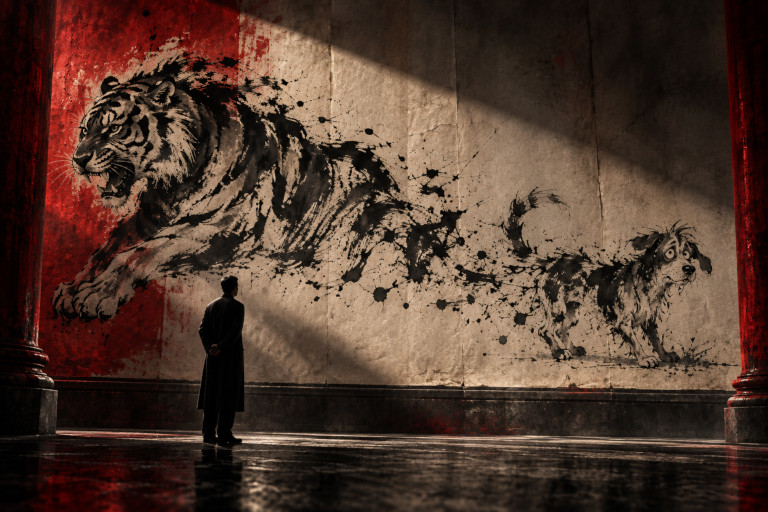
The purported letter goes on to contrast Mao’s place within the communist system with Xi Jinping’s political image.
It invokes the figures of Black and White Impermanence from traditional Chinese folklore — underworld beings associated with escorting souls to the realm of the dead — to mock what the letter portrays as Xi Jinping’s attempts to project fear and authority.
Zhong also reportedly attacked the numerous costly or troubled projects associated with Xi Jinping’s rule, including the Xiong’an New Area and the Belt and Road Initiative.
The letter refers to Xi Jinping by the satirical nickname “chief accelerator,” a term used by critics who believe his policies have accelerated the CCP’s decline rather than strengthened it.
According to Zhong’s account, ridicule of Xi Jinping extends far beyond political dissidents and intellectuals and can even be found among officials inside the system.
A culture of submission and double-dealing
Why, then, do officials continue to offer such extravagant displays of loyalty?
The purported letter argues that fear is the answer.
Under a political system built around surveillance, informants, and the constant threat of punishment, officials seeking to protect their careers and families learn to suppress what they really think.
The source uses the striking metaphor of the “eunuch-ization” of officials — not literally, but as a description of what it sees as the deliberate stripping away of courage, independence, and moral character.
Yet forced obedience does not necessarily produce genuine loyalty.
“Even a eunuch,” the letter reportedly says, “would give his loyalty only to a brilliant and capable emperor, not willingly offer absolute loyalty to a muddled and violent ruler.”
The result, according to Zhong, is a political culture in which nearly everyone becomes “two-faced.”
In public, officials compete to deliver ever more extravagant declarations of loyalty. In private, the letter claims, some of the same people mock the leader they praise from the podium.
The article points to Ren Zhiqiang’s famous criticism of Xi Jinping as “a clown who insists on playing emperor even after being stripped naked,” arguing that such sentiments were not confined to a handful of outspoken intellectuals.
According to Zhong’s purported account, similar resentment has spread quietly through the ranks of the Party itself.
A system that demands absolute loyalty may therefore produce the appearance of unity while concealing distrust, fear, and contempt beneath the surface.
And if Zhong’s reported letter is genuine, the testimony comes from someone who once stood very close to the center of that system.
To be continued in Part 2
This article reflects the personal views and opinions of the original author.
Translated by Chua BC
Follow us on X, Facebook, or Pinterest
