
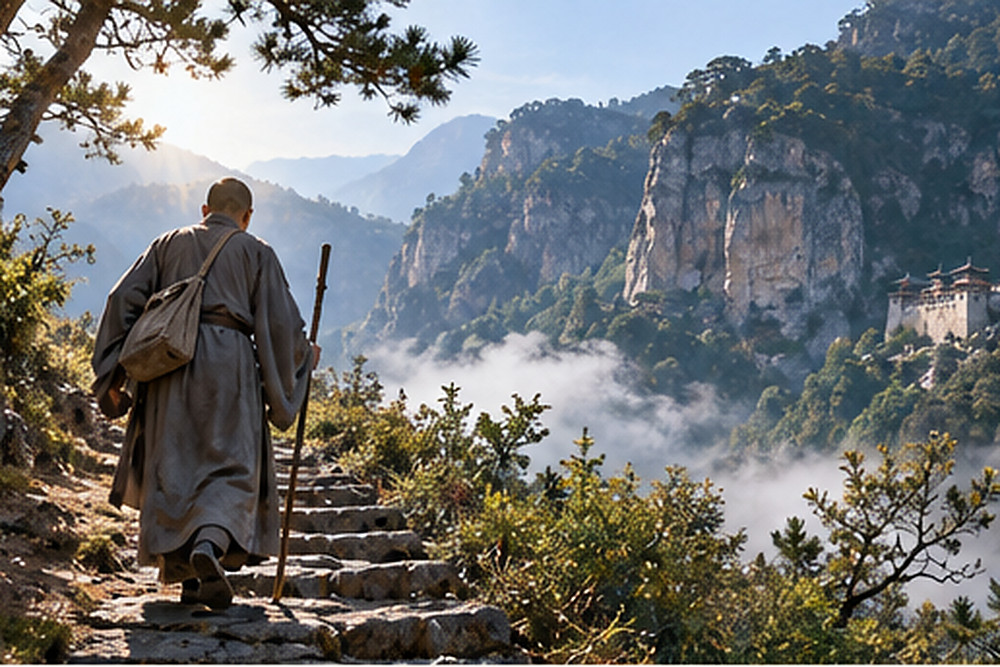
One of the best-known legends from Mianshan, a mountain in central China’s Shanxi Province, tells of a monk who ended a severe drought in Chang’an with a single ladle of water and came to be revered as the “Living Buddha of Mianshan.”
That monk was Zhichao. Long before the famous rain miracle associated with his name, stories of his devotion, endurance, and refusal of worldly honors had already made him a respected Buddhist figure.
Monk Zhichao
Monk Zhichao was born Tian Shanyou, according to legend, around the end of the Northern and Southern Dynasties period. His ancestral home was Fengyi in Shaanxi, but his life later became deeply connected with Shanxi. From childhood, he seemed naturally drawn to Buddhism. He enjoyed bowing before the Buddha and sitting quietly in meditation, and he showed little interest in worldly wealth or status.
His family, however, was unwilling to let their only son renounce worldly life. Hoping to keep him at home, they arranged a marriage for him and went ahead with the wedding. On their wedding night, Monk Zhichao solemnly told his bride that his heart was devoted to the Buddha. He had already resolved to pursue spiritual cultivation and could not give himself over to worldly romance.
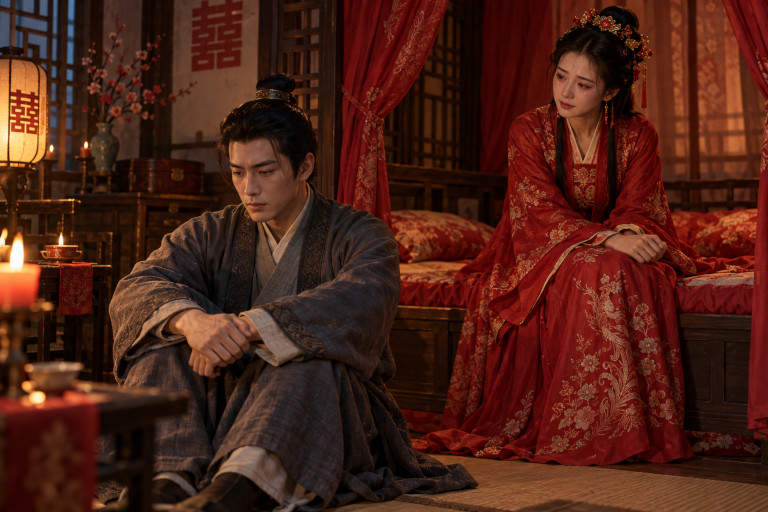
Rather than becoming angry, his bride was moved to tears. According to the legend, she agreed that they would remain husband and wife in name only and promised not to interfere with his spiritual practice. From then on, after the household had gone to sleep, Monk Zhichao would sit alone in meditation until dawn.
At the age of 27, he finally received permission to leave home and become a monk. He went to Kaihua Temple in Bingzhou and sought to become a disciple of the Buddhist master Huizan. Huizan, however, did not immediately accept him. The temple had many monks and a great deal of hard work to be done, including carrying water, chopping wood, pounding rice, sweeping the courtyard, preparing meals, and repairing buildings. Huizan assigned Monk Zhichao the most difficult and exhausting tasks as a test of his character.
Monk Zhichao never complained. He volunteered for work others were reluctant to do and quietly took on unpleasant chores that others avoided. He rose before dawn and often did not rest until late at night. In time, Huizan saw that Monk Zhichao could endure hardship, remain true to his original purpose, and refrain from resentment even when treated with indifference. He then formally accepted him as a disciple. Monk Zhichao devoted himself to studying Buddhist scriptures and practicing day and night, and his reputation gradually spread beyond the temple.
Unmoved before armed robbers
The years surrounding Monk Zhichao’s entry into monastic life were a time of political turmoil. During the reign of Emperor Yang of the Sui Dynasty, Buddhism faced restrictions, and monks were not free to travel together as they wished. Hearing of their difficulties, Monk Zhichao sometimes left the mountains to visit local officials and Buddhist supporters, hoping to secure greater freedom for monks to practice and spread the Dharma. As he traveled, he also encouraged people to observe moral precepts, cultivate goodness, and distance themselves from harmful deeds.
One night, Monk Zhichao was sitting quietly indoors with his disciples after chanting when a group of armed robbers suddenly burst through the door. The intruders apparently expected those inside to panic and flee. Instead, Monk Zhichao and his disciples remained seated, calm and unmoving. The robbers stood with weapons in hand, unsure how to respond. They had never encountered people who, when confronted by armed men, neither fled nor became angry or afraid.
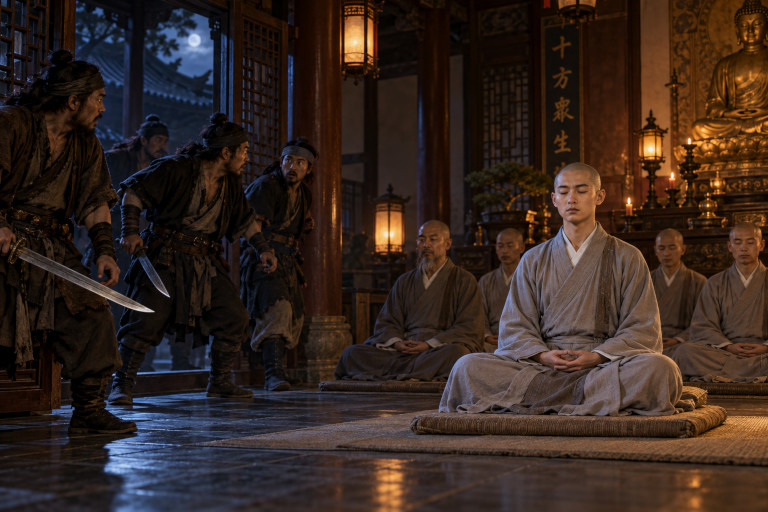
According to the legend, the robbers’ aggression gradually subsided. One of them lowered his weapon, knelt before Monk Zhichao, and asked for forgiveness. The group was eventually moved by him, abandoned its wrongdoing, and turned toward goodness. Some reportedly even became his disciples, and Monk Zhichao’s reputation spread still farther.
Rejecting life at the imperial palace
Later, as the Sui Dynasty was collapsing amid widespread unrest, Li Yuan raised an army in Taiyuan and rebelled against Sui rule. His campaign would eventually lead to the founding of the Tang Dynasty the following year. Monk Zhichao believed that the passing of one dynasty and the rise of another followed the will of Heaven, and he led a group of monks to Jinyang, Li Yuan’s base in the Taiyuan region, to spread the Dharma. More and more people began following him in spiritual practice.
According to legend, Monk Zhichao’s disciples strictly observed Buddhist precepts. They treated one another with humility, took nothing that did not belong to them, and did not deceive others. The local people were gradually influenced by their example. It was said that lost belongings could be left untouched by the roadside and that households could leave their doors unlocked at night. People believed such harmony could not be achieved through strict laws alone, but came from people’s hearts turning toward goodness.
After Li Yuan established the Tang Dynasty as Emperor Gaozu, he treated Monk Zhichao with great respect. The emperor invited him to reside in Taiji Palace and offered him generous support so that he could remain in the capital and spread the Dharma. Such an invitation represented extraordinary honor and privilege, but Monk Zhichao declined.
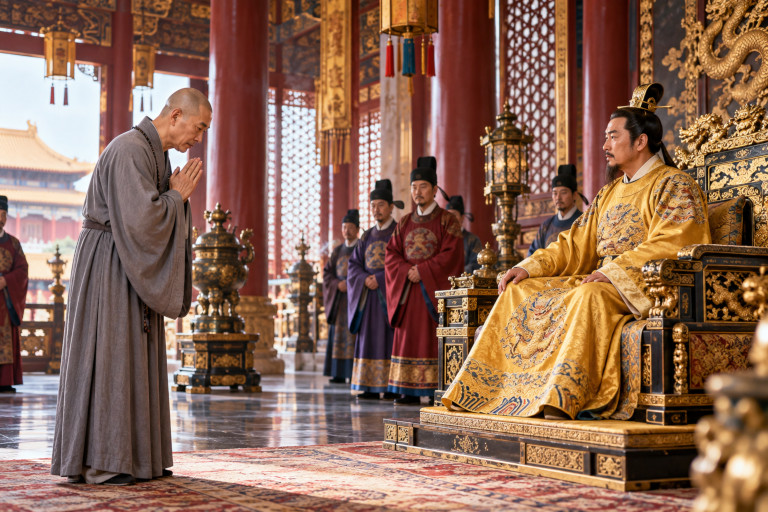
He bade farewell to the emperor and, together with his disciples, left the prosperous capital for Mianshan in Shanxi, where he continued his cultivation. Eventually, Monk Zhichao settled near Baofu Cliff on Jieshan Mountain. The cliff overlooks a deep valley and rests against towering peaks. Its rock walls curve inward in a shape likened to an embracing belly, giving rise to the name Baofu, or “Embracing the Belly.”
Clear springs flowed through the mountains, ancient trees covered the slopes, and clouds and mist often surrounded the cliffs, creating the atmosphere of a secluded Buddhist pure land far removed from worldly affairs. Temples were later built there, including Baofu Temple and Guangyan Temple, while the traditions surrounding Monk Zhichao’s cultivation gave Mianshan a strong association with Buddhist miracles and legends.
Sources
Dao Xuan, Continued Biographies of Eminent Monks (Xu Gaoseng Zhuan)
Biographical materials on Tian Zhichao
Translated by Katy Liu
Follow us on X, Facebook, or Pinterest
