
Monk Zhichao was a Buddhist practitioner whose life became closely associated with Mianshan, a mountain in central China’s Shanxi Province. According to traditional accounts, he earned a reputation for his devotion, endurance, and moral influence, even declining an invitation from Tang Dynasty founder Emperor Gaozu to reside at the imperial palace.
Monk Zhichao instead withdrew with his disciples to Mianshan, where he settled near Baofu Cliff and continued his spiritual cultivation. It was there that some of the most remarkable legends surrounding his life began to take shape.
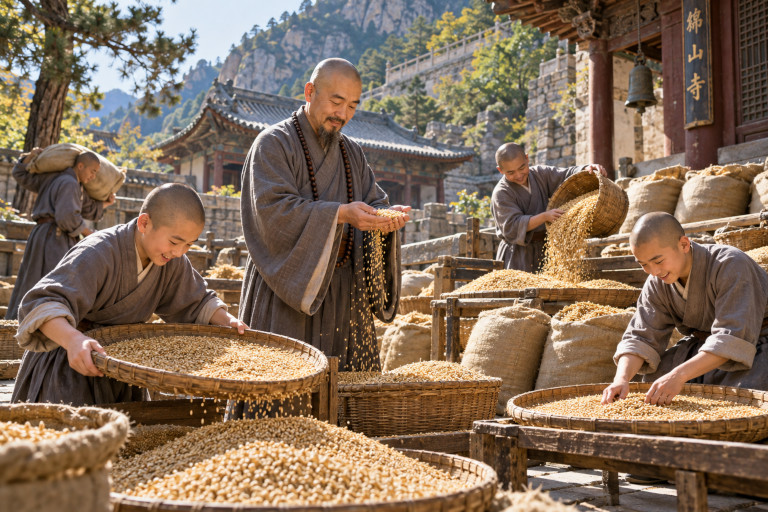
Nearly 100 monks and disciples followed Monk Zhichao to Mianshan for a time. They had brought very little food — according to the legend, only six shi of wheat, using a traditional Chinese measure of grain. For so many people, the supply should have been exhausted quickly.
The disciples worried about what would happen once the grain ran out. Deep in the mountains, far from any marketplace, they wondered how everyone could continue their spiritual practice without enough food. Monk Zhichao remained calm and told them to continue chanting the scriptures, working, and cultivating as usual rather than worrying excessively about their provisions.
The miraculous wheat
According to the legend, something remarkable then occurred. Day after day, the stone mill turned, but the wheat seemed never to run out. Whenever they took grain from storage to prepare meals, the supply never seemed to reach the bottom.
The mountain spring was also said to change according to the number of people present. When few monks were on the mountain, the water flowed gently. When larger numbers came to worship and hear the Dharma, the spring became more abundant, providing enough water for drinking, cooking, and washing. People in the mountains came to believe that Monk Zhichao’s level of spiritual cultivation was so great that even the springs and grain responded to it.
As his reputation spread, more people came to Mianshan. Some wanted to see Baofu Cliff for themselves. Others came to pray for sick family members or to seek peace amid the suffering of a troubled age. Still others wanted to see what was different about a monk who had declined an emperor’s invitation.
Monk Zhichao himself remained unchanged. He did not boast about miraculous occurrences or become proud because of his growing number of followers. He continued to chant the scriptures, meditate, work, and guide his disciples, while stories of his miracles spread among villagers and pilgrims.
The great drought and Emperor Taizong’s journey to Mianshan
In the 12th year of the Zhenguan era (AD 638), a severe drought struck the Guanzhong region. According to legend, the area around Chang’an had gone without rain for a long time. The earth cracked, crops withered, and the people waited for rain.
Emperor Taizong, Li Shimin, heard that Mianshan had escaped the drought and continued to enjoy favorable weather, so he personally traveled to Baofu Cliff to seek an audience with Monk Zhichao. After reaching the mountain, Taizong explained the drought in Chang’an and asked Monk Zhichao to pray for rain on behalf of the people.
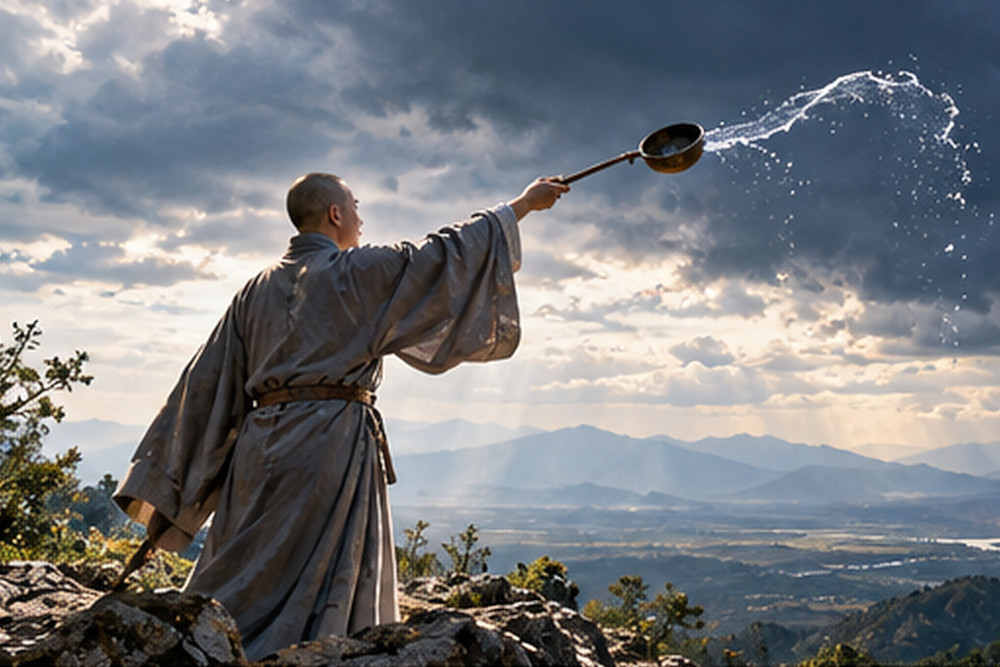
Monk Zhichao did not immediately answer. At the time, one of the temple disciples was washing rice near the kitchen stove, and the cloudy water left after washing the rice had been collected in a gourd ladle. Monk Zhichao simply instructed the disciple: “Throw the rice water toward the southwest.” The disciple did not ask why. He lifted the ladle and cast the water in that direction.
According to the legend, clouds soon began gathering in the southwest. Dark clouds formed over the area around Chang’an, thunder sounded, and heavy rain began to fall. The parched land was finally soaked, and the withered crops received badly needed water. People believed the rain had arrived in time to relieve Chang’an from the drought, and from then on, Monk Zhichao came to be known as the “Living Buddha of Mianshan.”
The story of Emperor Taizong seeking rain, Monk Zhichao ordering his disciple to scatter the water left from washing rice, and rain subsequently falling over Chang’an became one of the best-known legends associated with Monk Zhichao. Versions of the story have continued to appear in local accounts and descriptions of Mianshan’s Buddhist culture.
A Tang princess enters the mountains
Monk Zhichao’s cultivation and reputation for miracles also influenced people within Emperor Taizong’s own family. According to legend, Taizong’s younger sister, Princess Changzhao, witnessed the events surrounding the prayer for rain at Mianshan and developed a deep respect for Buddhist teachings. She eventually went into the mountains and became a nun.
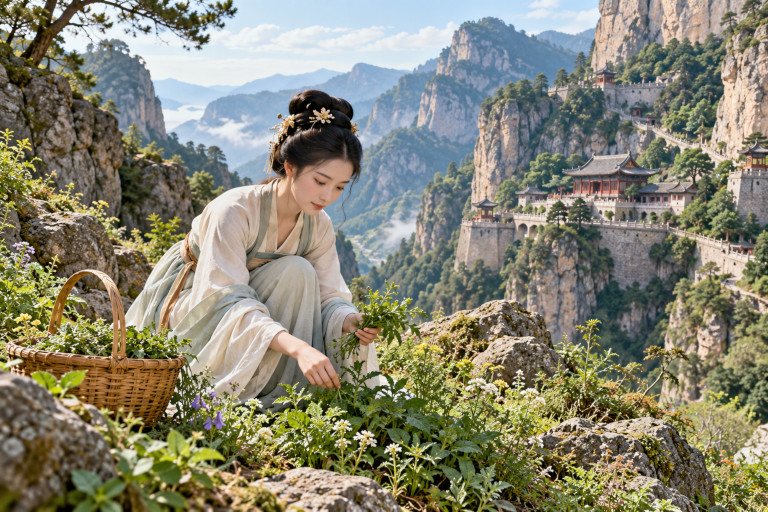
Although born into the imperial family, she did not conduct herself as a princess. During the day, she joined the others in chanting scriptures, meditating, and working. At times, she also gathered medicinal herbs in the mountains and treated illnesses among local people. Villagers knew that an unusually refined woman was practicing in the mountains, but few realized that she belonged to the Tang imperial family.
In these traditions, Princess Changzhao’s renunciation came to symbolize the Buddhist principle that worldly distinctions between high and low lose their importance before the Dharma. An imperial princess could set aside fine clothing and luxurious food just as an impoverished villager could enter a temple and cultivate the Way. At Baofu Cliff, social status and wealth mattered less; what mattered was whether a person could preserve a heart that was kind, pure, and steadfast.
The Ancient Kongwang Buddha
In the 15th year of the Zhenguan era (A.D. 641), on the 11th day of the third lunar month, Monk Zhichao passed away. The following year, Emperor Taizong again traveled to Mianshan with his officials. According to legend, he hoped to see the monk who had once helped bring rain to drought-stricken Chang’an and express his gratitude.
When Taizong reached Baofu Cliff, however, Monk Zhichao’s disciple Yinkong received him and informed the emperor that his master had already passed away and “returned to the West,” a traditional Buddhist expression for death. Taizong remained silent for a long time. Before him were the green mountains of Mianshan, deep valleys veiled in mist, and the distant sound of temple bells. The monk who had declined life at the imperial palace and chosen to remain at Baofu Cliff was no longer in the world.
Taizong looked up at the sky and sighed, “I came here hoping to see the Buddha, but in vain.” According to the legend, four golden Chinese characters then appeared in the sky: “Ancient Kongwang Buddha” (空王古佛). Monk Zhichao’s Dharma body also appeared faintly amid the glowing clouds, astonishing the emperor and his officials.
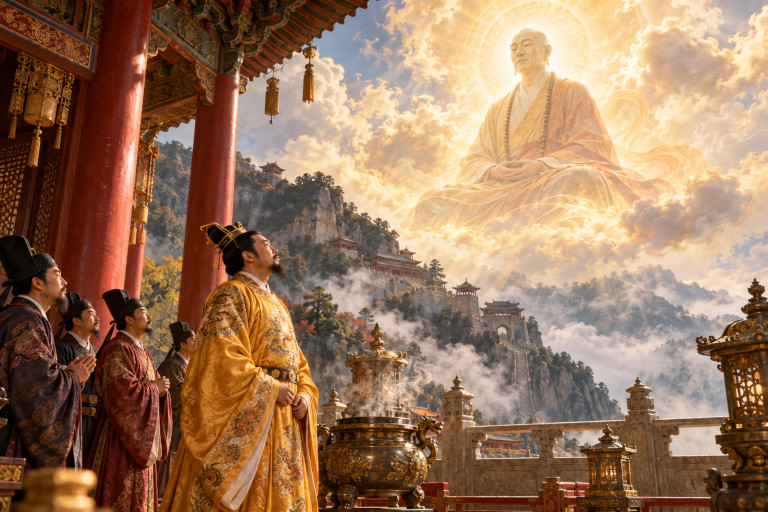
The story says Taizong then understood that Monk Zhichao was no ordinary monk, but an incarnation of Kongwang Buddha who had appeared in the human world. The emperor then ordered a temple to be built around Baofu Cliff in memory of Monk Zhichao, helping preserve the traditions associated with the monk and Baofu Temple for later generations.
Sources
Dao Xuan, Continued Biographies of Eminent Monks (Xu Gaoseng Zhuan)
Biographical materials on Tian Zhichao
See Part 1 here
Translated by Katy Liu
Follow us on X, Facebook, or Pinterest
