
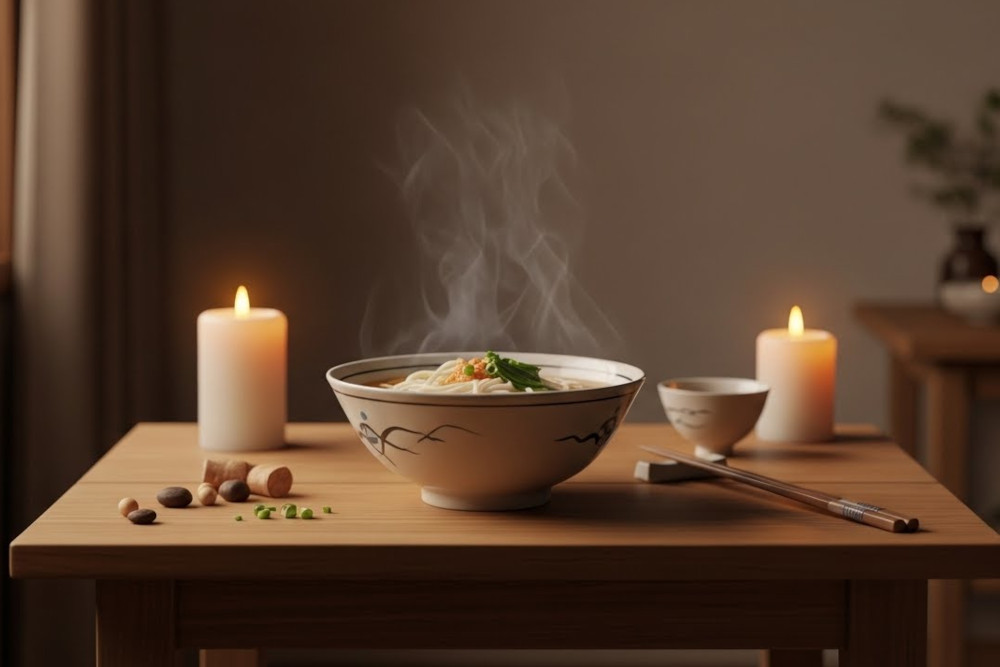
That evening, after the evening prayers ended, the young monk followed his master back to their quarters. A vegetarian noodle dish sent by an unknown benefactor had been cooked into two bowls and set on the table, steam rising gently from the surface. Outside, the evening breeze stirred the bamboo grove, its soft rustling echoing through the dusk. Inside, candlelight flickered, illuminating the two bowls as wisps of white steam curled upward.
The young monk sat on his cushion, staring at the noodles before him, yet he could not bring himself to eat. The resentment lodged in his chest felt like a lump in his throat, leaving him unable to swallow.
At last, unable to hold it in any longer, he set down his chopsticks and asked: “Master, do people who commit terrible deeds really face retribution?”
The master did not answer right away. He lowered his head and took another mouthful of noodles, the quiet slurping sound unusually clear in the still room. He chewed slowly, then looked up and said calmly: “You’ve waited so long for retribution that your noodles have gone cold.”
The young monk stiffened, his brow tightening. “But… they’re truly wicked. Are we just supposed to let it go?”
The master set down his chopsticks and wiped the corner of his mouth with his sleeve. His gaze met the young monk’s through the candlelight, his voice steady but heavy, like a muted blow to the heart. “You think heaven owes you fairness, but in truth, you owe yourself the peace of a quiet meal.”
The young monk felt rooted to the spot.
Moonlight streamed through the window lattice and fell across the small table. He stared at the bowl of noodles — greens still floating in the broth — though the steam had thinned.
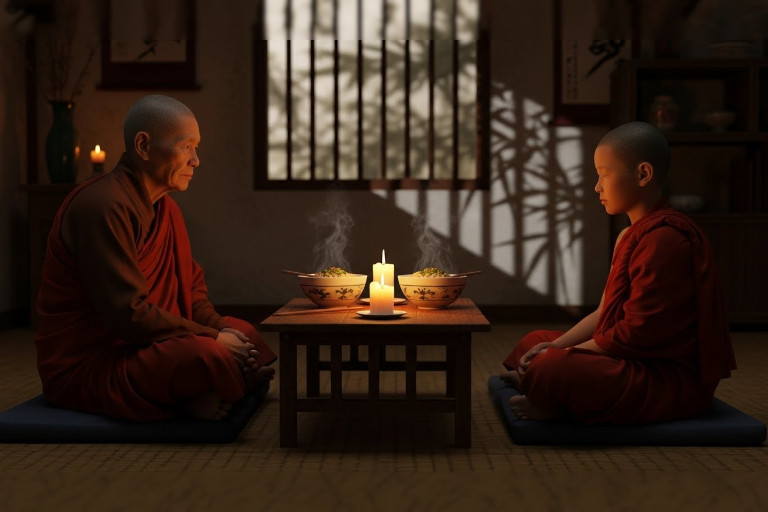
Lifting a strand of noodles, the master spoke slowly. “The ancients said: ‘Not condemning right and wrong is not the same as agreeing with the world.’ This does not mean you should lose your sense of justice, but that you must not let right and wrong imprison you. Those who do evil have already planted their causes. The consequences that must come will come. But what about you? What have you made of your own days?”
The young monk lowered his head, gazing into his bowl.
“Do you know why this bowl of noodles must be eaten while it’s hot?” the master asked suddenly.
“Because… it doesn’t taste good when it’s cold?” the young monk replied hesitantly.
“Because it is hot right now,” the master said with a smile. “Even the finest broth tastes different once it cools. Life is the same. Every moment has its own warmth. If you spend your time staring into other people’s ledgers, by the time you wake up, your own days will already have gone cold.”
He took another satisfied sip and continued: “‘The net of Heaven is vast, yet nothing escapes it.’ You don’t need to dwell on that. Guarding another person’s karma is like watching over a dry well, waiting for someone else to fall in — only to find yourself dying of thirst first.”
The young monk’s heart stirred.
Lately, he had been fixated on the man from the village who once bullied him — wondering how that man could still live so comfortably, questioning why heaven had not punished him. Yet during this time, how had the young monk himself been living? His mind wandered during sutra recitations, he could not sit still in meditation, and everything irritated him. He believed he was waiting for justice, but in truth, he was punishing himself for another’s wrongdoing.
“Master, I still can’t swallow this anger,” the young monk said, his voice trembling.
“Anger must be released, but not this way.” The master pointed at the bowl. “Look — your noodles are nearly clumped together. Do you understand? Resentment is like adding foul broth to a good soup. It ruins what was once wholesome. It doesn’t spoil anyone else’s taste — it spoils your own.”
The old monk paused, his voice softening. “Karma will come, but that is not for you to manage. Heaven and earth have their own rhythm — can you control it? The Diamond Sutra says: ‘One should not dwell on anything and thus give rise to the mind.’ If resentment settles in your heart, a pure mind cannot arise. Do what you ought to do, and leave the rest to cause and condition.”
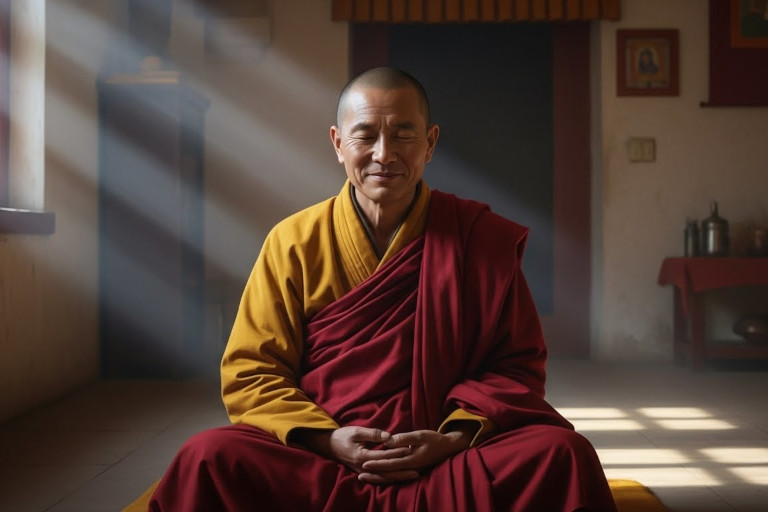
The young monk looked at his master. He had nearly finished his bowl, a gentle smile resting on his face.
“Remember,” the master said at last, “this bowl of noodles before you is hot right now — worth eating while it’s warm. Your life is the same — worth continuing to live well. Don’t let the misdeeds of others delay you from tasting life’s flavors.”
The young monk took a deep breath, lifted his chopsticks, and finally took a bite. The noodles were still warm, the broth clear and lightly sweet. In that moment, he realized he had not truly savored a meal in a very long time.
After finishing, the young monk stood to wash the bowls. Outside, the night air had grown cooler, carrying the fragrance of osmanthus blossoms from the courtyard. The master stood beneath the eaves, gazing at the bright moon, then turned and said: “Return your focus to yourself — this is the work of being human.”
From that day on, the young monk gradually came to understand something simple:
Often in life, we are not waiting for an outcome, but learning how to dwell in the present. Those who harm others will face their own karma in time; you need only live your own days well. For cultivation lies not in others, but in whether you can loosen your grip on resentment and allow warmth to return to your life.
Like that bowl of noodles — eating it while it is hot is the truest respect for food, for time, and for life itself.
Translated by Audrey Wang
Follow us on X, Facebook, or Pinterest
