

Some teas are named for the place they grow. Others are named for the people who first picked them. White peony tea (白牡丹茶, bái mǔdān chá) is named for something stranger and lovelier: the legend says its leaves were once flowers.
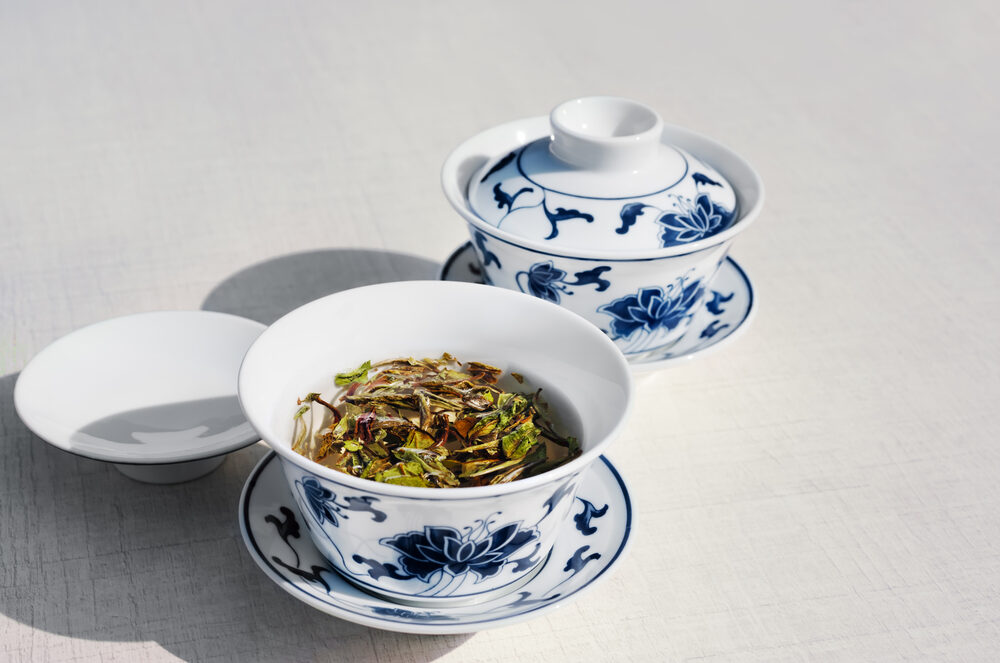
Known in Chinese as Bai Mudan (白牡丹), white peony tea is a gentle, downy white tea from the mountains of Fujian Province. When the leaves unfurl in hot water, a pale silver bud nestles among soft green leaves like a blossom opening, and you can see at once how it earned its name. Yet the deeper story behind that name reaches back some 2,000 years, to a devoted son, an ailing mother, and a grove of peonies that, as the tale goes, turned to tea overnight.
This article follows that story from legend into the cup. We will trace its origin, explore why this tea is named after a flower, examine what the leaf actually is, weigh the benefits attributed to it by tradition and modern research, and learn how to brew it at home.
The legend of white peony tea
According to a beloved Chinese tea legend, the story begins during the Western Han Dynasty, more than two millennia ago. An official named Mao Yi grew weary of corruption at the imperial court. Rather than bend to it, he gave up his position and retired to the quiet of the countryside, bringing his elderly mother with him.
One day, as the two traveled through the mountains, an unfamiliar fragrance drifted in the air, sweeter than anything they had known. They asked an elder where it came from and learned of 18 white peony plants growing beside a clear lotus pool. The place was so beautiful that it looked like a fairyland, and mother and son decided to stay.
In time, the long years caught up with Mao’s mother. She grew ill and weak, and however hard Mao searched, he could not find the medicine she needed. Then, one night, he dreamed of a celestial being with gray hair and a long mustache, who spoke to him gently: “The cure for your mother can only be carp and new tea, and it must be both of them together.”
Mao woke certain that the dream was guidance from heaven, and he set out at once. It was the depth of winter. He broke the ice on a frozen pond and, after patient effort, caught a single carp. But where, in that frozen season, would he find fresh tea? As he stood wondering, the 18 white peony plants transformed before him into flourishing tea trees.
Mao gathered the tender leaves and dried them in the sun, and as he watched, the downy leaves seemed to fold into the shape of white peony flowers. He poached the carp in the freshly brewed tea, brought the dish to his mother, and soon she was well again. In honor of the miracle, the tea was named white peony.
In the fuller telling passed down in Fujian, the story does not end there. After her recovery, Mao’s mother is said to have stepped out the door and risen into the sky, becoming an immortal who still watches over the tea plants. To remember Mao Yi and his devotion, the local people built the Bai Mudan Temple, and the famous tea grown in that region has been known as Bai Mudan, or white peony, ever since. Like the legend of the lingzhi mushroom of immortality, it is a story in which a healing plant, a dream, and a pure heart meet.
The meaning behind the name
To understand the tea, it helps to understand the flower it is named for. In China, the peony (牡丹, mǔdān) is no ordinary bloom. It is the “king of flowers” (花王, huāwáng) and the “flower of riches and honor,” a symbol of prosperity, beauty, and good fortune treasured for well over a thousand years.
The peony rose to prominence during the Tang Dynasty (618–907 CE), when it became a favorite of the imperial court and a frequent subject of poetry and painting. To this day it appears in art, embroidery, festivals, and weddings, where its full, generous petals stand for a flourishing life and an enduring love. You can read more about how blooms like this carry meaning within the symbolism of flowers in Chinese culture.
So when the legend describes downy tea leaves curling into the shape of white peony blossoms, the image is doing quiet cultural work. It links a humble mountain tea to one of the most beloved and auspicious flowers in the Chinese imagination. A cup of this tea, in other words, was never only a drink. It was a small emblem of beauty, abundance, and care.
What is white peony tea?
White peony tea, or Bai Mudan, is a variety of Chinese white tea made from one tender bud and the two or three young leaves that grow just beside it. The leaves are simply withered and dried, with no rolling and only minimal oxidation, preserving their natural shape and soft, silvery down. The result is a tea fuller-bodied than the all-bud Silver Needle, yet more delicate than the leafier Shou Mei.
This light touch in processing is the heart of white tea’s character. Because the leaf is handled so little, white peony keeps a clean, gentle flavor, often described as softly floral and sweet, with hints of fresh hay, melon, and orchid. The brewed liquor pours a pale gold rather than a deep amber.
Like all true white teas, white peony comes from the same plant as green, oolong, and black tea, Camellia sinensis. What sets the six tea families apart is not the bush but the craft: how the leaf is picked, withered, oxidized, and finished. White tea sits at the most minimal, least processed end of that spectrum.
A brief history: From Fujian’s mountains to the world
While the legend reaches back to the Han Dynasty, the tea we know as white peony is much younger. White tea, as a distinct style, developed in northern Fujian in the late 1700s, and Bai Mudan itself was first crafted around 1922 in Shuiji, Jianyang County. From there, the counties of Zhenghe and Fuding became its most famous homes, and they remain the heart of white peony production today.
Much of that fame rests on a remarkable tea bush. The Da Bai, or “Big White,” cultivar, native to Taimu Mountain in Fuding, produces the plump, downy buds that give fine white tea its silvery shimmer. Grown in the cool, misty hills of Fujian, these leaves became the foundation of both Silver Needle and white peony. You can find more background on the tea’s regional history in this overview of Baimudan tea.
The broader tradition to which the white peony belongs has earned global recognition. In 2022, UNESCO inscribed China’s traditional tea processing techniques and associated social practices on its Representative List of the Intangible Cultural Heritage of Humanity, recognizing the knowledge and customs behind the country’s six great tea families. White tea, with its quiet craft of withering and drying, is one living thread in that vast heritage.
White peony tea benefits
In Chinese tradition, white tea has long been valued as a cooling, calming drink, and an old Fuding saying captures the special regard for aged white tea: “One year tea, three years medicine, seven years treasure” (一年茶,三年药,七年宝). It suggests that white tea only deepens in worth as it rests and matures.
Modern research is still young, but studies of white tea suggest several gentle benefits. As with all traditional remedies, these are best understood as supportive qualities of a healthy drink, not as cures, and anyone with a medical concern should speak with a healthcare professional.
- Rich in antioxidants: Because white peony is so lightly processed, it retains high levels of catechins and polyphenols, plant compounds that help the body counter oxidative stress.
- Supports heart health: Some studies suggest that white tea may help maintain a healthy cholesterol balance, which in turn supports cardiovascular health.
- Good for the skin: The same antioxidants are thought to help protect skin cells from damage caused by sunlight and everyday environmental stress.
- Gentle on the body: Compounds in white tea have shown mild antibacterial properties in research settings, which is part of why it has traditionally been seen as a soothing, restorative drink.
- Calm, steady focus: White peony contains L-theanine, an amino acid known for its calming effect, alongside a moderate amount of caffeine, offering a relaxed alertness rather than a jolt.
In this, white peony keeps good company with another traditional Chinese tea prized for calm, part of a long lineage of traditional Chinese teas and remedies meant to nourish the body gently rather than overwhelm it.
How to brew white peony tea
White peony is forgiving, but its delicate leaves reward a soft touch. Water that is too hot will scorch the buds and turn the flavor bitter, so let the kettle settle before pouring.
For a simple Western-style cup:
- Heat fresh water to about 80°C to 85°C (175°F to 185°F), just below a rolling boil.
- Use roughly 3 to 4 grams of leaf, about two teaspoons, per cup.
- Steep for 2 to 3 minutes, then taste and adjust to your liking.
- Strain and enjoy, then resteep the same leaves two or three more times.
If you prefer the gongfu style, use more leaf, less water, and several very short infusions, watching the flavor open and evolve from cup to cup. Either way, good water matters. White tea is so subtle that poor water can easily mask its quiet sweetness. Brewed well, white peony gives a soft, lingering finish that invites a second pot.

Comparing Fujian white teas
White peony belongs to a small family of Fujian white teas, distinguished mainly by which part of the plant is picked. Understanding the three classic grades makes it easy to choose the cup that suits you.
| White Tea | Plucking | Appearance | Flavor | Caffeine |
|---|---|---|---|---|
| Silver Needle (白毫银针) | Buds only | Plump, silvery, downy | The most delicate and sweet | Moderate to higher |
| White Peony (白牡丹) | One bud, two to three leaves | Silver buds among green leaves | Soft, floral, fuller-bodied | Moderate |
| Shou Mei (寿眉) | Mature leaves, few buds | Larger, darker, autumnal | Mellow, deeper, earthy | Generally lower |
Silver Needle, made only from the youngest buds, is the most prized and refined. Shou Mei, made from more mature leaves, is the most everyday and robust. White peony sits gracefully between them, offering much of Silver Needle’s elegance with a little more body and depth, which is part of why it has become the most popular white tea of all.
Frequently asked questions
Does white peony tea have caffeine?
Yes, but a moderate amount. A cup of white peony typically contains somewhere between 15 and 50 milligrams of caffeine, depending on how much leaf you use and how long you steep it. A shorter steep yields a lighter, lower-caffeine cup. For more details, see Healthline’s overview of caffeine in white tea.
What does white peony tea taste like?
White peony has a soft, gentle flavor that is lightly floral and sweet, with notes often compared to fresh hay, melon, and orchid. It is fuller and rounder than Silver Needle but far more delicate than green or black tea, with a smooth, lingering finish.
Where does white peony tea come from?
White peony, or Bai Mudan, comes from Fujian Province in southeastern China. The counties of Fuding and Zhenghe are its most famous growing regions, where the downy Da Bai cultivar from Taimu Mountain produces the buds that make fine white tea.
Final thoughts
The origin of white peony tea is, at heart, a story about devotion. A son who walked away from a corrupt court, a mother restored by a dream, and a winter carp, a grove of flowers that became a grove of tea: the legend has lasted because it speaks to something we all recognize. Behind the cup is care, patience, and a little wonder.
This gentle tea carries all of that into the present. It is a white tea named for the king of flowers, lightly processed to preserve its natural sweetness, and traditionally valued as a calming, restorative drink. Modern research is only beginning to catch up with what generations of Fujian tea growers already sensed: that there is quiet goodness in a simple, well-made leaf. To explore this living heritage further, wander through more stories from Chinese culture and tradition.
The next time you brew a pot, let the leaves open slowly and watch the pale buds bloom among the green. Somewhere in that unfolding is a 2,000-year-old story, still warm, still steeping, still asking to be shared.
Follow us on X, Facebook, or Pinterest
