
I once heard and agreed with this saying: “Every person who is not related to you by blood, yet treats you well, is a gift from Heaven.” Only after going through a period of hardship in life do you come to understand just how precious those people around you are — those with whom you share no blood ties, yet who stand by you through thick and thin.
Generous mentors can recognize unpolished talent
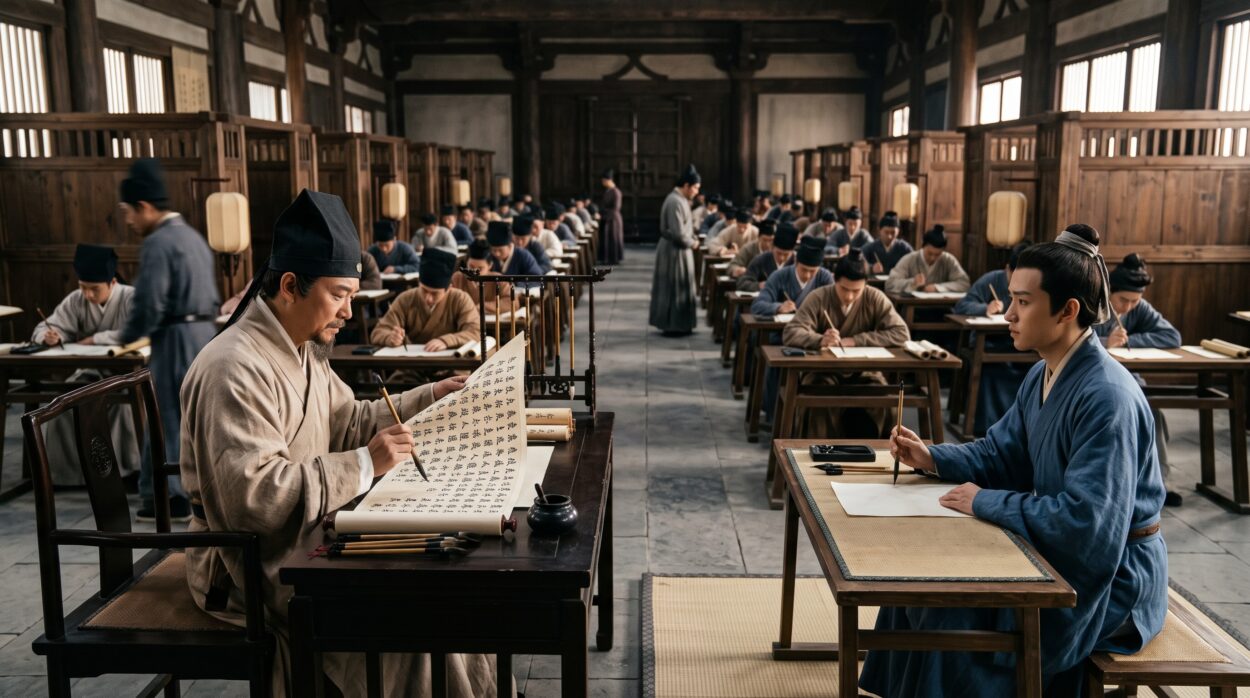
During the Northern Song Dynasty (960-1127), Su Shi, a young man, traveled to the capital to take the imperial examinations. His writing was sharp and incisive, yet few recognized his talent. Ouyang Xiu, who served as the chief examiner at the time, read his essay and was struck by its coherent style and extraordinary insight.
At that time, Ouyang Xiu was already a leading figure in literary circles, yet he repeatedly recommended Su Shi in the imperial court and even offered private guidance through letters: “Your writing should strive for simplicity and antiquity; avoid superficiality and ostentation.” With Ouyang Xiu’s help, Su Shi gradually gained the emperor’s favor.
Later, when Su Shi was imprisoned in the Wutai Poetry Case, although Ouyang Xiu had passed away many years earlier, the books Ouyang Xiu had given Su Shi during his lifetime became Su Shi’s most important source of spiritual support. In his later years, Su Shi often remarked to his disciples: “Without Lord Ouyang, I would have been nothing more than a madman from Sichuan.”
How fortunate must a person be to receive the patronage of an elder with whom they share no blood ties? Ouyang Xiu was undoubtedly both a benefactor and a guide in Su Shi’s life. This is not an isolated case. The story of Liu Zongyuan and Liu Yuxi is equally moving.
True companions willingly sacrifice their own comfort
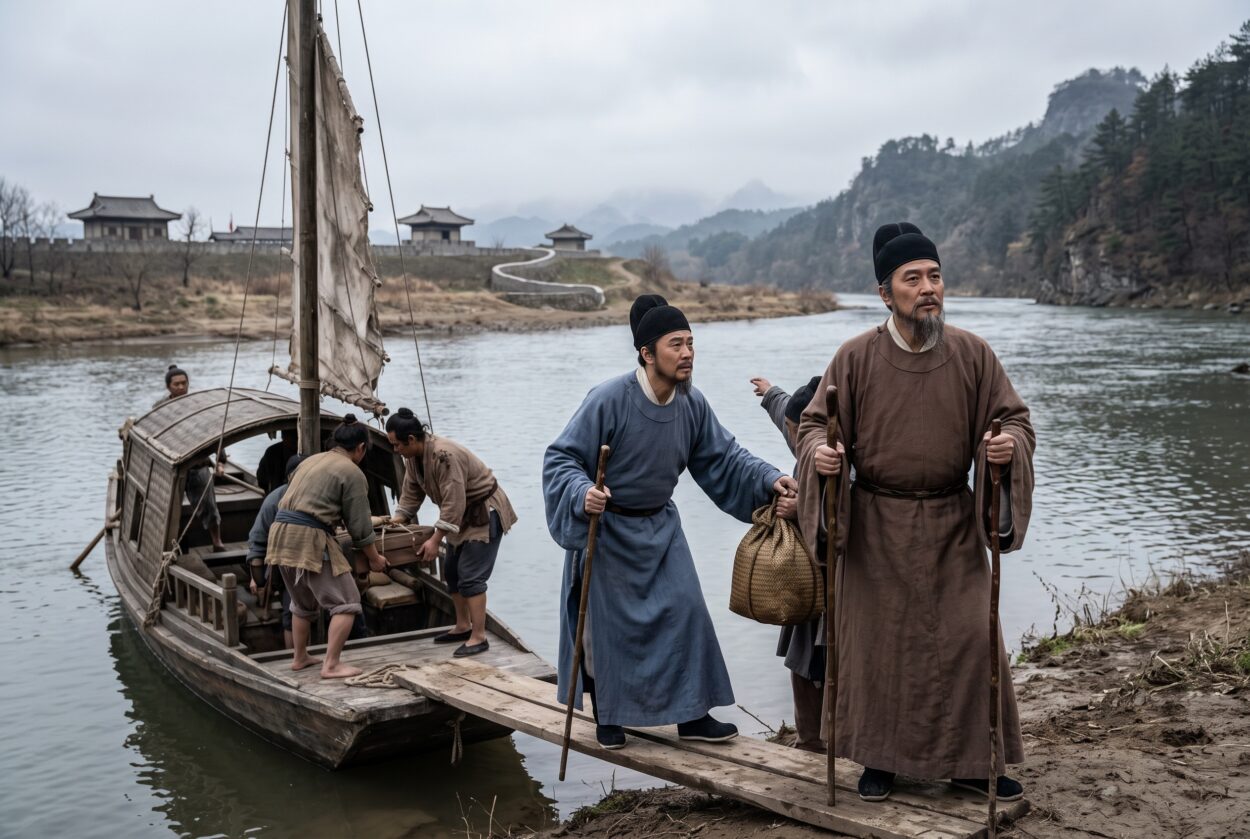
In 805, 10 reformist officials were severely punished and demoted by the imperial court following the failure of the “Yongzhen Reform,” which became known as the “Two Wang and Eight Sima” incident. After the incident, Liu Zongyuan was exiled to Yongzhou, while Liu Yuxi was demoted to Langzhou. Ten years later, the two finally returned north after a pardon, only to be demoted once more for offending powerful officials.
This time, Liu Zongyuan was exiled to Liuzhou, while Liu Yuxi was sent to Bozhou, where conditions were even harsher. However, Liu Yuxi’s mother was already over eighty years old and simply could not endure such a life of upheaval. Upon learning this, Liu Zongyuan immediately submitted a petition to the imperial court requesting to swap exile destinations with Liu Yuxi.
In his letter, Liu Zongyuan’s words were heartfelt and sincere, every character written through tears. The emperor was moved and consequently changed Liu Yuxi’s sentence to Lianzhou. Liu Yuxi’s mother thus had her life spared, but not long after, Liu Zongyuan passed away, overcome by poverty and illness.
On his deathbed, Liu Zongyuan entrusted all his manuscripts and his children to Liu Yuxi. Liu Yuxi resolutely shouldered this heavy responsibility, compiling Liu Zongyuan’s writings into volumes and raising his two children to adulthood.
Bitter adversity and harsh public mockery can be transformed
An ancient saying goes: “A sword’s edge is forged through grinding; the fragrance of plum blossoms comes from bitter cold.” When we are young, we often believe that the hardships we face in life are simply trials imposed by fate. Yet as time passes, it is not until middle age that we realize: enduring those hardships is actually the fastest path to growth. Those past experiences that pierced your heart with pain will ultimately leave their mark on you in a different way.
Zheng Banqiao (1636-1912), a painter and calligrapher of the Qing Dynasty, grew up in poverty and faced repeated setbacks on the path to passing the imperial examinations. At the age of 30, he traveled to Beijing to take the exams. Though he had already begun to make a name for himself through his talent and scholarship, his lack of understanding of the social niceties of the bureaucratic world led his fellow examinees to ostracize and frame him. He was falsely accused of moral misconduct and failed the exams.
Upon returning home, he faced constant ridicule from his neighbors; some even pointed their fingers at him and hurled insults directly in his face. Former friends and relatives gradually distanced themselves from Zheng Banqiao, believing he was out of touch with reality and unlikely to amount to much.
During that time, Zheng Banqiao could only make a living by selling his paintings. However, his unique style clashed with the meticulous brushwork that was popular at the time, and his works often went unsold. A wealthy merchant once tried to buy his sketches at a low price. When Zheng refused, he was mocked: “Paintings of such a crude, unrefined style are only fit for pasting on walls.” Yet Zheng Banqiao did not let this bring him down.
Instead, these insults became the fuel for his artistic growth. Zheng Banqiao began to shut himself away from visitors and devoted himself entirely to perfecting his art; the resentment and frustration in his heart were fully channeled into the bamboo, rocks, orchids, and grasses he painted.
At the age of 40, he took the imperial examinations once more and finally passed, earning the title of jinshi (scholar). He later served as the magistrate of Wei County. During his tenure, Zheng Banqiao governed with integrity and diligence, ensuring that the people lived in peace and prosperity.
His calligraphy and painting also matured day by day, and the “Banqiao Style” became unrivaled in the country. The verse, “Though subjected to a thousand hardships and ten thousand blows, it remains firm and resilient; let the winds blow from the east, west, north, or south,” is still widely celebrated today.
By this time, Zheng Banqiao had long since ceased to dwell on the humiliation of those years. Yet the very wounds inflicted by those who once sought to trample him into the dust ultimately became the ladder that lifted him to the pinnacle of his art.
Inner peace is achieved by directing one’s focus inward
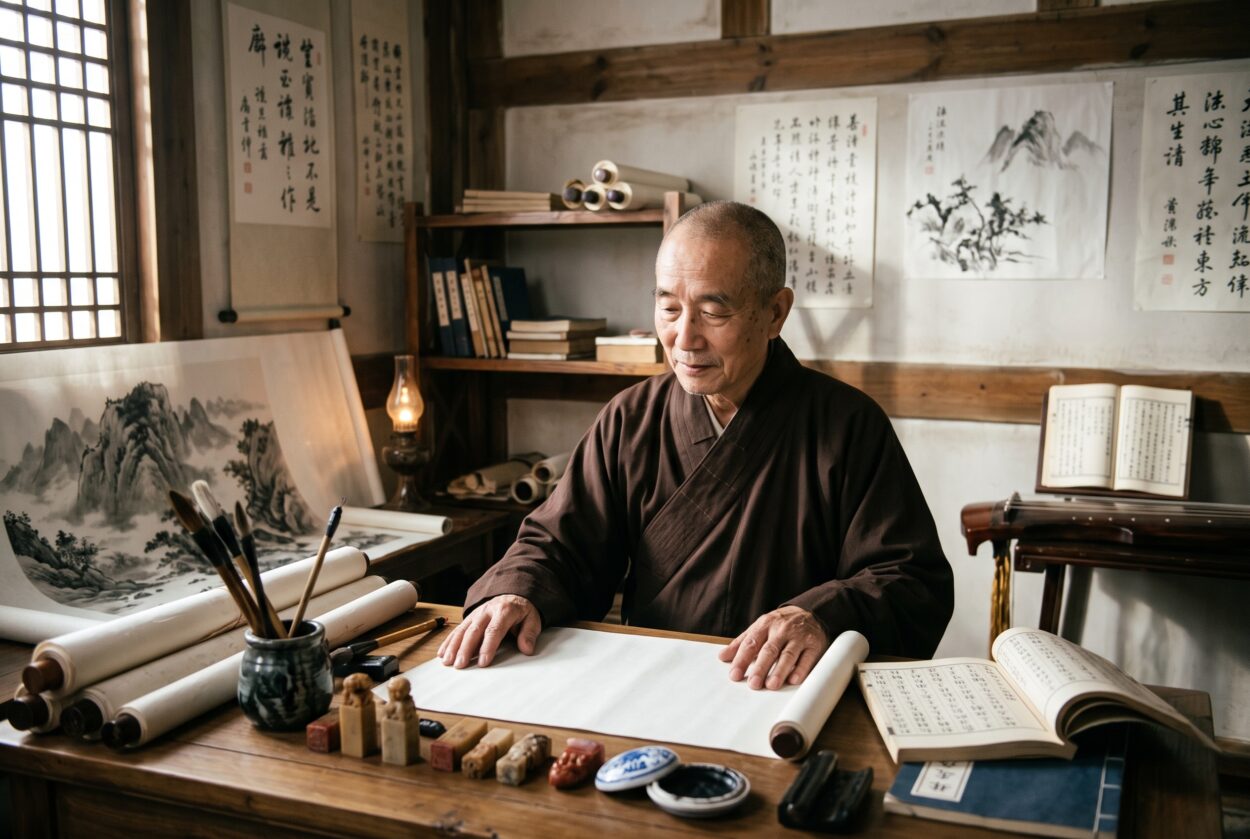
Once one reaches middle age, it is essential to understand: external matters are beyond one’s control, but spiritual cultivation depends on oneself. Venerable Hongyi (1880-1942) was born into a distinguished family and achieved success at a young age; after returning from his studies abroad, he became an artist renowned both at home and abroad, excelling in poetry, calligraphy, painting, seal carving, music, and theater.
However, just as everyone was captivated by his famous composition “Farewell,” he suddenly renounced worldly life, took monastic vows at Hupao Temple in Hangzhou, and began leading an austere life of a single meal of porridge a day, a single mat, and a single lamp. His wife, whom he had brought back from Japan, pleaded with him in tears to return to secular life, but he did not waver in the slightest. This decision caused a huge uproar at the time, with doubts and criticism flooding in like a tidal wave.
Some said he was “shirking responsibility and letting his family down”; others accused him of “pretending to be noble and deceiving the world for fame”; and some former friends even wrote articles mocking him: “Once a dashing man of letters, now a withered old monk — he’s merely using Buddhism as a stage for a show.” Some busybodies even went to the temple and, from behind the curtain, hurled scathing sarcasm and harsh words at him.
A young novice monk at the temple, witnessing this, could not help but speak up in his defense: “Master, these people simply do not understand your good intentions. Why should you put up with this?” Master Hongyi, however, simply continued to calmly wipe the sutras on his desk and said softly, “How to quell slander? By not arguing. How to put an end to resentment? By not contending.”
He continued to lead a life as plain as water: rising at four o’clock every morning to recite sutras, and still copying scriptures by the light of an oil lamp late into the night, his minuscule regular script as neat as if carved, every stroke a manifestation of a calm mind. When some saw that his monk’s robe was patched over and over again, they brought him a newly made silk kasaya, but he politely declined.
Throughout his life, he strictly observed the precepts, yet treated others with the gentleness of water; even when those who had once slandered him came to seek an audience, he still welcomed them with a smile and patiently offered guidance.
Master Hongyi proved throughout his life that external praise and criticism, gains and losses, honor and disgrace are ultimately fleeting, like passing clouds; what truly provides a stable foundation for life is inner resolve and spiritual cultivation. You cannot stop others from gossiping, but you can choose whether to be swept away by rumors.
Spiritual practice in middle age is simply about learning, amidst all the turmoil, to turn your gaze inward rather than chasing after external things, and to transform your expectations of others into demands upon yourself. True strength lies not in conquering the world, but in mastering oneself; the best spiritual cultivation is to practice not living to meet others’ expectations, but living with inner peace and strengthening the integrity of one’s own heart.
Translated by Audrey Wang and reviewed by Maria
Follow us on X, Facebook, or Pinterest
