
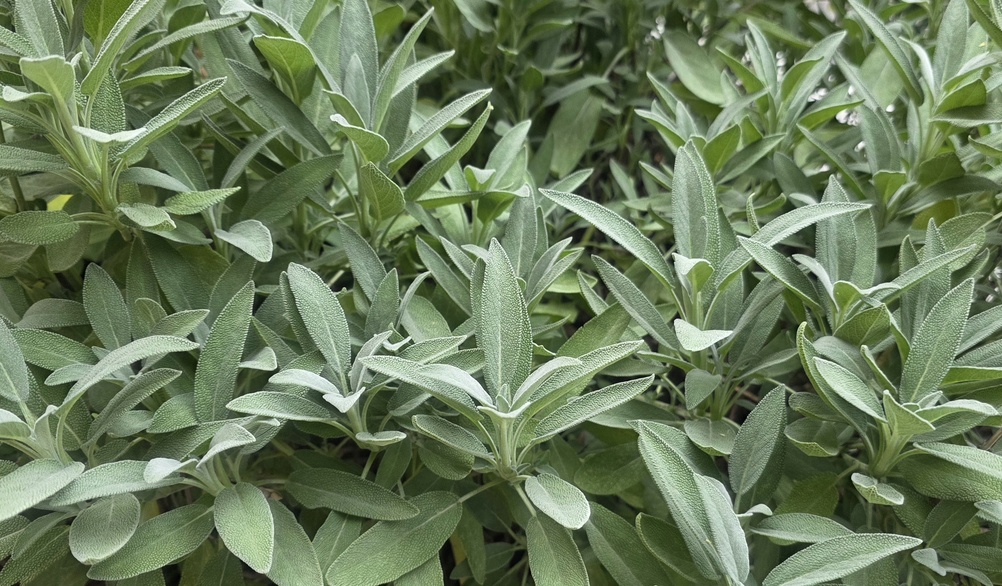
Cur moriatur homo cui salvia crescit in horto? Why should a man die who has sage growing in his garden? The line belongs to a medieval Latin health poem, the Regimen Sanitatis Salernitanum, associated with the physicians of Salerno in southern Italy. They meant it seriously. A gray-green shrub by the kitchen door, they believed, could hold death at the gate. And in the very next line of the poem, in the same breath, they took it back: against the power of death, no such herb grows in any garden.
That tension has followed sage for eight centuries. It is the herb of wisdom, the holy herb, the plant that saves. It is also just a plant, and the monks who loved it knew as much. Here is what makes the story worth telling again. The name is an accident. Sage the herb and sage the wise elder come from two entirely unrelated Latin roots, and the resemblance in English is a coincidence of sound. Yet when researchers finally put Salvia officinalis into a randomized trial, they found something in it that acts, quietly and measurably, on human memory. The coincidence turned out to be right anyway. And on the other side of the world, China had a sage of its own, and asked it for something completely different.
Why sage is called the herb of wisdom
Sage is called the herb of wisdom largely by a linguistic accident. The plant’s name derives from Latin salvia, from salvus, meaning “healthy” or “safe.” The word sage meaning a wise person descends from a separate root, Latin sapere, to taste or to discern. The two words are unrelated. English simply landed them in the same spelling. It goes one step further. Sagacity, the word most often produced as proof of the connection, comes entirely from a third Latin root, sagax, meaning keen of perception. Etymonline notes plainly that sagacious is not etymologically related to either sense of sage. Three roots. One collision. No hidden thread of meaning running through them.
So why did the folk etymology stick so hard that herbalists still repeat it? Because people were not reasoning from Latin. They were reasoning from experience. Sage was the plant they reached for when memory faltered, when the mind felt dull, when an old man’s hands shook. They noticed something, named it wisdom, and built a false etymology on top of a real observation. The false part is the Latin. The real part is what the plant does.
The holy herb of Rome and the monastery garden
Long before Salerno, sage was already sacred. Roman writers treated salvia as a plant apart, and accounts of Roman practice describe a harvest that reads more like a rite than a chore.
A harvest ritual: Clean hands, clean clothes, and a bronze knife
To gather sage properly, a Roman came with washed hands and clean clothing. Iron was forbidden. The cut was made with a bronze blade, because iron was thought to sour the plant and offend it. Whether this was botany, superstition, or the ordinary human instinct to slow down around something valuable, it tells you what sage meant to them. You did not simply go outside and grab a handful. The Greeks and Romans reached for it constantly: for digestion, for wounds, for fevers, for a mind that would not hold what it was given. The Romans called it the holy herb. That reputation carried into the Christian centuries, and sage became a fixture of the monastic garden, planted alongside rue and rosemary in the physic beds that supplied a monastery’s infirmary.
Salerno, and the proverb that would not die
Salerno is where the reputation hardened into verse. The Schola Medica Salernitana, founded around the ninth century, is often described as Europe’s first true medical school. The health poem attached to its name then traveled the continent in hundreds of manuscript copies. The stanza on sage runs roughly like this: Why should a man die who has sage growing in his garden? Sage strengthens the nerves, stills the trembling of the hands, and drives off sharp fevers. Then the counter-line lands: against the force of death, no such medicine grows in gardens. The exact Latin of that second line varies between manuscripts, which is its own small lesson about how medieval texts survive. What strikes a modern reader is the honesty. The physicians of Salerno wrote the hope and the disappointment into the same stanza. They were not selling immortality. They were saying, “This plant is remarkable, and it will not save you.” The Metropolitan Museum of Art’s Cloisters garden keeps an essay on that very proverb, planted among the herbs it describes.

The sage-for-tea trade: What actually happened
There is a story circulating about sage and China, and almost every version of it is garbled. Including, until now, the version published here. The usual telling: the Chinese so prized sage that they traded away four pounds of their finest tea for every pound of it, in an exchange with Britain. Three details in that sentence are wrong. It was not Britain. The traders were Dutch, sailing for the Dutch East India Company. The rate was not four to one. And it does not come from a ledger.
The source is a book by the English physician Thomas Short, A Dissertation on Tea, published in London in 1730. Short reports that on an early voyage to China, the Dutch offered sage, an herb then unfamiliar there, and that the Chinese would give three pounds of tea for every pound of it. That is the whole basis for the claim: a secondhand anecdote, written down roughly a century after the events it describes, by a man who had never been to China.
It may well have happened. Sage was genuinely valuable in Europe, and the history of how tea traveled out of China is full of stranger transactions. But it should be told as what it is, a story recorded by Thomas Short, not as a fact about Chinese taste. And there is a quiet irony buried in it. The Dutch sailed east carrying what they believed was a rare and precious herb, convinced they were bringing China something it lacked. China already had a sage. It had been growing there for two thousand years.
China’s own sage: Danshen, the herb of the heart
The Mediterranean sage of the monastery garden, Salvia officinalis, is known in Chinese as 鼠尾草 (shǔwěicǎo), literally rat-tail grass, a plainly descriptive name for a plant that carried no cultural weight there. It never entered the Chinese pharmacopeia in any serious way. It did not need to. The genus Salvia is enormous, numbering near a thousand species, and one of them is native to the hills of China.
Danshen in the Shennong Bencao Jing
That plant is 丹参 (dānshēn), Salvia miltiorrhiza, called red sage or red sage root in English. The character 丹 means cinnabar, a deep vermilion red, and describes the color of the root when it is cut. The character 参 is the same one used for tonic roots such as ginseng. Danshen appears in the Shennong Bencao Jing, the foundational Chinese materia medica traditionally dated to the Han Dynasty, where it is placed among the superior-grade herbs, the class considered safe for long use. It has been prescribed more or less continuously ever since. Centuries later, the great Ming physician Li Shizhen cataloged it again in his Bencao Gangmu, the compendium that remains one of the towering works of Chinese medicine. Like the lingzhi mushroom, danshen belongs to that small group of Chinese herbs whose reputation is measured in millennia rather than decades.
What traditional Chinese medicine asks of it
Here the two sages part company completely. In traditional Chinese medicine (TCM), danshen is classified as bitter in taste and slightly cold in nature. It enters the Heart and Liver meridians. Its central action is to invigorate the blood and dispel blood stasis, which, in the TCM framework, means restoring movement where circulation has become sluggish or obstructed. It is also used to cool the blood and calm a restless spirit in patients who cannot settle or sleep. Europe’s sage was asked to sharpen the mind. China’s sage was asked to move the blood and quiet the heart. Neither tradition was reaching for the other’s plant. They were reaching for different organs, and the genus obliged them both. You can read more on traditional Chinese herbal wisdom and how it understands the body’s inner geography.
Two Sages, Two Civilizations
| Garden sage | Danshen, red sage | |
|---|---|---|
| Species | Salvia officinalis | Salvia miltiorrhiza |
| Chinese name | 鼠尾草 shuweicao, rat-tail grass | 丹参 danshen, cinnabar root |
| Native to | The Mediterranean | China and Japan |
| Part used | The leaf | The root |
| Tradition | Greek, Roman, medieval European | Traditional Chinese medicine |
| Classical text | Regimen Sanitatis Salernitanum | Shennong Bencao Jing |
| Traditionally used for | Memory, throat, digestion, long life | Invigorating blood, dispelling stasis, calming the spirit |
| The organ it serves | The head | The heart |
| Key compounds | Rosmarinic acid, carnosic acid, thujone | Tanshinones, salvianolic acids |
What modern pharmacology found
More than 200 compounds have been isolated from danshen root, falling into two broad families: the tanshinones, including tanshinone IIA, and the phenolic acids, including salvianolic acid A and B. Most modern research on the plant has concentrated on the cardiovascular system, which is to say that laboratories spent decades investigating exactly the territory Chinese physicians assigned it two thousand years ago. One practical warning belongs here. Danshen is traditionally used to move the blood, and it appears to interact with warfarin and with antiplatelet medication. Anyone taking a blood thinner should speak to a clinician before going near it. This is not a herb to experiment with casually.
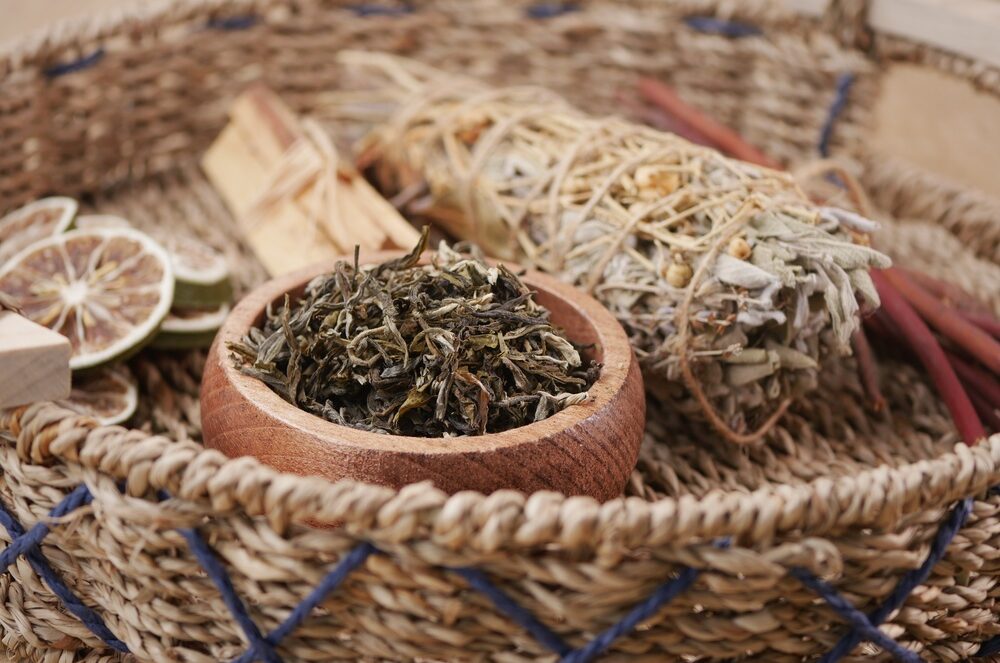
What science actually found about sage and memory
Now back to the garden sage, and to the accident in its name.
The messenger and the eraser
Think of acetylcholine as a messenger the brain uses for attention and memory. Think of an enzyme called acetylcholinesterase as the eraser that clears the messenger away once the message has landed. Both are necessary. Erase too fast, and the message never quite arrives. Several drugs prescribed for Alzheimer’s disease, donepezil among them, work by slowing that eraser down. Beginning in the 1990s, researchers at the Medicinal Plant Research Center at Newcastle and Northumbria universities set out to find plants that folk memory linked to the mind. Then they tested whether any of them did the same thing. Sage did. Extracts of Salvia inhibit acetylcholinesterase. The plant that medieval Europe called the herb of wisdom, on the strength of a mistaken etymology, turns out to act on the precise enzyme that modern medicine targets when memory fails. Nobody planned that. It is one of the more satisfying coincidences in the history of herbal medicine.
What the trials showed, and what they did not
The human evidence is real, but it is narrower than the headlines suggest. In healthy young adults, sage oil capsules improved performance on word-recall tests. In healthy older volunteers, a Salvia extract with anticholinesterase properties improved memory and attention. In one study of a monoterpenoid sage extract, gains in secondary memory and attention peaked about an hour after the dose. Reduced mental fatigue and sharper alertness arrived later, around the four-hour mark. And in a 4-month placebo-controlled trial, older adults with mild-to-moderate cognitive impairment took a sage extract daily. They scored better on standard cognitive assessments than those on placebo, with no meaningful difference in side effects.
Here is the honest boundary. A systematic review of these trials concludes that sage appears to confer a genuine acute benefit on cognitive performance in healthy people and those with impairment, and that it is well tolerated. The evidence does not establish that sage slows the long-term progression of cognitive decline. A better score on a Tuesday afternoon is not the same thing as a different disease trajectory, and no responsible reading of the literature confuses the two. Sage is not a treatment for dementia. It is a plant with a measurable, short-lived effect on attention and recall, which is remarkable enough without inflating it. Readers interested in what holds up over the long run may find our simple practices for mental sharpness a more useful place to start.
How to drink sage and who should not
Sage tea is the oldest and gentlest way to meet the plant.
Making sage tea
- Use about 5 or 6 dried sage leaves, or 1 teaspoon of loose dried sage, per cup.
- Bring water to a boil, then let it settle for a moment off the heat.
- Pour the water over the leaves and cover the cup. Covering matters, since the aromatic oils will otherwise leave with the steam.
- Steep for three to five minutes. Longer draws out more bitterness.
- Strain, and add a slice of lemon or a little honey if you like.
- Drink it warm, unhurried. This herb is long associated with slowness.
Fresh leaves work too, roughly double the quantity. The flavor is resinous, faintly camphorous, closer to a forest than to a fruit.

Thujone, and the sensible ceiling
Common sage contains thujone. In animal studies, large doses of it harm the nervous system. However, no evidence shows harm to humans at culinary or ordinary tea-drinking levels. Risk assessments suggest that roughly three to six cups of sage tea a day stay comfortably below the thresholds of concern.
A few plain rules:
- Never swallow sage essential oil: It is enormously concentrated, and this is where the real thujone risk lives.
- Do not drink sage tea in pregnancy or while breastfeeding: Sage has estrogen-like activity.
- Avoid concentrated sage if you have a seizure disorder: If you are taking medication that a clinician has told you interacts with herbal preparations.
- Spanish sage (Salvia lavandulaefolia): The species used in much of the memory research contains no thujone.
As with any traditional remedy, the National Center for Complementary and Integrative Health is a level-headed place to check before you begin. And no herb substitutes for a conversation with your doctor about a serious condition.
A note on white sage
One clarification, because the confusion causes real harm. The plant sold in bundles for burning is not the sage in this article. It is white sage, Salvia apiana, a different species native to a narrow band of Southern California and northern Baja California, and nowhere else on earth. White sage is sacred to Indigenous nations of that region, including the Cahuilla, Chumash, Kumeyaay, and Tongva, who have used it as food, medicine, and in ceremony for thousands of years. Smudging is a specific ceremonial practice belonging to those communities. It is not a wellness accessory, and this article is not in a position to instruct anyone to do it.
The commercial boom has been ruinous. Most white sage on the market is poached from public or private land rather than farmed. The California Native Plant Society runs a white sage protection campaign. It reports seizing thousands of pounds of poached goods from individual poaching operations and estimates that nearly half of all wild white sage populations are already gone. Many Indigenous practitioners hold that white sage should never be bought or sold at all. Yet depletion has reached the point where Native communities must now purchase a plant they once simply gathered. Garden sage is not white sage. If you are curious about the practice itself, we have written about the science and history behind smudging. If you want to burn something, grow your own garden sage. Leave the hillsides alone.
How the herb of wisdom earned its name twice
Sage came by its reputation dishonestly, and then earned it. The monks of Salerno planted it against death and lost that argument, as they knew they would. The Romans cut it with bronze knives. Herbalists for eight hundred years insisted the name meant wisdom, and the Latin never supported them. And yet the plant they chose, out of all the plants in the garden, turned out to slow the enzyme that erases memory. They were wrong about the word and right about the leaf.
Meanwhile, along Chinese hillsides, a red-rooted cousin was being dug, dried, and simmered for something else entirely, and the physicians who prescribed it were not thinking about memory at all. They were thinking about blood, and circulation, and a heart that would not rest. Two civilizations reached for the same genus and asked it two different questions. Both, it seems, got an answer. That is the quiet argument of the herb of wisdom: that traditional knowledge is not a museum piece, and not a superstition to be humored. It is a very long record of careful attention, and sometimes it knows things before it can explain them.
There is sage in the supermarket, and probably some in your cupboard, dusty in a jar from a roast you made last winter. It won’t make you immortal. The physicians of Salerno told you as much, in Latin, in the second line. But it is worth a cup, slowly, on an afternoon when you have somewhere to think.
Follow us on X, Facebook, or Pinterest
