
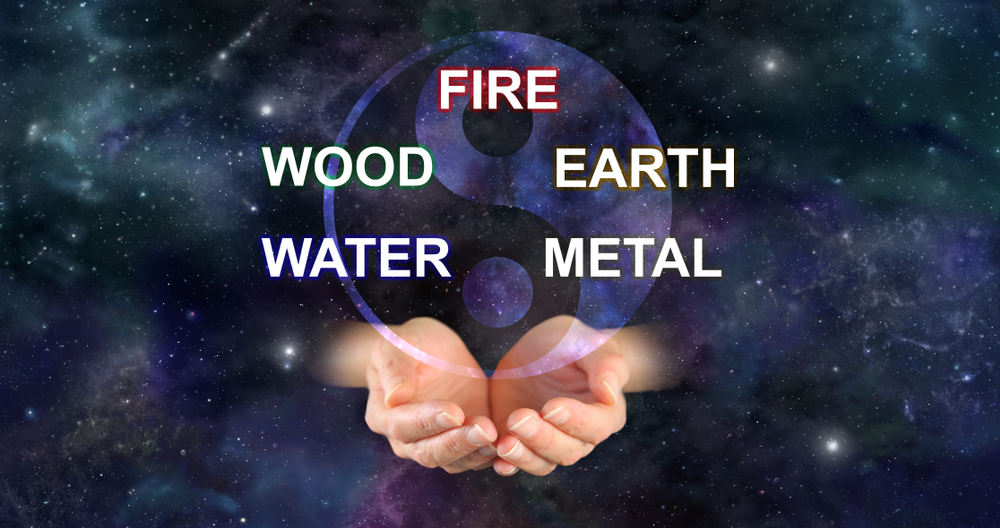
A physician of traditional Chinese medicine (TCM) will often look at you for a long moment before asking a single question. She studies the whites of your eyes. She asks you to put out your tongue. She notices the timbre of your voice, whether your complexion carries a greenish cast or a sallow one, and whether you flinch at the cold. To a Western eye, this looks like guesswork. It is not. She is reading a map: the theory of the five elements in Chinese medicine, drawn roughly 2,200 years ago.
In Chinese medicine, the five elements are not substances that make up the body the way carbon and calcium do. They are five kinds of motion, five phases that everything in the natural world moves through, including you. Your liver is not made of wood. Your liver behaves the way wood behaves: it pushes upward and outward, it wants to grow, and when it is thwarted, it becomes rigid, and it snaps. What follows is the complete map: where it came from, how its parts connect, and what the classical texts say about your senses and your organs. It also covers one aspect of the system that almost every modern account omits. We will be honest, near the end, about what this framework cannot do.
What are the five elements in traditional Chinese medicine?
In Chinese medicine, the five elements are Wood, Fire, Earth, Metal, and Water. Known as wu xing (五行), they describe five phases of natural change rather than physical substances. Each governs an organ system, a season, an emotion, a color, a taste, and a sense organ, interacting through cycles of generation and restraint.
At a glance:
| Element | Organ | Season | Emotion | Taste |
|---|---|---|---|---|
| Wood | Liver | Spring | Anger | Sour |
| Fire | Heart | Summer | Joy | Bitter |
| Earth | Spleen | Late summer | Worry | Sweet |
| Metal | Lung | Autumn | Grief | Pungent |
| Water | Kidney | Winter | Fear | Salty |
The translation “five elements” is a well-worn convenience. A more faithful rendering of xing (行) would be “phases,” “movements,” or even “goings.” The Greek elements were building blocks. The Chinese five are verbs. This distinction matters more than it sounds. For example, if you think of Water as a substance, the claim that the kidneys “are” Water is mystical nonsense. In contrast, think of Water as a phase: something that sinks, stores, stills, and waits through winter for spring. The claim then becomes a plain description of what the kidney system does in the classical model. It stores essence, it governs the deepest reserves, and it is the organ of the year’s dark quarter. Most accounts stop there. The classical system goes considerably further, and the full table is worth seeing.
| Element | Chinese | Yin organ | Yang organ | Sense organ | Season | Emotion | Colour | Taste | Note (五音) | Virtue |
|---|---|---|---|---|---|---|---|---|---|---|
| Wood | 木 mù | Liver | Gallbladder | Eyes | Spring | Anger | Green | Sour | jué 角 | Benevolence |
| Fire | 火 huǒ | Heart | Small intestine | Tongue | Summer | Joy | Red | Bitter | zhǐ 徵 | Propriety |
| Earth | 土 tǔ | Spleen | Stomach | Mouth | Late summer | Worry | Yellow | Sweet | gōng 宫 | Sincerity |
| Metal | 金 jīn | Lung | Large intestine | Nose | Autumn | Grief | White | Pungent | shāng 商 | Righteousness |
| Water | 水 shuǐ | Kidney | Bladder | Ears | Winter | Fear | Black | Salty | yǔ 羽 | Wisdom |
The framework reaches its mature form in the Huangdi Neijing, the Yellow Emperor’s Inner Canon, compiled over 2,200 years ago during the Warring States period (475 to 221 BCE). UNESCO inscribed the text on its Memory of the World Register in 2011. It calls the Neijing “the earliest and most important written work of Traditional Chinese Medicine.” The edition on the register was printed from woodblocks in 1339, and it remains the earliest well-preserved version we have.
The five windows: How your senses open into your organs
Return to the physician studying your eyes. She is not being poetic. She is using one of the oldest diagnostic ideas in the tradition, and the clearest place to watch how the five elements and the human body connect. The classical texts describe five apertures, five openings through which each organ system meets the outside world. The tradition sometimes calls them windows. The spleen opens at the mouth. The lungs open at the nose. The liver opens at the eyes. The heart opens at the tongue. The kidneys open at the ears.
Why a Chinese physician looks at your tongue
Each window works in two directions, and this is the part that gets lost in translation. Outward, the window is how the organ reaches the world. The lung takes in air through the nose. The spleen, which in TCM governs the transformation of food, receives it at the mouth. Inward, the window is how the organ reports on itself. Therefore, a physician reads the tongue for the state of the heart. Blurred or dry eyes point her toward the liver. A persistent ringing in the ears leads her to look at kidney essence rather than at the ear itself. The organ cannot be seen. The window can.
The ethical turn hidden in windows
There is a further claim in the classical material, and it is a strange and beautiful one. Because the five windows share a single system, whatever enters through one reaches all five organs. Hear music of real refinement and the benefit is not confined to the ears. See something genuinely elegant and the liver is not the only beneficiary. The senses were understood as a shared inheritance, which means that what you choose to look at, listen to, and taste is not a private matter of preference. It is a matter of what you are feeding five organ systems at once. Hold on to that idea. We will come back to it, because it is the thread that leads to the part of wu xing that modern wellness writing has almost entirely forgotten.
How the five elements move: Four cycles, not two
Nearly every popular account of the five elements in Chinese medicine describes two cycles. The classical system has four. The two that get omitted are the two that explain how people actually get sick.
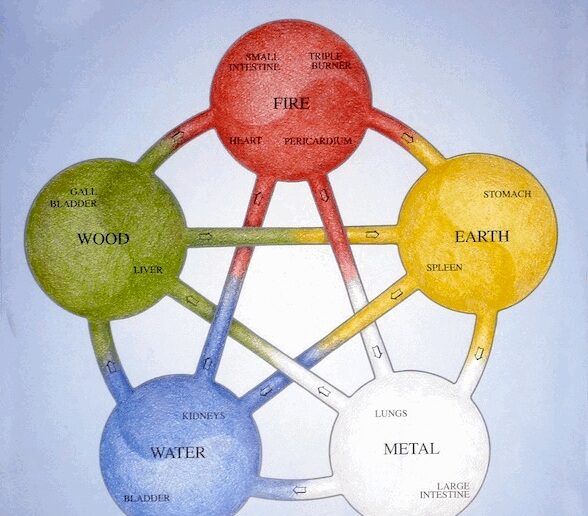
Generating: The sheng cycle
The generating cycle, sheng (相生), describes how each phase feeds the next, the way a parent feeds a child. Wood feeds Fire, because wood burns. Fire creates Earth, because ash returns to soil. Earth bears Metal, because ore forms in the ground. Metal carries Water, because a cold blade gathers dew. Water nourishes Wood, because nothing green grows without rain. Round and round, without end. In the clinic, this means the kidneys (Water) support the liver (Wood), and a liver that will not settle may be a kidney that has run dry. That support is not an abstraction. The classical model routes it along the meridian system Chinese medicine describes, the unseen channels through which qi is said to travel between the organs.
Controlling: The ke cycle
The controlling cycle, ke (相克), is the system’s brake. Each phase restrains the phase two steps ahead of it, so that nothing runs away with itself. Wood parts Earth, the way a root splits a paving stone. Earth dams Water. Water quenches Fire. Fire melts Metal. Metal cuts Wood. Generation without restraint would be a fire that never stops burning. Restraint without generation would be a world that never grew. In this model, health is not the absence of conflict between the elements. It is the presence of the right amount. Anyone who has followed the interplay of yin and yang will recognize the logic.
Over-acting: The cheng cycle
Now the two that get left out. Cheng (相乘) is overacting, and the controlling cycle has gone too far. The brake does not merely slow the wheel; it seizes it. Wood is supposed to part Earth. When Wood is excessive, it does not part Earth; it strips it. Clinically, this is the most familiar pattern in the whole system. A liver inflamed by long-held frustration (Wood) overacts on the spleen and stomach (Earth). The result is a churning gut, an appetite that vanishes, a meal that sits like a stone. Anyone who has lost their appetite during a bitter argument has felt cheng from the inside.
Insulting: The wu cycle
Wu (相侮) is the rebellion. Here, the phase that is supposed to be controlled turns and controls its controller. The arrow runs backward. Metal ordinarily cuts Wood. However, if Wood grows dense and hard enough, the blade turns on itself. A lung system already weakened (Metal) cannot restrain a liver in full flood (Wood), and the liver overwhelms the lung instead. Two cycles describe a system at rest. Four describe a system under stress, which is the only condition in which anyone ever visits a physician. It is the same combinatorial instinct that produced the eight trigrams of Bagua: a small set of forces, and a rigorous account of every way they can meet. The generating cycle runs around the circle. The controlling cycle cuts across it as a star.
The five elements and the five emotions
The five elements in Chinese medicine make no separation between what you feel and what your body does. No border exists because, in this model, there never was a border. The connection between your emotions and your organs is not offered as a metaphor. It is offered as physiology. Each organ houses an emotion. The liver holds anger. The heart holds joy. The spleen holds worry and overthinking. The lungs hold grief. The kidneys hold fear. The classical claim runs in both directions, and both halves are worth stating plainly. An organ in distress produces its emotion. A liver under strain generates irritability that has no object, the anger that arrives before anything has happened to be angry about.
In contrast, an excess of emotion injures its organ. Not felt, but dwelt in. Grief that is passed through belongs to the lungs and does them no harm. Grief that is refused, held, made into a residence, is the grief the tradition says will thin the breath and hollow the chest. It is not hard to find people who will tell you they have watched exactly that happen to someone they loved. Note that joy appears on this list. Not as a hazard to be avoided, but because the tradition understood that even joy, when it becomes mania, scatters the heart. The system does not moralize about which feelings are good. It observes that any of them, held too long and too hard, will wear a groove.
Wood is benevolence, metal is righteousness
Here is what almost no modern account will tell you: wu xing was a moral theory before it was ever a medical one. Britannica notes that the five phases began as a moral theory associated with Zisi, the grandson of Confucius, and with Mencius. Only in the third century BCE did a figure named Zou Yan, a sage-alchemist, build the systematic cosmology around them. That cosmology later came to dominate the intellectual world of the Han Dynasty (206 BCE to 220 CE). Then, the neo-Confucian philosophers of the Song Dynasty (960 to 1279 CE) revived wu xing and returned it to its origins, treating the five phases as the Five Virtues: benevolence, righteousness, reverence, wisdom, and sincerity.
The traditional pairing runs like this. Benevolence (仁, rén) is Wood, the virtue that grows toward others. Righteousness (义, yì) is Metal, the virtue with an edge, the one that cuts and divides rightly. Propriety (礼, lǐ) is Fire, which illuminates and warms a room of people. Wisdom (智, zhì) is Water, which sinks, stills, and knows the depth. Sincerity (信, xìn) is Earth, the ground everything else must stand on.
Now consider what that means alongside everything above. The same five phases that describe your liver and your lungs also describe your capacity for kindness and your capacity for justice. The organ and the virtue are not analogies for one another. In this framework, they are two readings of a single structure. The body and the moral life were understood to follow a single grammar. This is why the five windows mattered so much to the classical writers. If refined music genuinely nourishes five organs at once, then the cultivation of the senses and the cultivation of character are the same project, undertaken from different ends.
A note on metal and gold
English translations of this material, including one that Nspirement itself published in 2017, frequently render the Metal phase as “gold.” The confusion is honest. The character 金 (jīn) means both “metal” and “gold,” and a translator working quickly will often reach for the more concrete word. However, in wu xing, the phase is Metal, and the difference is not trivial. Gold is a treasure. Metal is a blade. The virtue paired with this phase is righteousness, the faculty that separates what is owed from what is not. Call it gold, and you have a system about wealth. Call it Metal, and you have a system about judgment. We are correcting our own record here, and it seemed better to explain the error than to quietly delete it.

The five types of people
You may have already encountered the modern version of this idea. “Which element are you?” quizzes are everywhere, and they tend to be flattering. Water is wise and adaptable, Fire is passionate and fun, Wood is a natural leader. Everyone comes out sounding like someone you would want at a dinner party. The classical version is older, stranger, and far less kind. The Lingshu, the companion volume to the Huangdi Neijing, devotes an entire chapter to it: “The Twenty-Five Types of People” (阴阳二十五人, yīn yáng èr shí wǔ rén). The scheme begins with five constitutional forms, one for each phase, and then subdivides each form into five by the musical notes we met earlier, which is how five becomes twenty-five. Here we need only the five main forms.
The Wood person, the text says, has a greenish complexion, a small head, a long face, broad shoulders, and a straight back. In terms of temperament, a peer-reviewed 2023 study in Biomedical and Environmental Sciences describes the classical profile as “talented, worried, debilitated, concerned, and hard-working.” Wood thrives in spring and summer and suffers in autumn and winter, the seasons of its controlling phase. The Fire person is “energetic, regards money lightly, credulous, overthinking, insightful, and impatient.” The Earth person is “peaceful, ready to help others, dislikes power, and dependent on others.” The Metal person, pale, small-headed, with narrow shoulders and short limbs, is “uncorrupted, eager, quiet, fierce, and good at execution.” And the Water person, in the plainest words the Lingshu offers, is “disrespectful and good at deceiving.”
No dinner-party flattery there. This is what makes the classical typology worth reading, where the quizzes are not. It was never built to make you feel understood. It was a clinician’s tool, and a clinician needs to see the whole person, including the parts a personality quiz is designed to soothe. The point was never to sort you into a tribe. It was to notice which phase runs strongest in you, because that is the phase most likely to tip first, in the body and in the character alike.
Where an ancient framework meets modern science
It would be easy to end on the poetry. Readers deserve better than that, so let us be careful. The five-element framework is not a scientific theory, and it was never intended as one. It is a system of correspondences, and systems of correspondences are extraordinarily good at organizing experience and notoriously poor at generating falsifiable predictions. A model that can accommodate any outcome has told you nothing about which outcome to expect.
Some researchers have found the structure suggestive. For example, a 2017 paper explored whether five-element logic could be mapped onto cellular-level processes. Others look to the body’s fascia, the connective web beneath the skin, for a physical correlate of the channels the tradition maps, an idea weighed in the modern anatomy of qi. Work of this kind is interesting and preliminary, and it should not be mistaken for validation of the clinical system.
Nevertheless, what deserves more attention is the framework’s insistence that emotional life and physical health are one subject. Western medicine spent much of the twentieth century treating that as sentiment and much of the twenty-first century rediscovering it. On this specific point, the old map pointed to a real place, which is a narrower claim than saying the map was right and a more interesting one. It is the sort of divergence we explored in looking at how East and West came to picture illness differently.
So, the honest boundary. The five elements are a way of thinking about health, not a diagnostic tool you can operate on yourself, and not a reason to postpone care. The US National Center for Complementary and Integrative Health provides a clear overview of what is and isn’t established about TCM. If something in your body has changed and you do not know why, see a doctor. The map is 2,200 years old. It can wait an afternoon.
Living with the five elements: Small daily practices
None of this requires you to believe anything. It asks only that you notice more carefully. Here is where the five elements in Chinese medicine become practical, and none of it costs money.
- Eat with the season, and with the flavor: Each phase claims a taste: sour for Wood, bitter for Fire, sweet for Earth, pungent for Metal, salty for Water. The traditional counsel is not to chase a single flavor but to keep all five in circulation throughout the week, leaning toward the season’s own. Our guide to healing foods for each of the five elements sets out the pairings in the kitchen.
- Guard the winter: Water governs winter and the kidneys, which store what the tradition calls essence (精, jing), the body’s capital rather than its income. Winter is the time to sleep longer, move more gently, and spend less of your kidney qi. Most of us do the opposite, and then wonder why spring finds us depleted.
- Read your own irritability as information: When frustration arrives without a cause, the framework suggests looking at the liver rather than the day. Whether or not you accept the physiology, the habit of treating a mood as a signal instead of a verdict is worth acquiring.
- Notice what you feed the windows: Five minutes of music chosen with care, rather than whatever autoplays. This is the oldest advice in the article and the easiest to act on tonight.
- Watch for over-acting: If your appetite disappears whenever you are angry, you have observed cheng in your own body. That is not a diagnosis. It is a relationship between two things you had been treating as unrelated, and noticing it is the whole of the practice.
Consistency matters more here than intensity. In a tradition that treats longevity as the slow protection of vitality rather than its pursuit, patience is the whole of the advice, as it is across traditional Chinese health practices generally.
Frequently asked questions about the five elements in Chinese medicine
What are the five elements in Chinese medicine?
The five elements, or wu xing, are Wood, Fire, Earth, Metal, and Water. They represent five phases of natural change rather than physical substances. Each governs an organ system, a season, an emotion, a color, a taste, and a sense organ, and they interact through cycles of generation and restraint.
Which organ goes with each element?
Wood governs the liver and gallbladder. Fire governs the heart and small intestine. Earth governs the spleen and stomach. Metal governs the lungs and large intestine. Water governs the kidneys and bladder. Each pairs a yin organ, which stores, with a yang organ, which transforms.
What is the difference between the sheng and ke cycles?
Sheng is the generating cycle, in which each element nourishes the next: Wood feeds Fire, Fire creates Earth, and so on around. Ke is the controlling cycle, in which each element restrains another: Wood parts Earth, Earth dams Water, Water quenches Fire. Generation grows the system; control keeps it from running away.
What does Chinese medicine say about kidney qi?
In TCM, the kidneys store jing, or essence, and govern kidney qi, the deep reserve that shapes growth, fertility, and how a person ages. Water is the kidneys’ phase, and winter is their season. Fatigue, tinnitus, and lower-back weakness are traditionally read as signs of depleted kidney qi, though each has ordinary medical causes worth ruling out first.
How do I know which of the five elements I am?
Classical Chinese medicine types people by constitution, not by quiz. The Lingshu describes five forms, one per phase, read from complexion, build, temperament, and the seasons in which a person thrives or struggles. Most people show one or two dominant phases rather than a single pure type. A TCM physician assesses this in person, so treat online results as curiosity, not diagnosis.
Are the five elements supported by science?
Not in the sense that a pharmacological claim is supported. It is a framework of correspondences, valuable for organizing observation and unable to produce falsifiable predictions. Its emphasis on the link between emotional and physical health has aged better than most of its specifics. It is not a substitute for medical care.
What the map is for
The five elements in Chinese medicine are not a personality quiz, whatever the Internet has made of them, and they are not a relic. They are a claim, made carefully over two millennia, that the things we insist on separating belong together: the organ and the emotion, the season and the appetite, the body and the character. Four cycles, not two, because a living system spends most of its life under stress. Five windows, because the senses are how the world gets in. Five virtues, because the people who built this map could not conceive of a healthy body housed in an unhealthy life.
What the framework asks of you is small. Notice which of the five phases is loud in you this week. Notice what your irritability, or your grief, or your sleeplessness might be reporting from somewhere further in. Then make one correction, and make it again tomorrow. Balance in this system was never a destination. It is a daily adjustment, made by people who understood that nothing in nature holds still. The kidneys wait through winter for a spring they cannot see. That waiting is not idleness. It is the work.
For more on the wisdom that shaped these ideas, explore our writing on Chinese culture and traditions.
Follow us on X, Facebook, or Pinterest
