
NVIDIA Denmark launches Gefion, marking a pivotal moment in the evolution of artificial intelligence and supercomputing. In July 2025, the world witnessed the debut of Gefion, a state-of-the-art AI supercomputer named after the Norse goddess renowned for transforming landscapes.
This naming is more than symbolic; it reflects Gefion’s mission to reshape the technological terrain, both regionally and globally. Far from being just another technological milestone, Gefion represents a tectonic shift in how we approach computation, creativity, and competition in the digital era.
Backed by a coalition of Danish institutions and NVIDIA’s global AI leadership, Gefion is not merely about raw computational power. It is about redefining what is possible in research, industry, and society at large. As we explore the significance of this launch, it becomes clear that Gefion is poised to influence every facet of our interconnected world.
What is Gefion, and what makes it so advanced?
At the heart of this transformation lies Gefion itself — a next-generation AI supercomputer housed in Denmark and built on NVIDIA’s latest GPU architecture. It combines thousands of NVIDIA H100 Tensor Core GPUs, each optimized for generative AI, scientific modeling, quantum simulations, and real-time analytics. This immense computational force is designed to handle the massive-scale training of foundational models and multimodal systems, ranging from climate simulations to large language models (LLMs) capable of understanding and generating code, video, and even emotion.
Gefion’s key specifications include:
Tens of ExaFLOPs of AI computing power: Enabling unprecedented speed and scale for AI research and applications.
Liquid cooling infrastructure: Ensuring sustainability and energy efficiency, aligning with Denmark’s green ethos.
Integration with NVIDIA AI Enterprise and Omniverse platforms: Facilitating seamless development and deployment of AI solutions.
Gefion is not simply a product; it is a platform for innovation. Its capabilities have the potential to transform entire sectors, from pharmaceuticals and healthcare to defense and creative industries. As we delve deeper into its impact, we see how Gefion’s technological prowess is matched by its broader vision.
Why Denmark became a launchpad for NVIDIA’s AI vision
Gefion’s home in Denmark is no coincidence. While some may find it surprising that a Scandinavian nation would become a global hub for AI leadership, Denmark’s unique blend of attributes makes it an ideal launchpad for NVIDIA’s AI vision. The country boasts a green energy grid, forward-thinking universities, and a stable geopolitical stance — factors that are crucial for building responsible and sustainable AI infrastructure.
Support for sovereign AI development: Allowing countries and enterprises to securely build and train their own models.
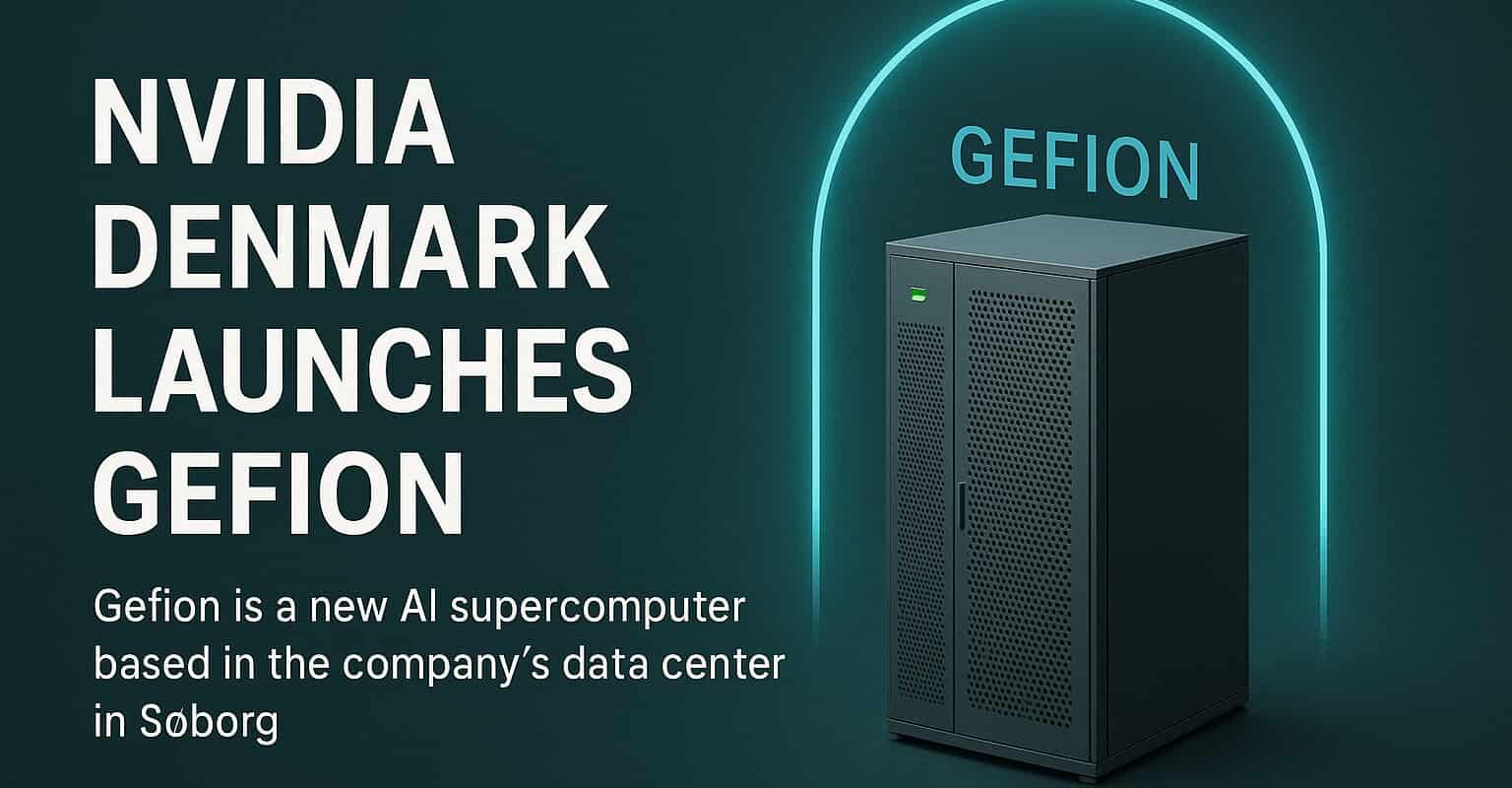
NVIDIA’s strategic partnerships with Danish research institutions, such as the Technical University of Denmark (DTU) and the eScience Center, ensure that Gefion serves a dual mission: advancing academic research while fostering commercial development. Denmark’s commitment to ethical AI governance and renewable energy further aligns with NVIDIA’s future-oriented goals.
This synergy between sustainability, security, and scientific excellence positions Denmark as a beacon for responsible AI development. As we consider Gefion’s place in NVIDIA’s broader strategy, Denmark’s role becomes even more significant.
How Gefion fits into NVIDIA’s long-term strategy
Gefion is not just a Scandinavian asset; it is a vital node in NVIDIA’s global latticework of AI infrastructure. This supercomputer fits seamlessly into a larger roadmap that includes innovations such as the Grace Hopper Superchips for AI and high-performance computing (HPC) convergence, the NVIDIA DGX Cloud for enterprise-grade AI training, and strategic partnerships with nations seeking AI sovereignty.
NVIDIA’s overarching goal is not to monopolize intelligence, but to modularize and democratize it. Gefion adds a powerful new node to the distributed, high-trust computing mesh that enables AI models to be developed locally while remaining competitive on a global scale. This approach empowers regions to maintain control over their data and models, fostering both innovation and independence.
As we transition from strategy to impact, it becomes clear that Gefion is both a strategic chess move and a lighthouse project — securing NVIDIA’s leadership in AI infrastructure while promoting AI independence for regions worldwide.
What changes with Gefion’s arrival — and what gets left behind
The arrival of Gefion heralds a new era of accelerated innovation. Model training that once took months can now be accomplished in days, unlocking an unprecedented pace of iteration and experimentation.
This acceleration brings about several key shifts:
Research acceleration: Universities and laboratories can simulate complex phenomena — such as weather patterns, genomic sequences, and economic systems — in near-real time.
Model localization: Countries can now train large language models in their own languages and legal frameworks, enhancing cultural relevance and compliance.
Enterprise deployment: Startups and corporations can develop competitive AI products without relying on U.S.-based computational resources.
However, this rapid progress also means that older tools and methods will quickly become obsolete. Just as digital photography rendered film largely redundant, many current bottlenecks in modeling, rendering, and data processing are about to disappear — along with the jobs and workflows built around them.
Gefion does not merely speed up existing processes; it fundamentally transforms the landscape, rendering yesterday’s systems archaic. This transformation, while exciting, also brings challenges for those whose skills and roles are tied to legacy technologies.
The human cost: Disruption for creative and technical professionals
With great technological power comes significant disruption. Gefion’s capabilities will inevitably upend several career paths, particularly for creative and technical professionals.
For example:
3D modelers and VFX artists: Those who rely on manual rendering pipelines may find their skills less in demand as automated, AI-driven solutions become the norm.
Language translators: Real-time, multimodal language models threaten to displace traditional translation roles.
Data labelers and junior data scientists: Many of these positions are at risk of automation as AI systems become more adept at handling data preparation and analysis.
This is the classic trade-off of AI advancement: brute-force computational capability can flatten artisanal skill. Many individuals who once monetized niche technical work will see declining demand as Gefion enables faster, cheaper, and more accurate outputs.
While Gefion empowers society as a whole, it also displaces certain roles. The transition will not be painless for those whose work becomes easily replicable by machines. Yet, as we move forward, it is important to recognize that disruption often paves the way for new opportunities.
New opportunities Gefion unlocks on a global scale
Every technological disruption carries within it the seeds of new possibilities. Gefion, with its immense computational power, opens doors to opportunities that were previously unimaginable:
AI research entrepreneurship: Solo researchers and small teams can now train competitive models with institutional-level resources, democratizing access to cutting-edge AI.
Digital sovereignty: Governments and NGOs can build culturally aware models that reflect local norms, languages, and values, fostering greater inclusivity and representation.
AI-for-science applications: Fields such as drug discovery, clean energy simulations, and climate forecasting stand to benefit immensely from accelerated computing.
Entirely new industries will emerge around AI orchestration, ethics, and localization. Gefion also enables deeper collaboration between disciplines — physics-informed AI, computational creativity, and synthetic biology are just a few areas poised for rapid advancement.
The bigger the computer, the bigger the ideas it can support. Gefion is not killing opportunity; it is reallocating it, inviting innovators to imagine and build the next generation of solutions.
Conclusion: A future built with — not just by — AI
NVIDIA Denmark launches Gefion not just as a regional announcement, but as a signal flare for the future of distributed, powerful, and ethical AI. Built in Denmark but designed for the world, Gefion exemplifies what is possible when technological might is guided by conscience and collaboration.
Conclusion:
Gefion represents a strategic leap in infrastructure, enabling both local and global AI advancement.
It will displace legacy workflows and certain creative or technical roles, necessitating adaptation.
At the same time, it will unlock massive innovation in science, language, government, and startup ecosystems.
The road ahead requires flexibility and a willingness to learn new skills, but the horizon is wide open. Those who embrace the opportunity to build with Gefion, rather than resist its arrival, will help shape the next digital renaissance — one grounded in the universal principles of truthfulness, compassion, and forbearance.
Follow us on X, Facebook, or Pinterest
