

Throughout history, people have believed that those who hold firm to righteousness are watched over by higher powers. The malicious, by contrast, eventually meet with misfortune. The old saying “Three feet above your head, the gods are watching” speaks to a universal truth: Divine beings are never far from those who do good.
This suggests that human society still has a moral foundation. Were it entirely corrupt — stripped of values like benevolence, righteousness, propriety, wisdom, and trust — heavenly beings would surely abandon it. Left unchecked, such a world would bring about its own destruction.
Xu Shan’s courage amid injustice
A compelling example comes from the Records of the Gods (《稽神錄》), which recounts the story of a young man named Xu Shan, a scholar who served during the Five Dynasties period in southern China under the state of Wu. Orphaned at a young age, Xu Shan was raised in Yuzhang County with his younger sister.
After Yang Xingmi, the ruler of Wu, conquered the region, a military officer abducted Xu Shan’s younger sister. Hoping to make her his wife, the officer sent betrothal gifts and tried to negotiate the marriage through Xu Shan. But Xu, coming from a well-established scholarly family, saw the match as improper and refused.
When the officer tried again, Xu Shan didn’t just decline — he threw the gifts away. Infuriated, the officer drew a knife and held it to Xu’s throat. Yet even then, Xu Shan showed no fear. Ultimately, the officer took his sister away by force.

A dream opens the path to justice
Xu Shan refused to give up. He traveled to the capital to seek an audience with Yang Wo, Yang Xingmi’s son and successor. At the time, Yang Wo had recently taken power and governed with strict discipline. He remained largely inaccessible to ordinary citizens, making Xu Shan’s appeal all the more difficult.
But fate — or something greater — intervened.
On the very day Xu Shan arrived in Baisha, Yang Wo had a vivid dream. In it, a figure said: “There is a talented scholar named Xu Shan staying at an inn in Baisha. He wishes to speak with you on an important matter. Treat him well.”
Awakening, Yang Wo took the dream seriously and sent for Xu Shan immediately.
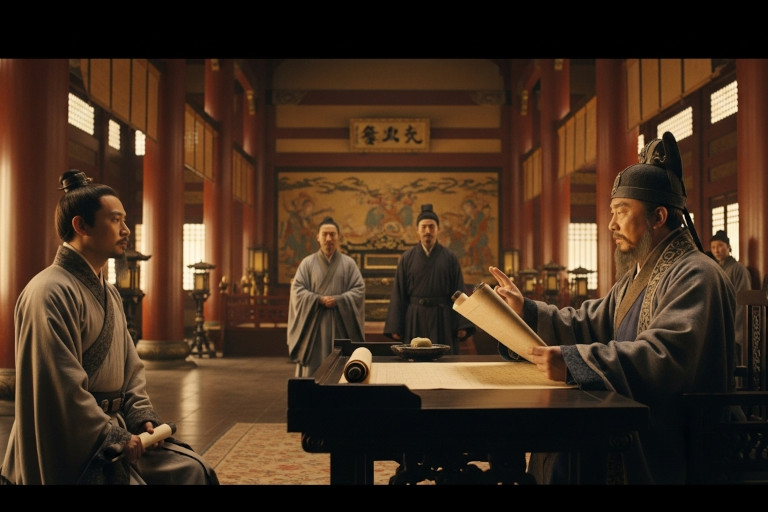
When they met, Xu told him everything — the abduction, the threats, and his family’s suffering. Yang Wo was outraged. He ordered the officer to return Xu Shan’s sister and restore her to the family. The governor of Shezhou, Tao Ya, was so impressed by Xu Shan’s bravery and moral integrity that he appointed him as an assistant secretary.
The unseen hand of the divine
This tale reflects a deep cultural belief — that divine forces shape our world, often invisibly. Even dreams, in both Eastern and Western traditions, are seen as tools through which higher powers intervene.
In Greek mythology, Morpheus was the god of dreams, capable of appearing in human form to deliver messages through sleep. Although ancient Chinese texts don’t name a specific deity of dreams, they do suggest that dreams are not random but directed by the divine.
For those who believe, faith brings inner calm. They feel protected, no matter how severe the situation. But those who reject the idea of a higher power often live in fear when real crises strike. Only those with moral integrity and belief in the divine find true peace — because they know that, even when no one else sees, the heavens do.
Translated by Joseph Wu
Follow us on X, Facebook, or Pinterest
