
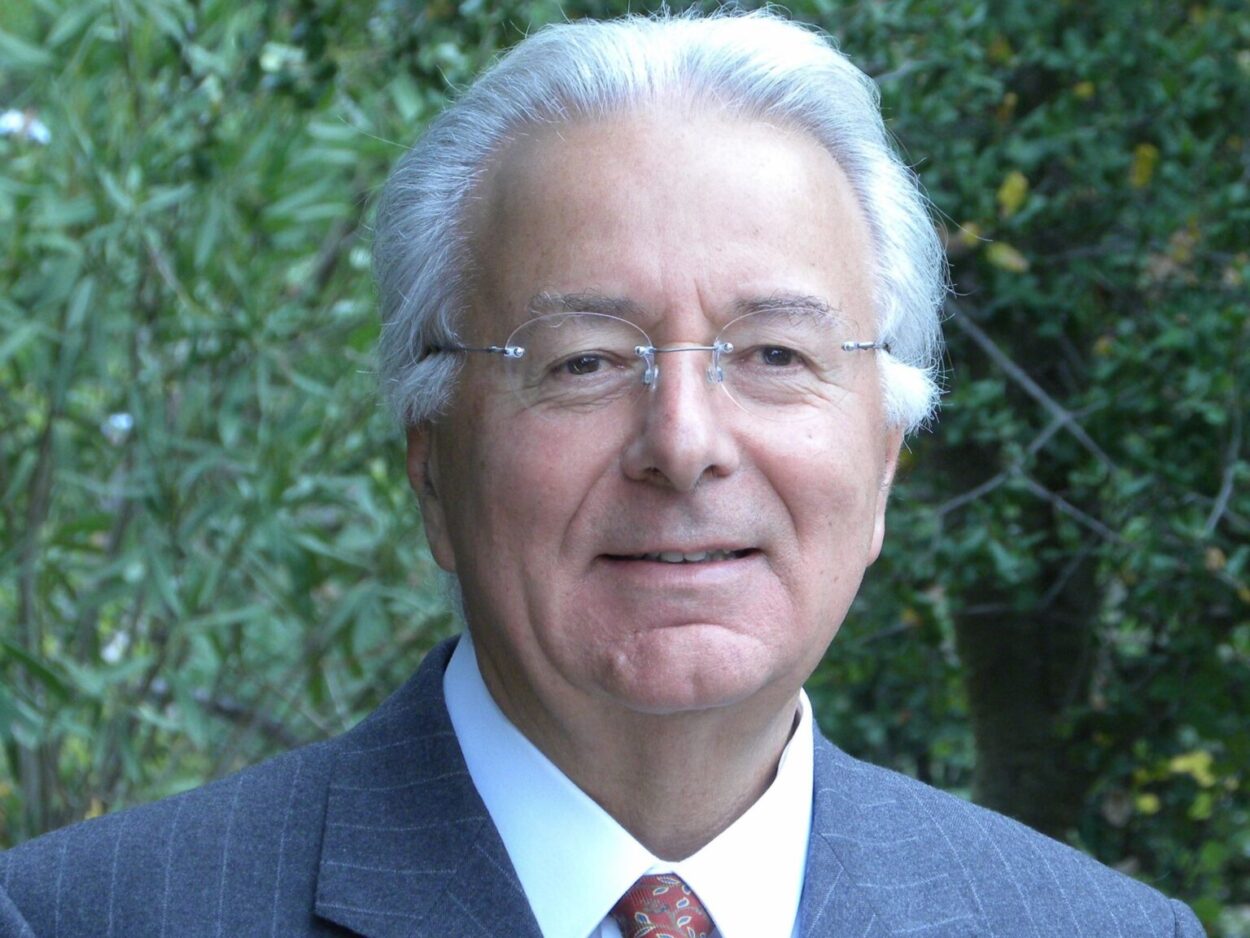
Federico Faggin, the pioneering inventor of the microprocessor, once confided: “What you’re about to hear might completely rewire how you see yourself.” His reflection does more than provoke awe — it signals a radical re‑visioning of identity, consciousness, and the architecture of reality itself.
Nearly 30 years ago, Faggin embarked on a journey of illumination. He discovered that “nobody can understand why quantum computers work because their actual operation cannot occur in spacetime.” From that insight, he postulates a profound idea: Our classical world — the one our senses construct — is but a surface layer of an unfathomably more profound quantum realm, one where fields, feelings, meaning, and information reside.
A hologram, not a machine
In his poetic metaphor, Faggin invites us to see our bodies not as mechanisms, but as holographic mirrors: “Each of your 50 trillion cells contains the entire blueprint of who you are — not mechanical — that’s holographic.” It is a field‑centric model: “We, as human beings, are fields which are part-whole of one… same pattern repeated at different scales.” It implies each cell is not an isolated unit, but instead woven into a conscious, self‑aware quantum field.
This perspective resonates with the holonomic brain theory, which posits that memory and cognition are processed holographically within quantum-like fields in the brain, rather than localized bits in neurons.

Quantum information vs. classical bits
In classical physics and computing, information is tidy, separable, and manipulable — the zeroes and ones of digital logic. But as Faggin emphasizes, quantum information defies those confines. It cannot be copied, cloned, or fully observed — properties rooted in the no‑cloning and no‑teleportation theorems of quantum information science. In his words: “The moment you try to measure a quantum bit, you collapse it; the original state is lost.”
These are not metaphors, but established physical theorems: A qubit’s infinite potential collapses into a single classical outcome with measurement — a one‑way street from the quantum to the classical world. That makes quantum information inherently private, like subjective experience.
Daniel Georgiev’s quantum‑information‑theoretic approach to the mind‑brain problem underscores this distinction: The unobservable quantum information of the “mind” contrasts with the classical bits accessible in the brain, reinforcing the privacy of conscious experience.
Consciousness: Byproduct or bedrock?
If classical science treats consciousness as an emergent byproduct of neuronal computation, Faggin’s model reverses that hierarchy. He proposes consciousness is foundational, not derivative. It is the quantum field, the agent of collapse, the shaper of reality — not an epiphenomenon.
This dovetails with the “quantum mind” hypotheses that argue classical laws alone cannot suffice to explain consciousness — quantum phenomena like entanglement or superposition may play key roles. One version, the Orch OR theory by Penrose and Hameroff, proposes that consciousness arises from orchestrated quantum processes in microtubules inside neurons.
Recently, a provocative study from Shanghai University suggests that quantum entanglement — mediated by infrared photons within the myelin sheath — may underpin neural synchronization essential to cognition. Though speculative, this research injects new potential support into the idea of a quantum network underpinning awareness.
Life and death: A field’s view
Faggin’s most stirring metaphor likens the body to a drone: Consciousness pilots the drone, experiencing the world through it. When the drone — our body — dies, what happens? Faggin suggests consciousness remains, detached from its physical vehicle: “When the body dies… the ego… looks around… ‘Oh, I’m… Wow.’ … consciousness doesn’t disappear, it simply loses its local connection.”
This echoes near‑death experience reports: clinical death accompanied by vivid perception, awareness outside the body, the sense of detached but coherent experience despite brain inactivity — phenomena that challenge the notion that consciousness is purely brain‑bound. Dr. Stuart Hameroff has observed a “gamma synchrony” spike in dying patients — brain activity associated with conscious perception — even as clinical signs flatline. He interprets this as possibly the soul — or some form of quantum consciousness — leaving the body.

Meaning, not data
In contrast to the empty data of zeros and ones, Faggin insists: “Meaning is within us… not in the information.” Subjective experience, qualia, meaning — they are not reducible to classical information. This aligns with panpsychism, the philosophical view that consciousness — or proto‑experiential qualities — is fundamental and ubiquitous in the universe. Peter Verheyen’s notion of the universe as a cosmic quantum computer further emphasizes that our conscious reality may be a mask, an interpretive layer over deep information from a hidden physical realm.
A new cosmology of self
All told, we are invited into a radically holistic cosmology: not machines, but fields of awareness; not passive observers, but participants in the collapse of reality itself. It posits consciousness not just as a filter, but as the generator of meaning, identity, and truth. In that reframing, the future belongs not to the fastest algorithm, but to those who awaken to deeper awareness. The self, properly seen, is not a fragment but an expression of a unified field gazing at itself. It is not a question of upgrading our machines — it is a question of remembering that we are not machines.
Follow us on X, Facebook, or Pinterest
