

In Chinese Buddhist tradition, some figures become legends — monks whose lives blur the line between history and spiritual story. Master Xuyun (1840-1959) is among the most famous of these figures in modern Chinese history. His life spanned the late Qing Dynasty, the turbulent Republican era, and the early years of Communist rule.
Stories about Xuyun include accounts of spiritual insight, unusual experiences, and acts of compassion during times of crisis. One of the most well-known tells how a Buddhist ceremony he led in Xi’an coincided with the sudden end of a devastating plague.
To understand how this monk came to stand beside an empress fleeing her capital, we begin during one of the most dramatic moments in late Qing history.
Flight from the Forbidden City
Before dawn on August 15, 1900, a small caravan of horse-drawn carriages hurried out of Beijing and raced westward through the dim morning light.
At the front rode eunuchs on mules clearing the road. Behind them rattled four simple carriages. In two of them sat Empress Dowager Cixi and the Guangxu Emperor of the Qing Dynasty.
The modest convoy bore little resemblance to the imperial pageantry that normally accompanied the empress. But the ceremony was impossible that morning. Just the day before, the Eight-Nation Alliance — an international military coalition responding to the Boxer Rebellion — had breached Beijing’s defenses and entered the capital.
At sixty-nine years old, Cixi fled the Forbidden City under the official pretext of a “Western Hunt,” a term meant to preserve imperial dignity. In reality, the court was escaping the advancing armies.
Among the nobles, ministers, and guards traveling with the imperial party was an unusual figure: a Buddhist monk named Deqing. Prince Qing Yikuang, a senior Qing court official, had specifically invited him to accompany the empress.
Deqing was not a fighter and carried no weapons. Instead, he was respected as a highly accomplished monk believed to possess deep spiritual attainment.
The journey to Xi’an
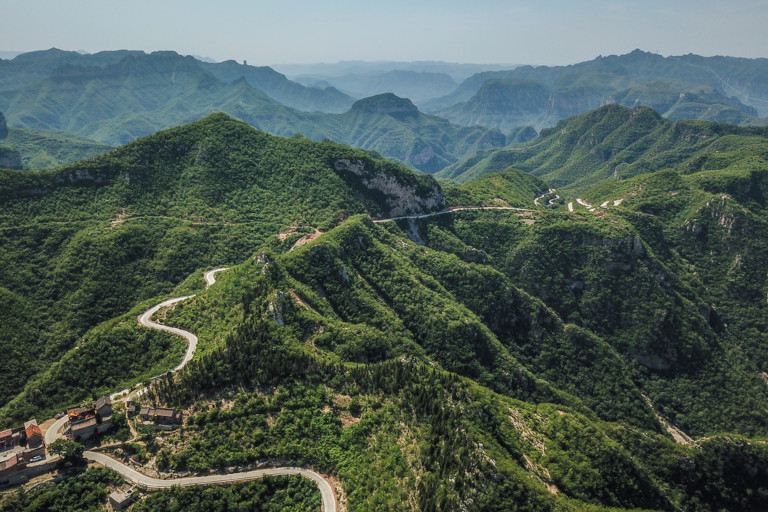
The imperial party left Beijing through Juyong Pass, crossed the Taihang Mountains, and traveled through Shanxi and Shaanxi provinces before finally reaching the ancient city of Xi’an.
Once the empress settled in the governor’s residence there, news spread quickly. With both the emperor and empress gone from Beijing, panic spread among the population. Refugees poured westward, and Xi’an’s population surged almost overnight.
The city’s already poor sanitation deteriorated rapidly. The year had brought famine and natural disasters, and war had further disrupted food supplies.
Conditions became desperate. Starving refugees stripped bark from trees to eat. People collapsed in the streets from illness and hunger. In some cases, corpses were secretly taken and consumed by the starving — an act that worsened the spread of disease and contributed to a deadly plague.
A ceremony to end the plague
Seeing the worsening crisis, the monk Deqing consulted with Prince Qing and proposed three urgent measures.
First, the authorities should strictly forbid the consumption of corpses.
Second, wealthy families should be encouraged to donate money to establish soup kitchens to feed the refugees.
Third, Deqing would preside over a Buddhist ceremony at Wolong Temple in Xi’an to pray for the end of the disaster.
At Wolong Temple, an altar platform was erected in the open space before the main hall. Tall flagpoles rose on either side facing the Buddha statue. The offering table held flowers, fruit, incense, lamps, and candles.
Ten monks wearing red robes chanted scriptures continuously on the altar while Deqing sat cross-legged in the center, his eyes closed and his expression solemn.
Below the altar, 108 monks sat in two groups and joined the chanting. They planned to maintain the recitation continuously for seven days and nights, taking turns in shifts.
Outside the temple, crowds packed the surrounding streets. Many had come hoping that the ceremony might bring relief from the suffering spreading through the city.

The ceremony continued for seven days and nights. According to accounts from the time, the number of new infections gradually declined and deaths began to decrease. Not long after the ceremony ended, the plague subsided.
Fame spreads across the region
News spread quickly that the monk Deqing had helped bring an end to the disaster.
Prominent families from around Xi’an came to Wolong Temple hoping to meet him, seek blessings, or ask to become his students.
Uncomfortable with the attention, Deqing quietly withdrew from public view. To avoid the crowds, he changed his Dharma name to “Xuyun,” meaning “Empty Cloud.”
Soon he disappeared from Xi’an altogether. Although he was gone, the name Xuyun spread widely and would become known throughout China. In later years he would be revered as one of the most respected Buddhist monks of the Republican era.
Some later observers suggested that the plague may have ended because authorities banned corpse consumption and quickly buried the dead, breaking the cycle of infection. But in popular memory, the ceremony at Wolong Temple remained closely tied to the disaster’s sudden end.
The story of the monk who helped calm the plague was only one episode in the remarkable life of Master Xuyun.
A life that began in reluctance
Master Xuyun was born in 1840 into a wealthy family with the surname Xiao. His father, Xiao Yutang, was a scholar from Hunan who later served as an aide to a magistrate in Yongchun, Fujian province.
His given name was Xiao Fumin, meaning “to enrich the nation and benefit the people.” The name reflected his family’s hope that he would succeed in the imperial examinations and bring honor to the household.
When he was twelve years old, he accompanied his father on a solemn journey to return his grandmother’s and mother’s coffins to Hunan for burial. Monks from Mount Heng were invited to perform Buddhist funeral rites.
Watching the chanting ceremony, the young boy felt an unexpected sense of familiarity and peace. Soon afterward he shocked his family with an announcement: he wanted to become a monk.
His father strongly opposed the idea and placed him under strict supervision in hopes of changing his mind.
At seventeen, his father arranged marriages to two women, hoping family responsibilities would anchor him to ordinary life. But the young man refused to consummate the marriages and instead spent his time discussing Buddhist teachings. Remarkably, both wives came to understand his aspirations and did not oppose him.
Two years later, when his family’s attention briefly lapsed, he left behind a poem known as “Song of the Leather Bag” — a Buddhist metaphor describing the human body as only a temporary vessel — and secretly fled to Yongquan Temple on Mount Gushan in Fujian.

There he shaved his head and became a monk, receiving the Dharma name Shideqing.
To avoid being discovered, he did not remain openly at the temple but instead hid in a mountain cave where he practiced meditation.
His father searched for three years without success before finally abandoning the search and returning home. Only after learning that his father had given up did Deqing return openly to the temple and continue his monastic life.
The path to renown
In the years that followed, he traveled widely to study and practice at major temples, including Xiantong Temple on Mount Wutai, Baoji Temple in Jiangxi, Gaomin Temple in Jiangsu, and Xianqin Temple in Yixing.
By the age of 60 — one full cycle in the traditional Chinese calendar — his reputation had spread widely in Buddhist circles and even reached the imperial court.
It was this reputation that led Prince Qing Yikuang to invite him to accompany the empress during the flight from Beijing in 1900.
The ceremony at Wolong Temple and the end of the plague secured Xuyun’s place in Chinese Buddhist history.
But this was only the beginning of his story.
See Part 1 here
Translated by Joseph Wu
Follow us on X, Facebook, or Pinterest
