

Life persists in ways that often escape notice. It claims the smallest cracks, stretches toward sunlight in unlikely places, and bends around obstacles we assume insurmountable. There is a quiet determination in the natural world — a force that pushes forward, shapes itself to survive, and endures long after the odds seem stacked against it. It is in these subtle acts of persistence that life reveals its remarkable strength, patience, and ingenuity.
When trees take root in stone and create miracles
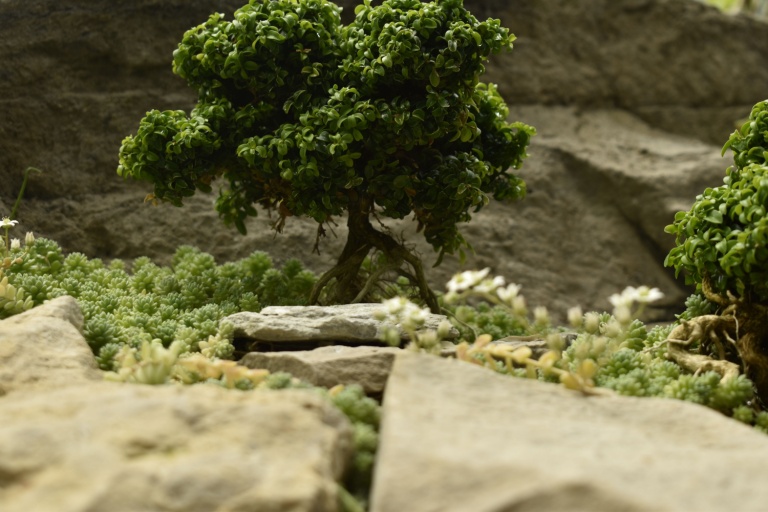
On my windowsill sits a handmade bonsai — a small banyan tree that has quietly accompanied me for over twenty years. It began as a tiny cutting I brought from Florida to New York, and through careful cultivation, it has grown into a living sculpture — still vibrant, still reaching upward.
In their natural tropical and subtropical environments, banyan trees grow rapidly, sending out countless shoots and aerial roots. And yet here it thrives — in a shallow pot scarcely a foot deep, far from its native climate. Of course, it requires attentive pruning and shaping, but beyond that lies something more profound: the tree’s own quiet resilience, its innate ability to adapt, endure, and flourish against the odds.
The instinct to live
The vitality of plants is not something taught — it is something inherent. Consider the cactus in the deserts of Arizona, capable of growing over ten meters tall under a blazing sun and scarce water. Yet that same cactus, when placed on a household balcony, can thrive in a modest pot — and with attentive care, will even produce blossoms of unexpected beauty.
Or take the pothos vines in Florida’s natural forests. Climbing high along towering palm trees, their thick stems resemble ropes, and their heart-shaped leaves — streaked with golden variegation — grow larger than lotus leaves. Yet in an ordinary home, a pothos may flourish in a small pot, even in a dimly lit room. Its leaves may be smaller, but they remain glossy, alive, and quietly persistent in growth.
The art and spirit of bonsai
There are bonsai so grand they require cranes to move them — such as those found in Vietnam, crafted from banyan, hackberry, or kumquat trees. In northern China, species such as elm, pine, cypress, apple, pear, and peach are shaped into sweeping bonsai landscapes.
The Japanese, guided by their refined aesthetic, often cultivate small indoor bonsai, favoring species such as pine and cypress. In China, too, a wide variety of trees adapt beautifully to domestic bonsai: black persimmon, Japanese yew, plum, ginkgo, hinoki cypress, firethorn, maple, pomegranate, crape myrtle, Chinese giant redwood, osmanthus, and many others. Each one, in its own way, tells a story of containment without confinement — of life learning to flourish within limits.
Trees that refuse to yield
In Taipei, there once stood an abandoned three-story building. Over time, trees and vines began to grow from its upper levels. Passersby could see banyan trunks climbing the outer walls, supported by a network of aerial roots clinging to concrete. By 2012, the second and third floors were shaded by dense canopies, transforming the structure into a natural treehouse.
In 2016, the homeowner cut away the crowns, leaving only bare trunks, perhaps assuming the trees would die. But life had other plans. Within a few years, the trees rebounded — lush, green, and thriving once more. What remained was not ruin, but a quiet testament: life, when it chooses to persist, often does so beyond expectation.
A home embraced by a tree
In Changhua, Taiwan, a woman in her nineties named Huang Su lives in a home that has become something of a living wonder. Decades ago, before building their house, she and her husband noticed a wild banyan tree growing on their land. Being tree lovers, they could not bear to cut it down. So instead, they built around it.
Forty years later, the tree has woven itself into the structure of the home. Its broad canopy shades the house from the sun and wind, making air conditioning unnecessary even in summer. From the street, one can see a leafy branch extending gracefully from a second-floor window.
Inside, the story becomes even more remarkable: the banyan tree has grown along the building’s reinforced concrete column, passing through the upstairs bathroom floor, stretching indoors before reaching out through the window into the open air. Each year, it continues to flower and bear fruit. A house and a tree, living not in conflict — but in quiet companionship.
The mango tree that endured
Also in Changhua stands a mango tree over 300 years old, rooted along a sidewalk beside a four-story building. Its dense canopy rises far above the roofline, offering shade and fruit in equal measure. Locals say its mangoes are especially sweet. At the base of the trunk is a large hollow, taller than a person. Long ago, the tree was struck by a heavy truck. It did not fall. Instead, it survived. Over time, a scar formed over the wound, transforming it into a vast, hollowed chamber.
Today, the mango tree stands as a living testament to endurance and resilience — proof that even when damaged, life can persist, adapt, and continue to flourish for centuries.
A tree growing from a tower
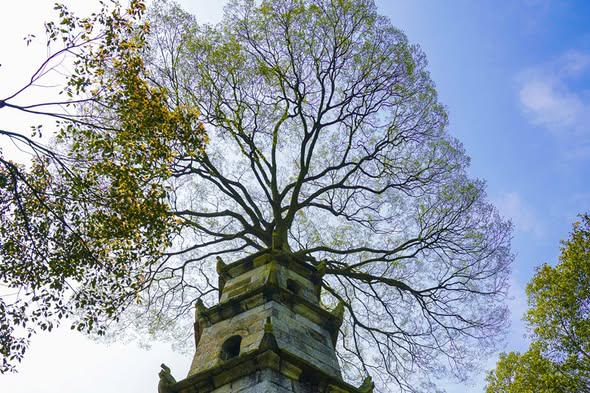
In Tea Pavilion town, Changsha, Hunan Province, a remarkable sight crowns an ancient cultural relic: a living tree sits atop a tower named “Cherish the Written Word.” Built in 1838 during the Qing Dynasty, this five-story, hexagonal granite tower — twelve meters tall and four meters across — once served a noble purpose. In ancient times, scholars would not casually discard paper bearing written words. Instead, such papers and documents were respectfully collected and burned in dedicated structures like this one.
In 1900, lightning struck the top of the tower. Later, birds perched there, and within their droppings were seeds — perhaps undigested hackberry seeds — that found their way into cracks in the stone. With time, rain, and patience, a tree took root. Today, it rises to about eight meters, its canopy lush and thriving — a living crown atop a man-made monument. The tower was last restored in 2008 and designated a protected cultural site in 2011, with the tree carefully preserved and tended as part of its legacy.
The tenacity of life
Time and again, one truth reveals itself: Life does not easily surrender. Whether rooted in a tiny pot, clinging to a crumbling tower, surviving cracked concrete, or bearing centuries of scars, trees push upward, outward, and onward. They bend, they scar, they adapt — and they endure. Watching them, we are reminded that persistence is not merely survival — it is life’s quiet, unyielding triumph.
Translated by Katy Liu and edited by Tatiana Denning
Follow us on X, Facebook, or Pinterest
