
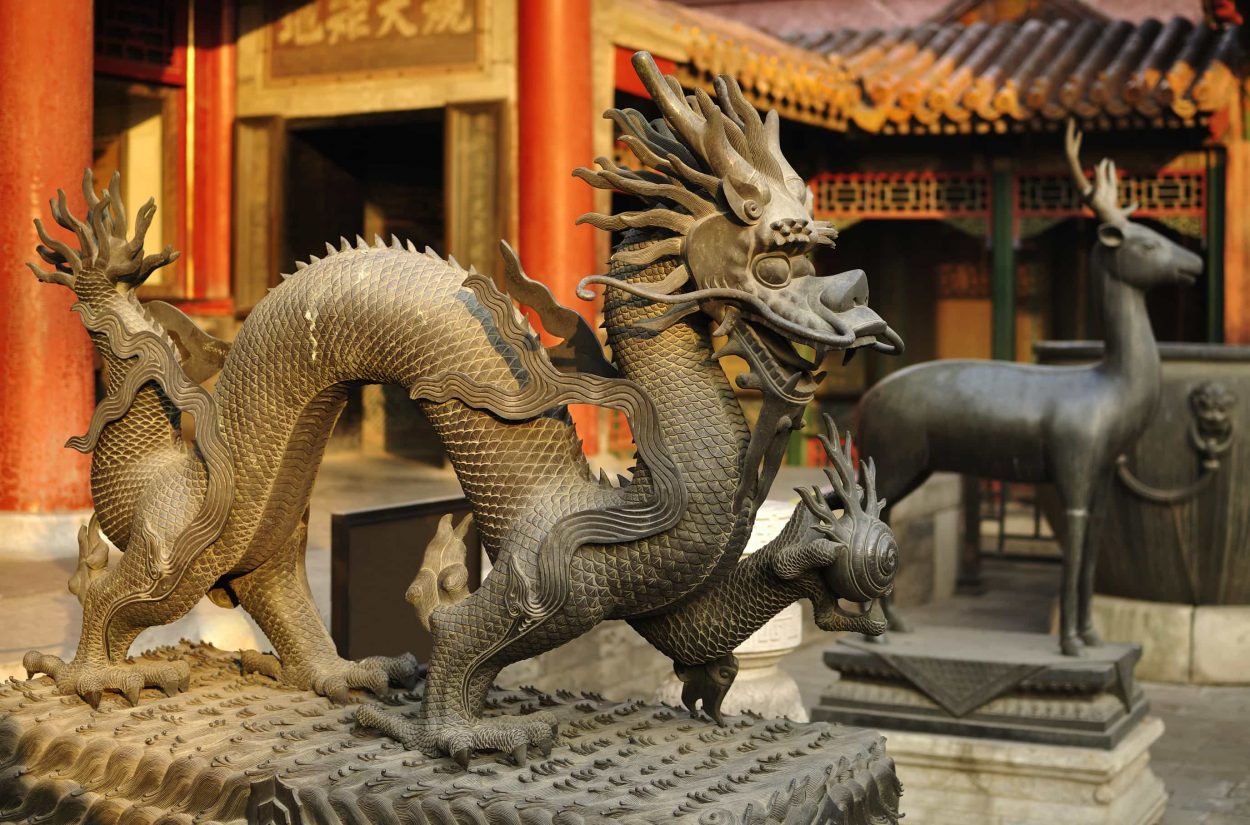
The culture of divine beasts in ancient China has a long and profound history. It draws from ancient mythology while also reflecting the cultural symbols, folk beliefs, and traditions of different dynasties throughout Chinese history. Many of the divine beasts that remain popular today originated in ancient texts and legends. As these stories were passed down through generations, the meanings and symbolism of the creatures continued to evolve, becoming an enduring part of traditional Chinese culture.
Among the many legendary creatures recorded throughout Chinese tradition, five divine beasts came to hold especially important symbolic and cultural significance, each representing distinct qualities, powers, and cosmic meanings.
China’s 5 divine beasts
1. The boundless transformative power of heaven and earth: The dragon
The dragon is one of the most important divine beasts in Chinese culture, long regarded as a symbol of power, sacredness, and the forces of Heaven and Earth. The ancient Chinese dictionary Shuowen Jiezi (Explaining Graphs and Analyzing Characters), compiled during the Han dynasty, records in Volume 11: “Dragon, chief of the scaled creatures. It can be hidden or revealed, small or large, short or long; at the spring equinox it ascends to Heaven, at the autumn equinox it plunges into the abyss.” This passage reflects the ancient belief that the dragon possessed limitless transformative power and could freely traverse both the heavens and the seas.
From the Warring States period through the Han dynasty, the dragon gradually became an imperial symbol. Emperors were later referred to as the “True Dragon Son of Heaven,” and dragon imagery came to appear extensively on imperial robes, architecture, and ceremonial objects.
Among the people, stories of the “Dragon’s Nine Sons” also became widely known. The Ming dynasty text Huailutang Ji records: “The dragon gave birth to nine sons, none of whom became dragons, each with their own preferences.” Later generations gave names to the dragon’s nine sons, legendary creatures said in folklore to be its offspring. These mythical beings had different appearances, temperaments, and symbolic associations. According to tradition, each possessed unique traits and therefore became connected with different aspects of art, architecture, and daily life.
For example, Qiuniu was associated with music and was often depicted on musical instruments, while Yazi was linked to fierceness and martial power and frequently appeared on weapons. Chaofeng, associated with vigilance and protection, was commonly placed on the corners of rooftops.
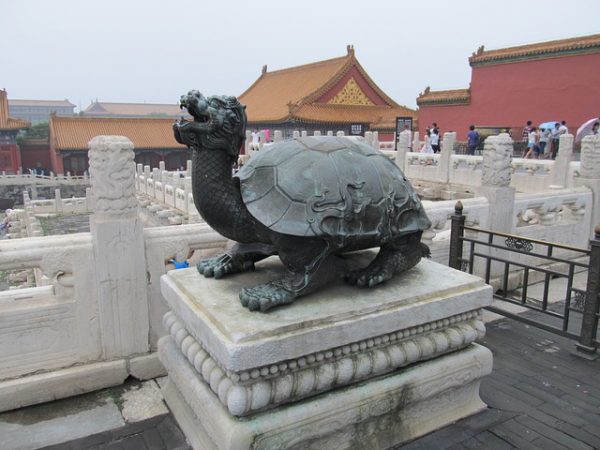
Among the nine sons, Bixi, which resembles a giant tortoise, became especially well known as a symbol of strength and endurance. Stone carvings of Bixi were often used as bases for large commemorative stone tablets and monuments, representing their ability to bear immense weight and preserve important writings over time.
Ancient Chinese texts also connected divine creatures associated with the dragon to the structure and order of the cosmos itself. Huainanzi — Lanming Xun, a philosophical work from the Han dynasty, records that when the goddess Nüwa repaired the broken heavens, she “cut off the legs of the Ao to set up the four pillars.” In Chinese mythology, the Ao was a giant divine turtle believed to possess immense strength capable of supporting the heavens. This story reflects the ancient belief that divine creatures were not merely symbolic animals, but cosmic beings connected to the stability and balance of the universe.

2. King of birds and auspicious symbol of virtuous rule: The phoenix
In Chinese tradition, the phoenix is regarded as the king of all birds and one of the most important and auspicious divine birds. It is associated with harmony, prosperity, and virtuous rule. The Classic of Mountains and Seas — Southern Mountains describes it as: “There is a bird shaped like a chicken, with five-colored markings, named Fenghuang.” The Shuowen Jiezi explains the naming tradition: “The male is called Feng, the female is called Huang.”
In ancient belief, the phoenix symbolizes peace and good governance when the world is in harmony and ruled by virtue. The Book of Documents — Yiji records: “When the ninefold music of Shao was played, the phoenix descended in harmony,” meaning its appearance was associated with refined culture and enlightened rule.
After the Han dynasty, the dragon and phoenix gradually became a paired symbol: the dragon representing the emperor and the phoenix representing the empress. As a result, dragon-and-phoenix motifs became widely used in court clothing, architecture, and ceremonial objects. This pairing also became a symbol of harmony and union, often expressed in the phrase “dragon and phoenix bring prosperity,” especially in the context of marriage.
In later interpretive tradition, the phoenix was also described as embodying the “Five Virtues” — righteousness, propriety, wisdom, benevolence, and sincerity — reflecting its role as a symbol not only of auspiciousness but also of ideal moral order and harmony in all things.
The true significance of the phoenix lies in its representation of auspiciousness, brightness, benevolence, and peace under Heaven. In folk tradition, the phrase “dragon and phoenix bringing prosperity” is often used as a metaphor for a harmonious and happy marriage.
3. Divination mysteries and symbol of longevity: The turtle
In ancient China, the turtle held an extremely sacred status. During the Shang and Zhou periods, turtle shells were widely used in divination practices, in which cracks formed on heated shells were interpreted as messages revealing fortune or misfortune. This practice, known as oracle bone divination, reflects the belief that the turtle could connect Heaven and Earth and serve as a medium for understanding destiny.
The Book of Rites — Liyun records: “What are the Four Spirits? Qilin, Phoenix, Turtle, and Dragon.” This shows that the turtle was considered one of the four great spiritual beasts in antiquity. The Records of the Grand Historian — Biography of Turtles and Divination even states: “The turtle is the treasure of the world.”
Thus, the turtle was not only valued for its long life but also revered for its sacred role in divination and its ability to communicate hidden patterns of fate. In later generations, because of its extraordinary lifespan, the turtle gradually became a widely recognized symbol of longevity, giving rise to auspicious sayings such as “the turtle’s age and the crane’s longevity,” which expresses the wish for enduring life and lasting vitality.
In classical cosmology, the turtle also developed a deeper symbolic role as part of the Four Symbols (Si Xiang) of Chinese constellations. When combined with the snake, it forms the Black Tortoise (Xuanwu), the divine beast of the north, associated with winter and the element of water. This combination reflects ideas of endurance, protection, and stability within the natural and cosmic order.
In later folk belief and Daoist-influenced tradition, the turtle continued to be regarded as a powerful protective creature. In modern feng shui practice, objects such as jade turtles are believed to symbolize stability and longevity, attract fortune, and ward off negative influences, reflecting the turtle’s long-standing association with protection and enduring strength in popular culture.
4. Beast of benevolence and omen of the sage’s arrival: The qilin
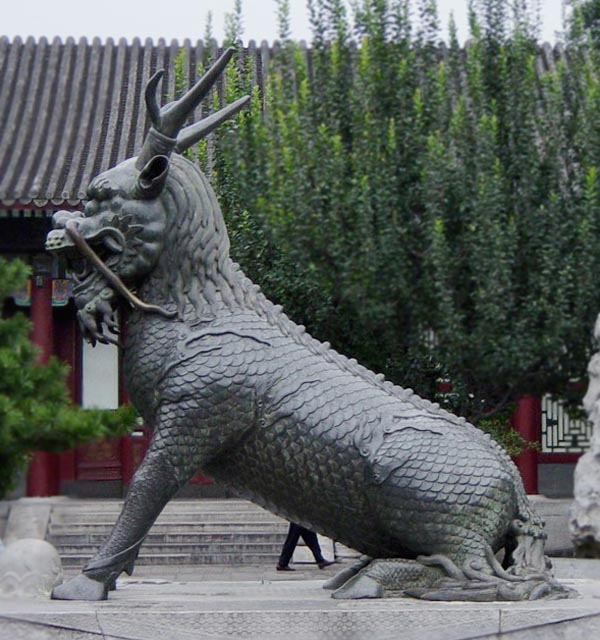
The qilin is one of the most representative auspicious divine beasts in ancient China. The Shuowen Jiezi records: “Qi, a beast of benevolence,” and further notes: “Lin, a great female deer.” The Book of Rites — Liyun also lists the qilin among the Four Spirits. The ancients believed the qilin possessed an extremely gentle nature, harming neither plants nor animals. Because of this, it was regarded as a symbol of ultimate benevolence, moral perfection, and virtuous power.
The Spring and Autumn Annals — Gongyang Commentary (Duke Ai, Year 14) records: “In the western hunt, a qilin was captured,” meaning that a qilin was encountered during a royal expedition and noted as an unusual and significant event. Within the Confucian tradition, the appearance of a qilin was regarded as an extraordinary omen, believed to signal peace under Heaven and the arrival of a sage, an exceptionally virtuous ruler, or a rare heavenly omen.
In folk tradition, there is also the legend of “the qilin bringing children,” which holds that the qilin appears to bless families with virtuous offspring. Because of this, the image of the qilin became closely associated with marriage wishes, fertility blessings, and the hope for noble descendants.
By the Han dynasty, artistic depictions of the qilin had already become relatively standardized, often combining features such as deer antlers, a dragon-like head, a scaled body, and hooved limbs. However, its appearance varied across different historical periods and artistic traditions, and it never had a single fixed form. In later feng shui culture, the qilin was further regarded as a beast that guards the household, wards off evil, and bestows blessings, while also being endowed with the function of promoting official rank and prosperity.
5. From driving away evil to attracting wealth: The pixiu
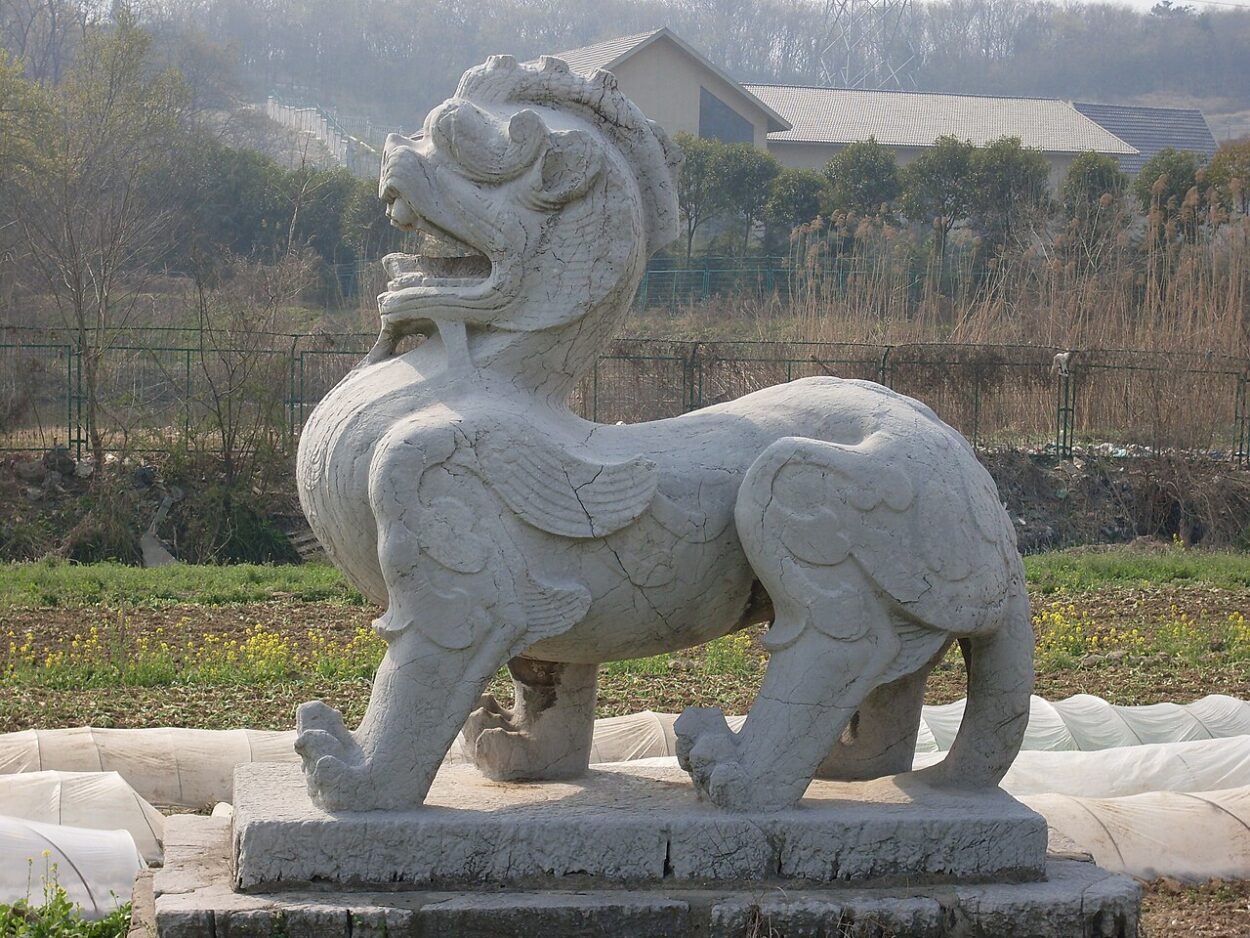
Pixiu is one of the most well-known auspicious beasts in ancient Chinese tradition and is later also referred to as “Bixie” or “Tianlu.” The Book of Han — Account of the Western Regions records: “Taoba, also called Fuba, has a tail like a deer; the one with a single horn is called Tianlu, the one with two horns is called Bixie.” This passage shows that the names Tianlu and Bixie already existed in early sources and later became important references in the formation of the pixiu image.
In Han dynasty tomb carvings, Tianlu and Bixie frequently appear as protective divine beasts, primarily guarding tombs and warding off evil. In this early context, their primary function was protection and the prevention of misfortune, rather than the later popular association with attracting wealth.
Over time, folk interpretation developed the belief that pixiu had a fierce appetite for wealth and could consume everything without releasing it. This led to the saying “only intake, no output,” which later came to be associated with the accumulation of wealth and prosperity. However, in earlier tradition, what was most valued was its role as a powerful spiritual guardian capable of repelling evil forces and protecting spaces and people.
In ancient Chinese thought, divine beasts were used to express the will of Heaven and were later incorporated into imperial ritual systems. These creatures also became closely associated with prayers for protection, good fortune, and harmony. The evolution of pixiu reflects this broader cultural shift in how auspiciousness was understood over time — from protection against harm toward the attraction of wealth and blessings in daily life.
Conclusion
In ancient Chinese thought, these divine beasts reflect a worldview in which the boundaries between nature, belief, and human life were fluid rather than fixed. These mythical creatures embodied ideals of harmony, protection, virtue, and the proper order of the world. What endures is a shared cultural language of symbolism, through which people expressed hopes for stability, prosperity, and balance between Heaven and humanity.
Translated by Cecilia and edited by Tatiana Denning
Follow us on X, Facebook, or Pinterest
