

Whether people believe it or not, every thought and intention is known to Heaven. When a good thought arises, divine protection follows; when a person has evil thoughts, demons and evil spirits surround them. I will share two stories about evil and divine thoughts.
Zhou Zili
During the Qing Dynasty, in Laiwu, Shandong, there lived a man named Zhou Zili, who was known for his great integrity. He had once transported goods to the Shenyang area and, finding it a pleasant place, settled there to run a small business. He married and eventually had two sons.
The elder Zhou and the younger Zhou were more than a decade apart in age. After Zhou Zili and his wife passed away, one after the other, the elder Zhou inherited the family business and supported the household through small trades. At the time, the younger Zhou was still in swaddling clothes, yet the elder Zhou paid him no mind. The neighbors, taking pity on the helpless child, took him in to raise him. Only when he grew a little older did they discover he was mute.
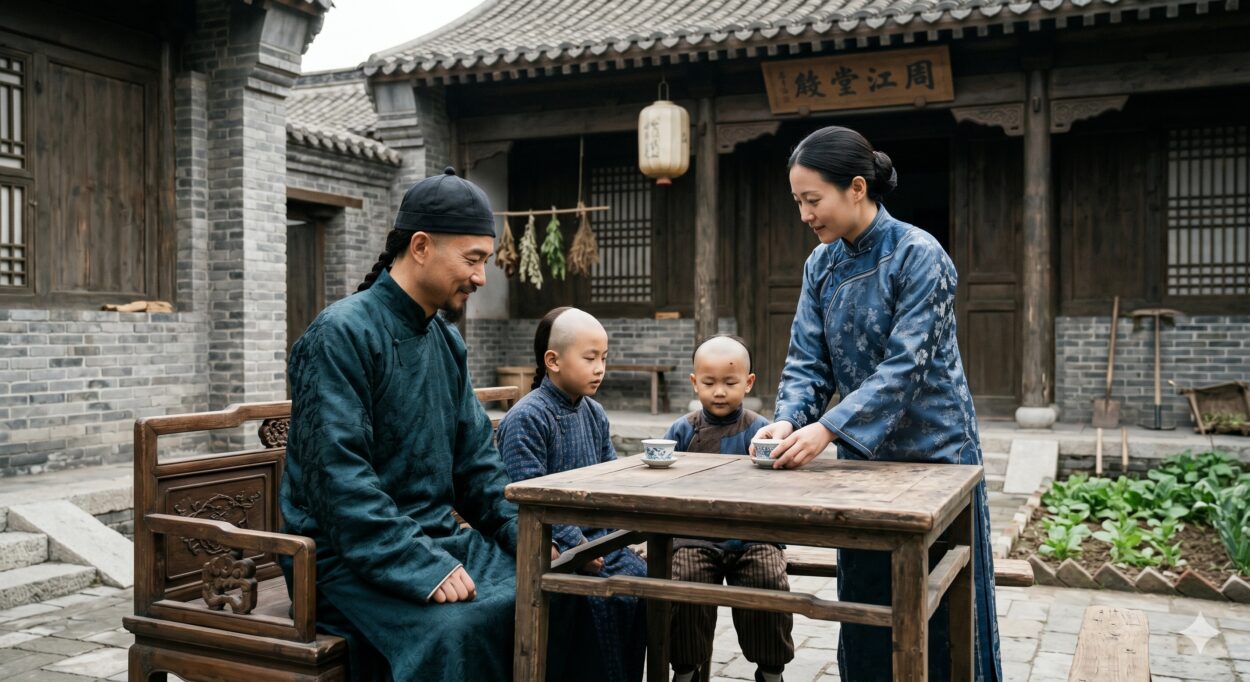
Da Zhou was a cunning man who married a woman named Du, who was known for her fierce reputation. Soon after, the neighbors had to move away and couldn’t take Xiao Zhou with them, so they asked Da Zhou to take his younger brother into his household. Though Da Zhou still felt some brotherly affection and wanted to take him in, he faced strong opposition from Du and had no choice but to give up.
Xiao Zhou was left to fend for himself on the streets, surviving by begging. Sometimes Da Zhou would invite his younger brother over for a meal, but Du Shi would shout angrily at them and chase them out of the house, leaving Da Zhou at a loss. Gradually, the two brothers grew as distant as strangers. Although Xiao Zhou could not speak, he was clever and quick-witted, and suffered from being unable to express himself to others. He inevitably harbored deep resentment toward his older brother for the way he treated him.
That winter, a sudden heavy snowfall fell one night. Xiao Zhou was cold and hungry, and his resentment toward his brother grew even stronger. He tucked a sharp knife into his clothes, intending to kill his sibling. Just as he scaled the wall of his brother’s courtyard and was about to leap inside, he suddenly came to his senses: “Though my brother has treated me cruelly, he is still my own flesh and blood. Is there anything more ominous than family members turning against one another? Moreover, if I were to kill my brother today, my own cruelty would be far worse than his.”
Thus, Xiao Zhou repented deeply. He also hated himself for being unable to speak up and persuade his brother, and could not help but crouch there and weep bitterly. Later, as he climbed down the wall, he felt a severe itch in his throat, and something protruded. He forced it out — it was a piece of cartilage, about the size of a copper coin. He tried to speak, and, to his surprise, his speech became incredibly fluent.
Xiao Zhou was overjoyed and hurried to knock on the door to call for his elder brother. When the man came out and saw it was Xiao Zhou, he was about to ask what was wrong, but, amazingly, Xiao Zhou opened his mouth and explained to his elder brother and sister-in-law everything that had just happened. Overjoyed, yet ashamed, they felt humiliated and unable to look at anyone; they could only weep with their faces against the wall.
The next day, Da Zhou gathered all the villagers together and expressed his willingness to give the entirety of their father’s inheritance to Xiao Zhou, but Xiao Zhou firmly refused. In the end, the villagers divided the estate equally between the two brothers.
Afterward, Da Zhou arranged a marriage for Xiao Zhou, and the two families lived together in perfect harmony. Whenever Xiao Zhou had a matter to discuss, he would consult his elder brother, and vice versa. It could be said that “the younger brother could not be happy without his elder brother for a single day, nor could the elder brother be joyful without his younger brother for a single day.” The two sisters-in-law were also renowned throughout the village for their virtue and grace. This story is recorded in the Qing Dynasty text The Record of Admonitions.

Yuan Zishi
The Treatise on Induction also contains a similar story: A man named Yuan Zishi, filled with hatred for a man named Miao, who had betrayed his trust, planned to go to his home at dawn to kill him. As he passed by a temple, an elderly monk, Xuanyuan Weng, was there, having risen early to recite sutras. Suddenly, he saw hundreds of grotesque and malevolent demons following a man, each wielding knives and axes, looking extremely ferocious. That man was Yuan Zishi.
A short while later, Xuanyuan Weng saw him walking back, but this time he was no longer accompanied by evil spirits. He was flanked by immortals adorned with golden crowns and jade pendants, and surrounded by fragrant flowers and ceremonial banners. Finding this most peculiar, Xuanyuan Weng called Yuan Zishi over to ask him what had happened.
Yuan Zishi said: “The man named Miao betrayed the kindness I showed him, so I originally intended to go to his home and kill him. When I reached his doorstep, though, I suddenly realized that although Miao had let me down, his wife and children were innocent. Moreover, he had an elderly mother. Killing him alone would be like killing his entire family. When I thought of this, I simply could not bring myself to do it, so I turned around and walked back.”
Upon learning the full story, Old Man Xuanyuan Weng told him about how evil spirits had beset him on his way there, yet Gods and Buddhas had accompanied him on his return. He congratulated him, saying: “The gods and Buddhas are already aware of your actions; you will be richly rewarded in the future.” After hearing this, Yuan Zishi devoted himself even more wholeheartedly to virtue and later passed the imperial examinations.
Both stories illustrate how a single thought can turn great misfortune into great blessing. Therefore, remember this: the moment a thought arises, the Gods of good fortune and misfortune have already begun to follow you.
Translated by Eva and edited by Laura Cozzolino
Follow us on X, Facebook, or Pinterest
