

At the height of its influence, Athens stood as one of the most powerful and admired cities of the ancient world — confident in its strength, proud of its culture, and certain of its destiny. Yet beneath this brilliance, subtle signs of imbalance had begun to appear, unnoticed or unheeded by its people. When war erupted and tensions rose across Greece, events unfolded that would test the very foundations of Athenian society, ultimately altering the course of history in ways very few had foreseen.
A historic plague strikes Athens
In the second half of the 5th century B.C., the city-states of Athens and Sparta fought the Peloponnesian War as they competed for dominance over the Greek world. In the second year of the war (430 B.C.), as the Spartan army approached Athens, they suddenly discovered countless new graves outside the city walls and soon learned that a deadly plague was raging within the city. Shocked by the situation, the King of Sparta hastily ordered a retreat.
Athens became isolated; neither its enemies nor its allies dared to approach the plague-ridden city again. The outbreak first appeared in Piraeus, the port near Athens. Three people were initially discovered to have contracted a strange illness at the same time. It began with a high fever and severe inflammation of the throat, followed by relentless diarrhea. Eventually, the sufferers collapsed and died.
Soon afterward, eleven more people in the same area succumbed to the disease. Their limbs developed gangrene, changing from deep red to black and beginning to rot, accompanied by a foul odor. Even as their bodies deteriorated, their hearts continued to beat, forcing them to witness their own gradual decline until they eventually passed away.
The patients did not appear highly feverish externally, yet they constantly suffered from an intense burning heat within, to the point that they could not tolerate any clothing covering their bodies. They could not endure even the lightest, most breathable linen sheets and often stripped themselves completely naked.
They were tormented by an unquenchable thirst and constantly longed to immerse themselves in cold water. If caregivers were even slightly negligent, the desperately parched patients would instinctively leap into pools and greedily gulp down the cool water. Yet no matter how much they drank, their burning thirst could not be extinguished. At the same time, they suffered the agony of being unable to rest or sleep.
Because people were afraid to care for the sick or even visit their afflicted relatives and friends, many patients died with no one to care for them. Yet even those who received meticulous care ultimately met the same fate. Many families in Athens were completely wiped out.
Every day, people died in great numbers, like sheep in a plague-stricken flock. The bodies of the dead piled up one upon another. The half-dead wandered through the streets or gathered around pools of water, desperately trying to quench their thirst. Refugees from the Athenian countryside were forced to take shelter in the temples; before long, the dead and the dying mingled together, crowding these sacred spaces.
With no one to bury them, corpses lay scattered everywhere, and no mourning rituals were observed. Birds and beasts fed on the bodies and soon fell dead themselves, and before long, even they stayed far away. For a time, flesh-eating birds disappeared entirely from the city. The city was abandoned, the fields lay desolate, and tens of thousands of corpses covered every corner of Athens.
Although Athens was home to many philosophers, scholars, poets, and artists, all their human knowledge, skill, wisdom, and strategy proved useless against the plague. The various remedies prescribed by physicians, whether taken orally or applied externally, were of no avail. In the end, even the physicians themselves became infected and succumbed to the disease.
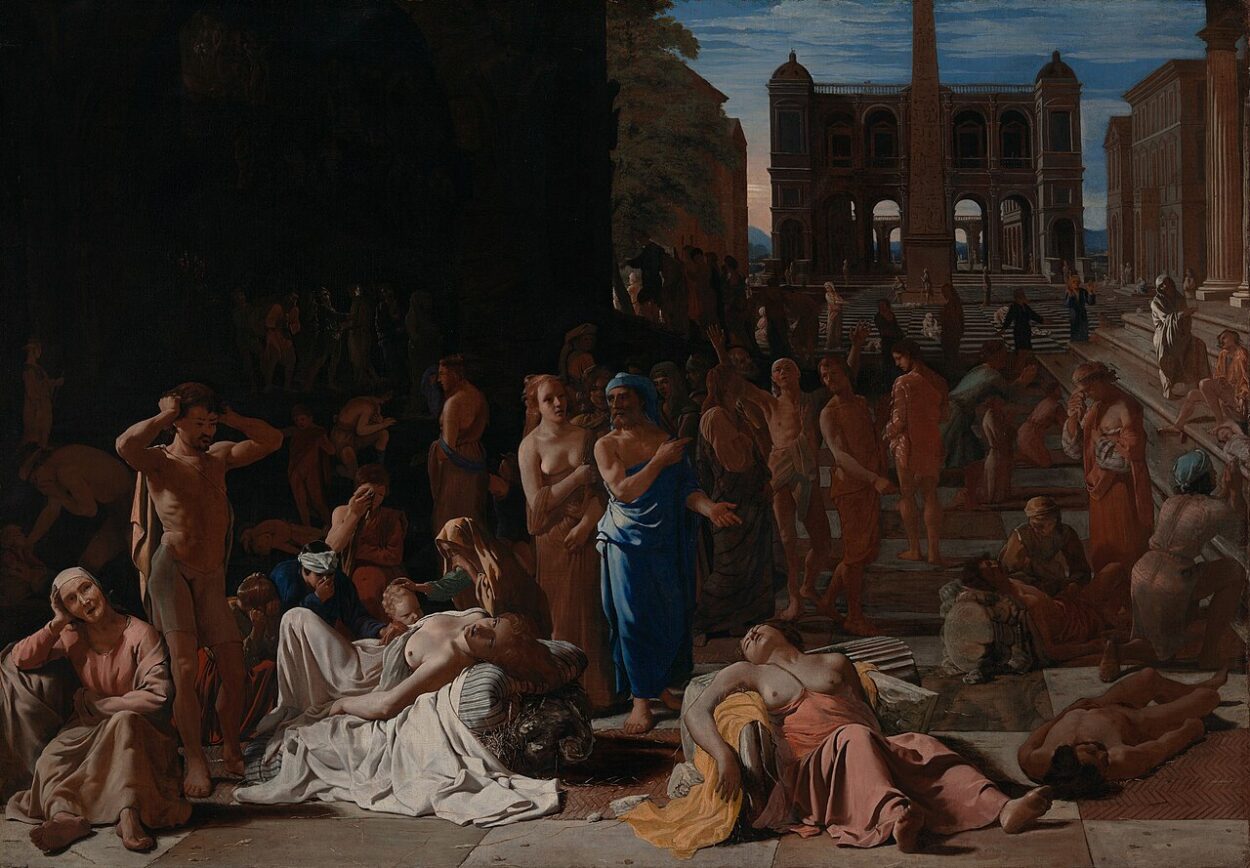
One-third of the population perishes
When the very temples where people sought sanctuary lay strewn with corpses, those whose faith faltered began to turn away from the divine. Both sacred authority and secular law lost their binding force over the citizens. In order to protect themselves, people acted against nature and reason, committing crimes openly and without restraint; theft, murder, and robbery spread throughout the city.
In the face of the plague, rich and poor died without distinction. The poor plundered the property of the wealthy, yet wealth itself had lost all meaning. No matter how much gold one possessed, it could not preserve life, and no one knew whether they would become the next body lying in the streets the following day.
Panic and despair made “seizing the moment” the prevailing attitude. The living rushed to spend their money quickly and pursued sensory pleasures with abandon, seeking to numb themselves and escape the fear of reality. As a result, a disturbing scene emerged in the once-civilized city-state: on one side lay the dead, while on the other, the living indulged in sensual pleasures, living as if in a drunken dream beside the corpses.
Death destroyed the Athenians’ final psychological defense. This great city-state, which even Spartan warriors had failed to conquer, was instead brought down by a plague, collapsing from within. Later historians estimate that about one-third of the population of Athens died, with total deaths ranging from approximately 75,000 to 100,000.
The philosopher Socrates personally experienced this plague but successfully resisted the attack through his restrained lifestyle and healthy habits. This catastrophe marked a turning point in his thinking, leading him to begin exploring personal morality and the pursuit of truth, which he later expressed in his famous principle: “I know that I know nothing.”
At 25 years old, Thucydides contracted the plague, yet through extraordinary willpower, he meticulously recorded everything he saw, heard, thought, and felt. As a result, the Plague of Athens became one of the most detailed accounts of an ancient disaster, providing future generations with valuable firsthand insight into the epidemic.
A plague with unsettling patterns
Although the plague raged, its transmission appeared unusually selective. During the Peloponnesian War, the Athenians captured many Peloponnesians and brought them to Athens. Yet in Thucydides’ account, there is no record of these prisoners being infected. The plague persisted only in Athens and its allied city-states. Even more strangely, after 426 B.C., the great plague that had devastated the city for several years suddenly disappeared.
According to Thucydides, the Plague of Athens originated in parts of Ethiopia before spreading to Egypt, Libya, and much of the Persian Empire. Although modern medical scientists and historians have proposed various theories, questions such as how the plague began and why it ended so abruptly remain unresolved to this day.
The deeply religious ancient Greeks attributed the outcomes of wars to divine will. They believed that plagues were a form of divine punishment for human wrongdoing or moral transgressions. Consequently, the cessation of a plague signified divine mercy and forgiveness.
Ancient Greece placed great importance on living a noble, spiritual, and disciplined existence. However, in the era preceding the plague, many Athenians succumbed to decadence and material excess, abandoning traditional values and normalizing what was once considered taboo. It is often argued that this moral corruption — a profound departure from Divine order — precipitated the catastrophic disaster that befell Athens.
After the plague ended, Athens persisted in fighting Sparta. However, in 429 B.C. and again in the winter of 427 B.C., the plague reappeared in Athens. These repeated outbreaks dealt devastating blows to Athens, killing national, religious, and military leaders alike. As a result, the city’s basic political order became increasingly difficult to sustain, political power weakened, and the morale of both the army and citizens sharply declined. In 404 B.C., the Spartan alliance besieged Athens by land and sea. Athens was ultimately defeated, and Sparta established its hegemony over Greece.
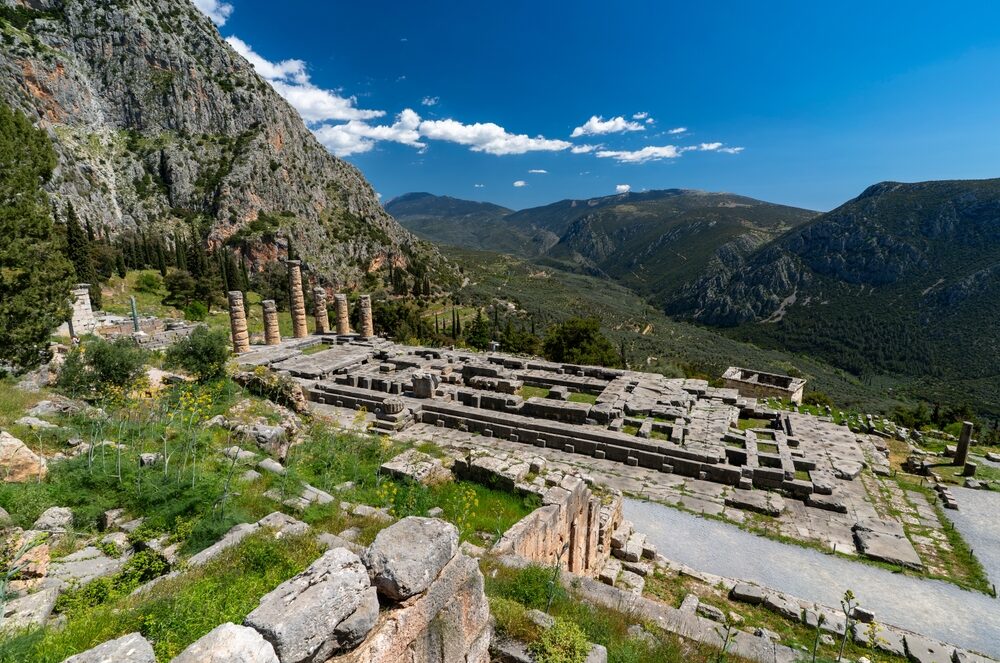
Prophecies of the oracles
The ancient Greeks believed in oracles — divine messages spoken through human intermediaries, often regarded as carrying prophetic truth. Before the outbreak of the war and the plague, an Athenian oracle is said to have warned the city: “A war with Sparta will come, and it will bring a great plague.” At the time, however, the Athenians did not believe it.
Prior to the Peloponnesian War, the Spartans also visited the Oracle of Delphi to seek guidance. They asked whether they should go to war with Athens, and the oracle responded affirmatively, stating that the gods would grant Sparta favor and ultimate victory. This prophecy was widely circulated throughout the war.
Athens and Sparta were originally evenly matched in power, but due to the outbreak of the plague, Athens — once confident in its strength and perceived invincibility — ultimately fell to Sparta. The words of the oracles were not in vain, for the course of history cannot escape Divine arrangement.
A lesson left to the future
The Plague of Athens is more than an ancient tragedy; it is a message preserved across millennia. When the world recently faced yet another pandemic, we were reminded of how quickly fear, confusion, and moral strain can test even the strongest societies. Thucydides recorded Athens’ suffering so that future generations might understand not only the disease itself, but the human choices surrounding it. Socrates, shaped by living through that dark time, urged people to examine their lives, strengthen their character, and guard against the moral drift that leaves a nation and its people vulnerable.
Perhaps this history endures to serve as a warning. Should the world ever confront such a crisis again, the remedy will not lie in knowledge or technology alone, but in remembering the lessons of those who came before us — that the strength of a civilization depends first on the moral integrity of its people.
Translated by Chua BC and edited by Tatiana Denning
Follow us on X, Facebook, or Pinterest
