
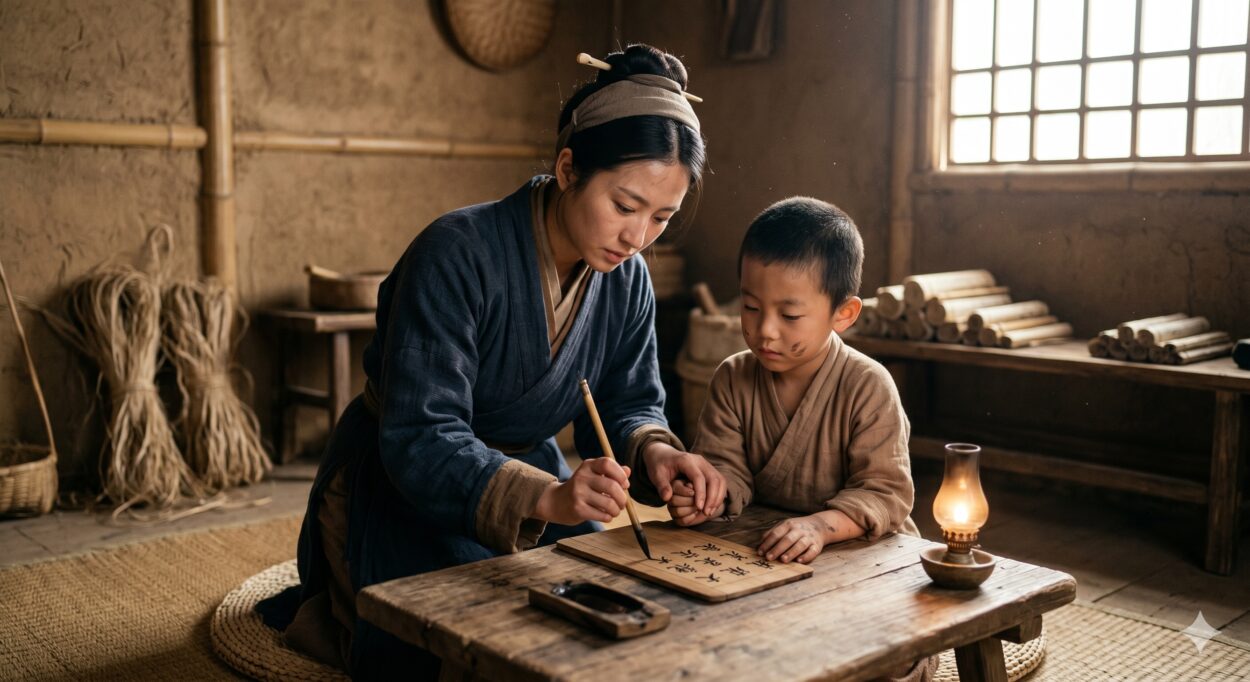
In Part 1, we explored the stories of the mothers of Confucius and Mencius, whose wisdom, integrity, and far-reaching vision helped shape the minds of two of the greatest figures in Chinese history. The ancient Chinese deeply believed that cultivating character begins in childhood and that a mother’s guidance plays a pivotal role in shaping a child’s values, aspirations, and destiny. In Part Two, we turn our attention to the mothers of Tao Kan and Yue Fei, whose steadfast guidance helped shape two men who would leave a lasting mark on Chinese history.
Tao Kan’s mother: Sincerity, integrity, and incorruptible character
Lady Zhan, the mother of Tao Kan, is remembered as one of history’s great exemplars of wise motherhood. Tao Kan lost his father at a young age, and his mother endured tremendous hardship to provide him with an education and instill in him strong moral principles.
One snowy winter day, Tao Kan’s friend Fan Kui, a respected scholar from Poyang, came to visit. The family was living in extreme poverty, and Tao Kan realized he had nothing suitable to offer his guest. Embarrassed by his circumstances, he felt deeply ashamed. His mother noticed his distress and gently comforted him. “Such heavy snow is falling,” she said. “Simply invite your friend to stay.” Then she quietly set about making it possible.
She cut off her own long hair and exchanged it for food and wine. She chopped wooden pillars from the house to use as firewood. Despite the bitter cold, she even gathered the family’s only bedding straw, cut it into feed, and gave it to the guest’s horse.
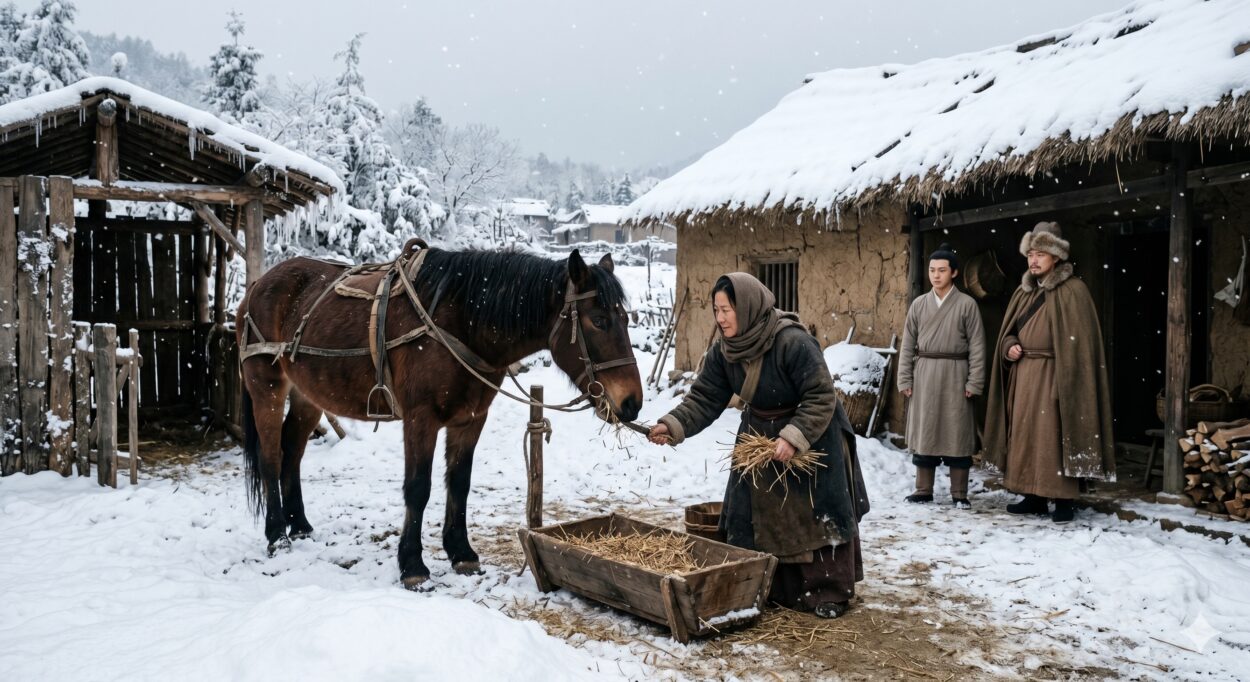
Fan Kui was profoundly moved by her extraordinary generosity. He later exclaimed: “If all mothers taught their sons as Lady Zhan teaches hers, what shortage of talent could a nation ever suffer? And what affairs under Heaven could not be properly governed?” This simple act of hospitality reflected something far greater than material sacrifice. Through her actions, Lady Zhan demonstrated that sincerity, generosity, and integrity are not merely spoken lessons but virtues to be lived.
Impressed by both mother and son, Fan Kui strongly recommended Tao Kan to influential officials. Before long, Tao Kan was nominated for public office and embarked upon a distinguished career. The example of his mother’s famous act of “cutting her hair to honor a guest” left a lasting imprint on his character.
Even after attaining high office, Tao Kan remained known for his courtesy, humility, and generosity toward others. He welcomed visitors warmly regardless of their status and earned widespread respect for treating people with genuine sincerity rather than mere outward formality. Her example demonstrated a timeless truth: the values children witness at home often become the principles that guide them throughout their lives.
Another incident further illustrates the values his mother instilled in him. While serving as an official responsible for waterways and fisheries, Tao Kan once sent his mother a jar of pickled fish as a gift. To his surprise, she returned it unopened. Along with the jar came a letter: “You are a government official. If you use public resources, even indirectly, to give me gifts, it brings me no joy. It only gives me reason to worry.” The lesson left a profound impression on him, and Tao Kan never forgot it.
He would go on to become renowned as one of the most honest and incorruptible officials of the Eastern Jin dynasty, helping to stabilize the government during a turbulent period. Once again, the source of his character can be traced back to the lessons learned at home. Through her unwavering integrity, Lady Zhan taught her son that true honor is not measured by rank or position, but by the ability to remain upright even when entrusted with power. The influence of these values would continue to resonate for generations.
Among Tao Kan’s descendants was the celebrated poet Tao Yuanming, famed for his “refusal to sell his dignity for a measly handful of rice,” which has long been regarded as a symbol of integrity and independence. His noble character may well have been rooted in the same family values that Lady Zhan helped instill generations earlier.
Yue Fei’s mother: Loyalty to country and devotion to principle
The mother of the great military hero Yue Fei was Lady Yao. She came from a humble rural background and had little formal education. Yet she possessed remarkable strength of character, sound judgment, and an expansive spirit. From an early age, she raised her son with discipline and high expectations, teaching him to endure hardship, face adversity with courage, and grow into a man of integrity.
Under her guidance, Yue Fei developed exceptional self-discipline and martial skill. At the age of nineteen, he enlisted in the army to defend his homeland. Soon afterward, however, his father passed away. Yue Fei temporarily left military service to observe the traditional mourning period and care for his mother. Then a national crisis unfolded.
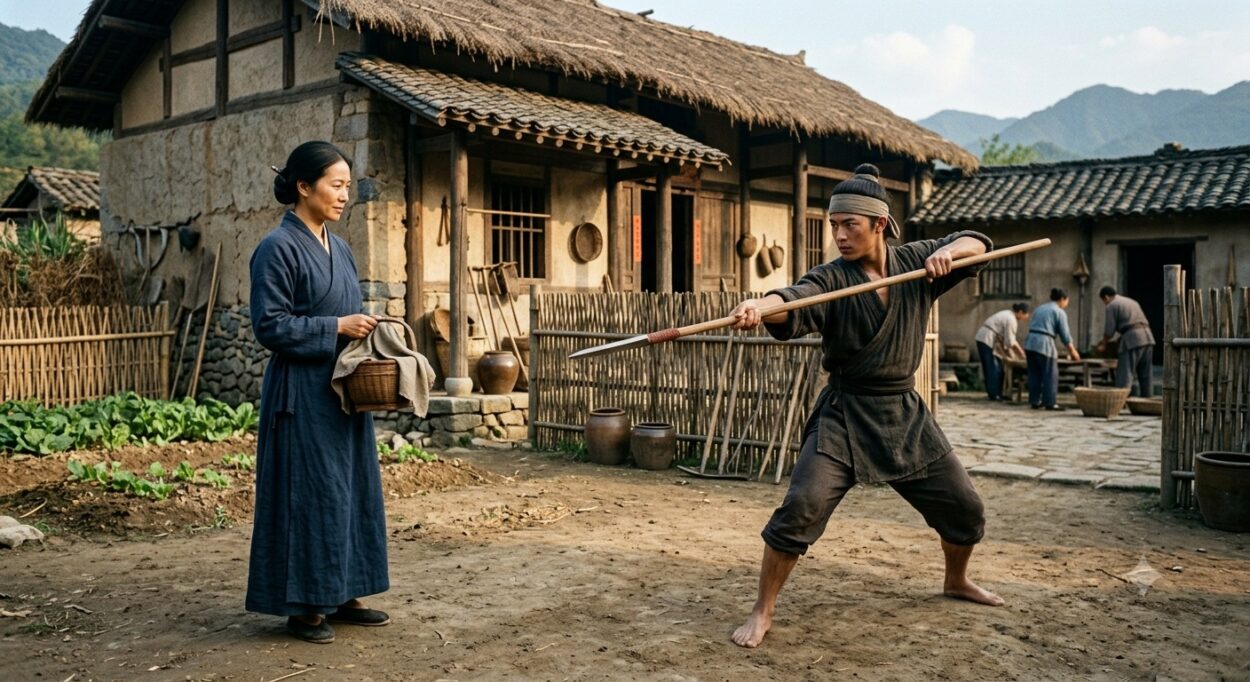
In 1126, the Jin armies launched a massive invasion of northern China. The Song dynasty suffered repeated defeats, and the nation stood on the brink of catastrophe. At the time, the Jin forces were widely regarded as nearly invincible. Patriotism was not merely an ideal to be admired; it demanded genuine courage, sacrifice, and a willingness to face mortal danger. What widowed mother would willingly send her only son into such peril? Yet Lady Yao did precisely that.
Rather than urging him to remain safely at home, she encouraged him to return to military service and defend the nation. Before his departure, she famously tattooed four characters onto his back: “Serve the country with utmost loyalty.” Those words would become the guiding principle of his life.
In a time of national peril, Lady Yao placed righteousness above personal attachment. She understood that there are moments in history when duty demands sacrifice and the greater good must take precedence over individual concerns. This spirit is captured in a well-known saying: “If it benefits the nation, one should face life and death without hesitation, not retreat because of personal fortune or misfortune.” Inspired by his mother’s example, Yue Fei rejoined the army at the age of twenty-two and embarked upon the military career that would make him a legend.
Over the years, he fought in more than two hundred campaigns, advancing deep into enemy-held territory and reclaiming lands that had been lost. He became renowned for his brilliant strategy, strict discipline, and willingness to lead by personal example. The Jin armies themselves were said to have declared: “It is easier to shake a mountain than to shake Yue Fei’s army.”
Yet behind these military achievements stood the enduring influence of his mother’s teachings. Throughout his life, Yue Fei never wavered from the principles she had instilled in him. His loyalty to his country and devotion to righteousness remained steadfast until his death.
His patriotic spirit is perhaps best captured in his famous poem, Man Jiang Hong (Full River Red), whose stirring verses have inspired generations and remain among the most celebrated expressions of loyalty, perseverance, and national devotion in Chinese history:
My hair bristles with righteous anger;
Leaning upon the railing, I watch the rain subside.
I raise my eyes to Heaven and let out a long cry,
My heart filled with boundless resolve.
Thirty years of achievement are but dust;
Eight thousand miles of journey are but clouds and moonlight.
Do not idle away your youth,
Only to mourn in vain when your hair turns white.
Today, twenty-two is often the age when young people graduate from university and begin their adult lives. Many modern parents understandably focus on helping their children achieve success — earning wealth, advancing careers, gaining status, and bringing honor to the family. Yet Lady Yao exemplified something even more difficult to teach: the wisdom of sacrifice.
When the nation faced peril, she was willing to set aside personal comfort, safety, and even the precious bond between mother and son for the sake of a greater moral responsibility. She chose principle over attachment, duty over convenience, and the common good over personal interest. For this reason, her example has endured for centuries. Yue Fei’s loyalty became legendary, but behind that legendary son stood an equally remarkable mother whose courage, selflessness, and unwavering sense of righteousness continue to inspire admiration to this day.
In Part Three, we will turn to the mothers of Ouyang Xiu and Xu Shu, as well as the matriarch of the famed Yang Family Generals — women whose guidance, wisdom, and strength helped shape scholars, strategists, and warriors whose names would echo through Chinese history.
See Part 1 here
Translated by Katy Liu and edited by Tatiana Denning
Follow us on X, Facebook, or Pinterest
