

A Taiwanese professor who wrote under the pen name Yunhe once viewed the traditional belief in karmic retribution skeptically. Having studied in the United States and received a modern education, he believed religious figures invented the concept to promote their teachings.
However, after repeatedly witnessing and personally experiencing events that seemed to illustrate cause and effect, his views began to change. He came to believe that the universe contains many mysterious phenomena that modern science has yet to explain.
The professor eventually compiled the stories he had collected into books, making them available for others to print and distribute free of charge. Through these accounts, he encouraged people to follow the traditional teaching: “Refrain from all evil and practice all that is good.”
Among the stories he shared were two remarkable accounts illustrating the belief that good deeds bring good rewards.
An unexpected reunion on a Texas highway
One June night in the 1930s, a highway patrol captain named Forby spotted a truck speeding through El Paso County, Texas. He pursued the vehicle on his police motorcycle, but accidentally collided with the rear of the truck. The impact severed an artery in his thigh, leaving him lying in a pool of blood, his life in danger.
The truck driver, a man named Smith, immediately stopped when he realized what had happened. Seeing the officer’s severe injuries, he rushed to his aid and managed to stop the bleeding. Without Smith’s quick intervention, Forby would likely have lost too much blood to survive until an ambulance arrived.

Five years passed.
One day, while patrolling the highway, Captain Forby received a radio report of a serious traffic accident. He hurried to the scene and discovered a man lying unconscious inside a vehicle. An artery in the man’s right leg had been severed, and he was bleeding profusely.
Forby immediately applied a tourniquet to stop the bleeding. Only after attending to the man’s injuries did he look more closely at his face.
To his astonishment, the injured driver was Smith — the very man who had saved his life five years earlier.
The man who had once rescued Forby from a life-threatening injury was now being rescued by him under remarkably similar circumstances.
The account, recounted in Reader’s Digest’s Mysteries of the Unexplained (Chinese-language edition, p. 63), offers a striking illustration of the traditional saying: “A good deed will surely be rewarded.”
A generous heart behind a modest life
On April 7, 1985, the Taiwanese newspaper Min Chung Daily News reportedly published an account of a man surnamed Li, a longtime employee of the Chiayi tax office who had quietly devoted decades of his life to helping people in need.
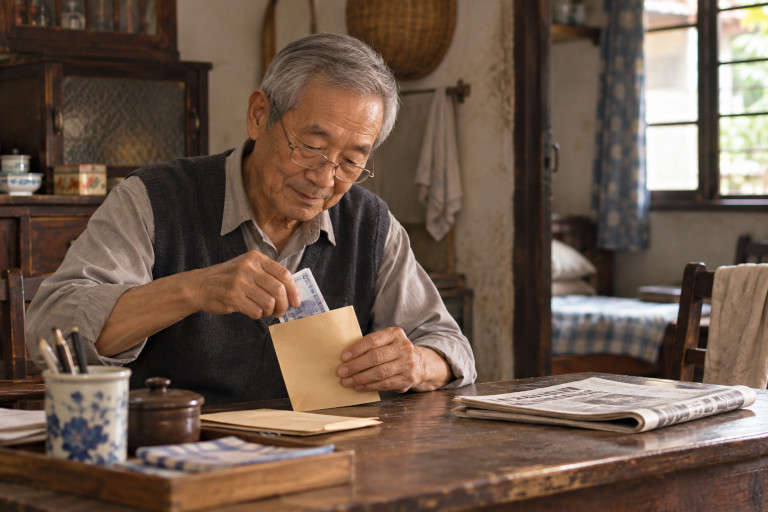
Whenever Li read newspaper reports about families facing misfortune or financial hardship, he often sent money to help them, using an assumed name so that his identity would remain unknown.
One day, he learned of a talented young student from an impoverished family in Houbi Township. Despite his family’s difficult circumstances, the boy had distinguished himself through excellent academic performance and exemplary conduct, earning admission to Provincial Chiayi Senior High School. Unfortunately, his family could not afford the registration fees.
When Li heard about the situation, he arranged monthly financial assistance through a local political party office, using an assumed name to conceal his generosity.
During his second year of high school, the student transferred to the Affiliated Senior High School of National Taiwan Normal University in Taipei, and Li temporarily lost contact with him.
After graduating, the young man earned admission to the Department of Economics at National Taiwan University. However, financial hardship threatened to end his education again because he could not afford the registration fees.
When Li learned of his predicament, he did not hesitate to help. He resumed his financial support, enabling the student to complete his university studies.
The young man, whose surname was Hsiao, later entered the graduate program in political science at National Taiwan University. He later received a government scholarship to continue his studies in the United States and eventually earned a doctoral degree in law in Pennsylvania. According to the 1985 account, he had returned to Taiwan and was working at National Taiwan University.
Through years of quiet generosity, Li had helped a promising young man overcome financial obstacles and fulfill his academic potential. His kindness made possible achievements that might otherwise have remained out of the student’s reach.
Yet despite his willingness to help others, Li was extraordinarily frugal in his own life.
One evening, a friend arrived unexpectedly at Li’s home around dinnertime. On the table, where Li and his wife were about to eat, the entire meal was a bowl of tofu, a plate of spinach, and a bowl of dried fish.
The sight moved the visitor to tears.
It was difficult to imagine that a man who lived so modestly, carefully economizing on his own needs, could be so generous when others faced hardship. He was willing to deny himself comforts while quietly contributing money over many years to help people he barely knew.

Li’s generosity also left a lasting impression on his own family.
Perhaps influenced by their father’s example and upright character, his three children all distinguished themselves through academic achievement and good conduct. Each gained admission to university and graduate school. His second child also received a government scholarship and traveled to the United States for further study in 1984, the year before the newspaper account appeared.
To those who believed in the traditional principle of moral cause and effect, the achievements of Li’s children seemed another illustration of the old Chinese saying: “Good deeds bring good rewards.”
The two accounts show different ways in which kindness may bear fruit. In the first, a man who saved another person’s life was unexpectedly rescued by that same person years later. In the second, a man’s quiet generosity helped transform a young student’s future, and his example of goodness was reflected in his own children’s lives.
Together, these stories illustrate the traditional belief that good deeds bring good rewards. When we extend a helping hand to someone in need, that kindness may one day return to us in an unexpected way. Even when the reward isn’t immediate or obvious, an act of generosity can have a lasting influence, reaching far beyond the person who first received it.
Translated by Joseph Wu
Follow us on X, Facebook, or Pinterest
