
In Jingchu, a region encompassing parts of present-day Hubei Province, lived a young scholar named Liang Jinkang. His family was so poor that he could not even afford to marry.
Among his fellow townsmen was a wealthy man named Huang Chongpu. The Huang family was not descended from nobility or distinguished officials, and Huang himself had begun his working life as a servant. Through years of successful business dealings, however, he had accumulated several hundred thousand taels in gold and silver, acquired extensive farmland, and built properties containing more than a thousand rooms. He eventually became one of the wealthiest men in the county.
Huang had a daughter named Huixin, a young woman known for her intelligence, beauty, and literary talent. She was particularly skilled at writing poetry and prose, and from an early age, she had made up her mind to marry a man of genuine talent and ambition. Yet despite the family’s enormous wealth, its humble origins remained an obstacle. The sons of prominent families generally considered the Huangs beneath their social standing, and few were willing to seek Huixin’s hand in marriage.
A marriage inspired by a poem
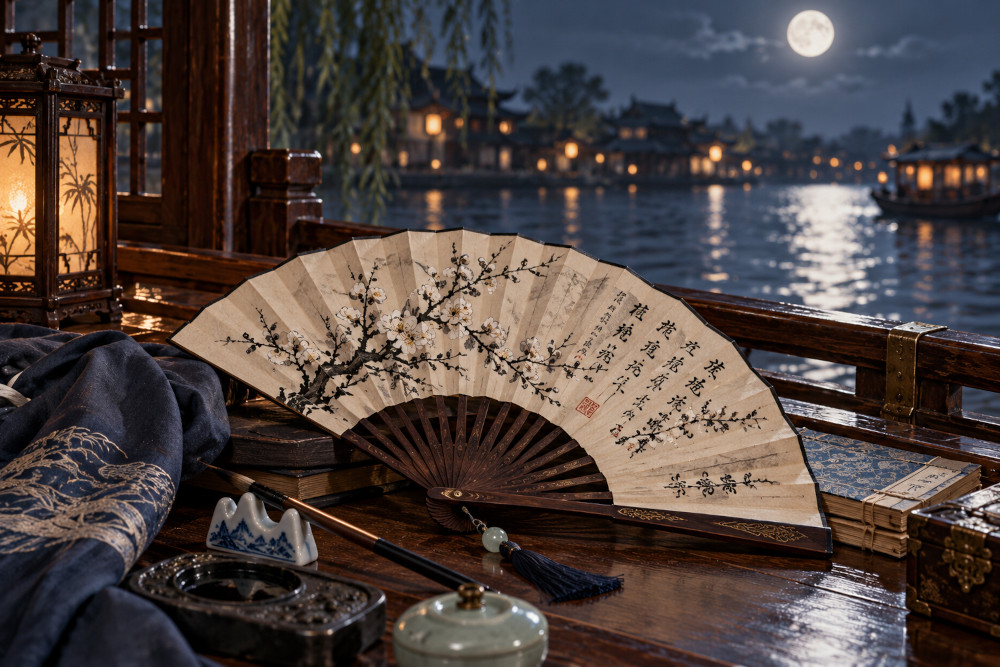
One day, a servant returned to the Huang residence carrying a folding fan. Painted on its surface was a branch of plum blossoms, accompanied by a poem:
The east wind brings word that spring draws near;
While winter lingers, I am first to bloom.
Lest none should recognize my proud spirit,
I stretch an ancient branch beyond the wall.
The painting and poem were the work of Liang Jinkang. When Huixin saw the fan, she was immediately captivated. To her, the plum blossoms represented dignity and perseverance in the face of hardship, while the poem seemed to reflect the scholar’s own character. Although poor, he appeared to possess both ambition and an independent spirit. The more she studied his work, the more she admired him, until she found herself developing feelings for a man she had never met.

Huixin confided her feelings to an elderly servant and asked her to tell her mother. But Mrs. Huang was far from pleased.
“Liang Jinkang is so poor that he can barely support himself!” she protested. “How could someone like him become our son-in-law? We have only one daughter. Are we supposed to marry her to an impoverished scholar and leave her struggling with household work for the rest of her life?”
When she saw how disappointed Huixin was, her mother tried to console her. With her beauty, accomplishments, and the family’s considerable fortune, she argued, Huixin could surely find a husband among the sons of princes and high-ranking officials.
But Huixin remained unmoved. “Were princes and great ministers born into their positions?” she replied. “Sima Xiangru was once a poor scholar himself. Did he remain poor for the rest of his life?”
She was referring to the celebrated Han Dynasty writer Sima Xiangru, whose romance with Zhuo Wenjun, the daughter of a wealthy merchant, had become one of China’s best-known love stories.
Realizing that her daughter would not change her mind, Mrs. Huang privately discussed the matter with her husband. The couple eventually agreed to the marriage, taking inspiration from the story of Sima Xiangru and Zhuo Wenjun. They decided to invite Liang to marry into their family and live in their household.
For Liang, who was struggling desperately with poverty, the proposal was like water brought to a fish stranded in a dry rut. He accepted with delight, and the marriage was soon arranged. After the wedding, he treated his parents-in-law with great respect and enjoyed a harmonious relationship with Huixin. Far from looking down on her husband’s poverty, Huixin continually encouraged him to devote himself to his studies and work toward a successful career.
From poverty to official honors
At that time, the imperial government had recently abolished the traditional civil service examinations. Huixin provided her husband with a substantial sum of money so that he could travel to Japan to further his education. After five years abroad, Liang returned to China and gained admission to the prestigious Hanlin Academy. He subsequently returned to his hometown to pay respects at his ancestral graves and arrange for their restoration.
Liang’s remarkable rise attracted considerable attention. Some people admired his accomplishments, but others took pleasure in reminding him of his humble beginnings. One day, a local resident deliberately mocked him, saying: “Your father-in-law started out as a mere servant, yet now he has a son-in-law in the Hanlin Academy! It seems having a daughter is better than having a son!”

The remark left Liang feeling deeply humiliated and angry. Although he did not dare respond openly, he could not forget the insult. Rather than recognizing how much the Huang family had contributed to his success, he became increasingly resentful of his connection to a household of such humble origins.
Several months later, Liang prepared to travel to the capital to assume his official duties. He purchased a boat and took Huixin with him. One evening, their vessel stopped on a broad stretch of river beneath a cloudless sky. The moon shone so brightly that the night seemed almost like day, and the peaceful scene recalled the famous Tang Dynasty poet Li Bai’s description of a clear night on the Yangtze River.
Liang stood alone beside the mast, enjoying the moonlight and the open expanse of water. His thoughts soon returned, however, to the townsman’s mocking words. As he remembered the humiliation, his earlier pleasure gave way to anger. He then returned to the cabin and said to his wife: “The moon is exceptionally beautiful tonight, and I’m in wonderful spirits. Why don’t we go outside together and enjoy the scenery?”
Betrayal beneath the moonlight
Huixin readily agreed and followed her husband onto the bow of the boat. As they admired the moonlit river, she was reminded of an ancient song and began to sing:
What wondrous night is this,
That we sail upon the river?
What fortunate day is this,
That I may share a boat with a prince?
Afterward, she turned to Liang and said: “Long ago, Emperor Xuanzong of Tang and his beloved Consort Yang admired the moon together at the Palace of Eternal Life. They privately vowed to remain husband and wife through every lifetime. Doesn’t tonight remind you a little of that occasion?”
Liang replied coldly: “Have you never heard of what happened at Mawei Slope?”
He was referring to the place where Consort Yang had met her tragic death. Before Huixin could answer, Liang suddenly pushed her into the river. Caught completely off guard, she fell into the water. He immediately ordered the boatman to depart, and the vessel sailed away, leaving his wife behind.

Yet Huixin did not drown. Something beneath the water appeared to support her body, preventing her from sinking. Although terrified, she remained afloat on the river.
Not far away, another vessel had stopped for the night. A high-ranking official of the imperial clan, known as Lord E, was traveling to the capital under government orders. When he heard a woman’s cries coming from the river, he immediately instructed his boatmen to investigate. They discovered Huixin in the water and brought her safely aboard.
Lord E questioned her about what had happened, but Huixin was so distraught that she could only weep. Although she knew her husband had deliberately pushed her into the river, she was initially unwilling to explain what had occurred. After the official questioned her several times, she finally broke down and recounted the entire incident.
Deeply moved by her suffering, Lord E offered her his protection and treated her as though she were his own daughter. His wife was equally compassionate, welcoming Huixin into their care with genuine affection.
A second marriage proposal
Upon arriving in the capital, Lord E quietly arranged an investigation into Liang Jinkang’s whereabouts. His men soon discovered where the scholar was staying.
Meanwhile, Liang was enjoying his new position and the prospect of a distinguished career. Believing that his wife was dead, he had no reason to suspect that his crime was about to be exposed.
Rather than confronting him immediately, Lord E devised a plan. He asked a respected scholar from the Hanlin Academy to visit Liang and convey a message: Lord E and his wife greatly admired Liang’s learning and accomplishments and wished to offer him their daughter’s hand in marriage.
Liang was overjoyed by the proposal. Lord E was a distinguished member of the imperial family with considerable influence at court, and Liang could hardly have hoped for a more advantageous marriage. Eager to establish a connection with such a prominent household, he accepted without hesitation.
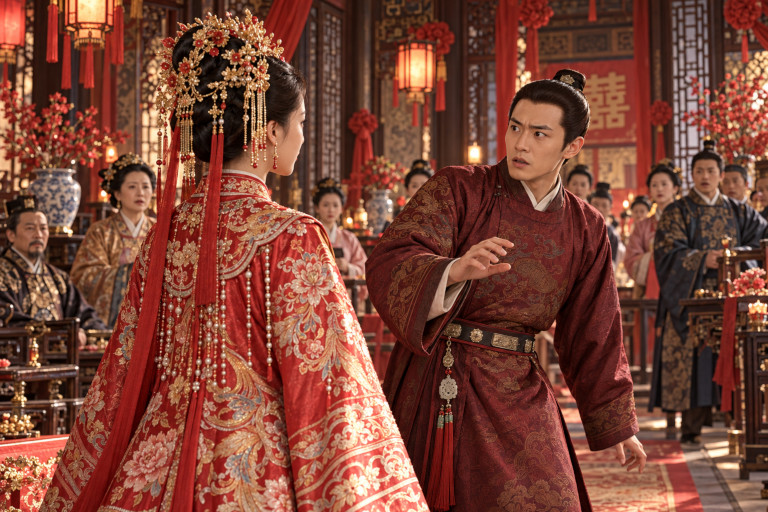
When the wedding day arrived, Lord E’s residence was filled with distinguished guests. Carriages crowded the surrounding streets as princes, ministers, senior officials, and members of the Hanlin Academy gathered to celebrate. Liang was delighted by the occasion. Having risen from poverty to a prestigious government position, he was now about to marry into one of the capital’s most influential families.
But when he entered the inner hall and saw his bride, he was struck with terror. Standing before him was none other than Huixin, the wife he had pushed into the river and believed to be dead. Liang stared at her in disbelief before shouting: “A ghost! A ghost!” He immediately turned and fled, so frightened that he neglected even to straighten his hat and shoes. The guests burst into laughter at the spectacle, but Lord E ordered his attendants to bring Liang back.
A scholar’s disgrace
Before the assembled guests, Lord E revealed everything Huixin had told him, along with the evidence uncovered during his investigation. Realizing that his crime had been exposed, Liang fell to his knees, repeatedly bowing his head and begging for mercy. Lord E, however, was unmoved.
“When you were poor,” he declared, “your wife’s family did not despise you. They paid for your education and made it possible for you to enter government service. Your wife devoted herself to supporting you and helped you achieve everything you now possess.
“Yet instead of showing gratitude, you allowed a single mocking remark to turn you against her. You pushed your own wife into the river and left her to die. How can a man so heartless and ungrateful be permitted to serve the imperial court?”
Lord E then arranged for Liang’s offenses to be formally investigated. He prepared a detailed report of the accusations and submitted it to the imperial court. After reviewing the circumstances, the court concluded that Liang’s ingratitude and attempt to murder his wife made him unfit for public office. An imperial decree stripped him of his position in the Hanlin Academy, removed him from his duties, and ordered that he be investigated and held accountable under the law.
The wedding that Liang had expected to bring him greater prestige instead became the occasion of his disgrace. The princes, ministers, and distinguished scholars who had gathered to congratulate him witnessed his downfall. The man who had risen from poverty to a respected position at court now faced punishment for betraying the very people who had helped him succeed.
Huixin, meanwhile, had survived her husband’s attempt on her life and found safety through the kindness of Lord E and his wife.
The true measure of character
In later years, Huixin often thought about the folding fan that had first drawn her to Liang Jinkang. She remembered the plum blossoms painted against the winter cold, their weathered branches reaching proudly beyond the wall. The painting and poem had led her to believe that their creator possessed the same strength of character and noble spirit as the blossoms themselves.
Yet Liang had ultimately proved otherwise. Though he could portray the plum blossom’s dignity and resilience in his art, he had failed to demonstrate those qualities in his own life. The poverty he once endured had not destroyed his ambition, but the success he later enjoyed had exposed his lack of gratitude and integrity.
A person may be poor without losing dignity or ambition. But when success comes, one must never forget the kindness of those who helped make it possible.
Source: Modern adaptation of a story recorded in Volume 3 of Nangao Biji (南皋筆記).
Translated by Chua BC
Follow us on X, Facebook, or Pinterest
