
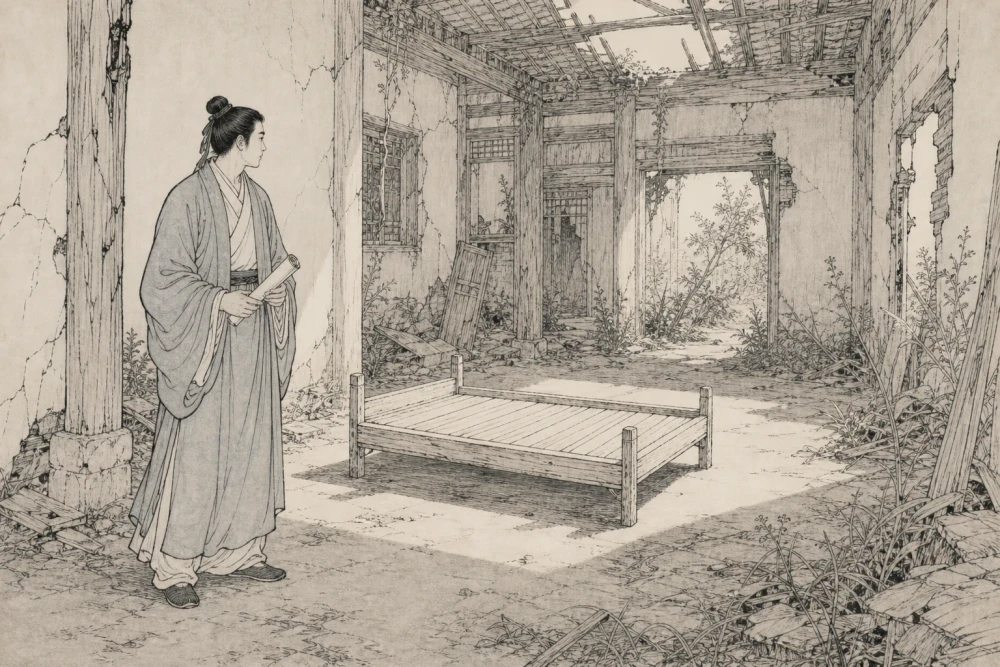
During the Tianbao era of the Tang Dynasty, a haunted house in Yongle Lane, Chang’an, often saw strange things happen. Everyone who lived there went bankrupt, and sometimes families were destroyed, or people died. As a result, no one dared to live there, and the house gradually fell into disrepair. Its halls and rooms were empty and desolate, and over time, dense weeds grew inside and around the property while foxes, rabbits, insects, and snakes frequently appeared. One day, a scholar named Su Wei from Fufeng, Shaanxi, who had no official position, was wandering around Chang’an. At first, he was happy to stay with relatives and friends, but as time passed, they grew indifferent, forcing him to move on.
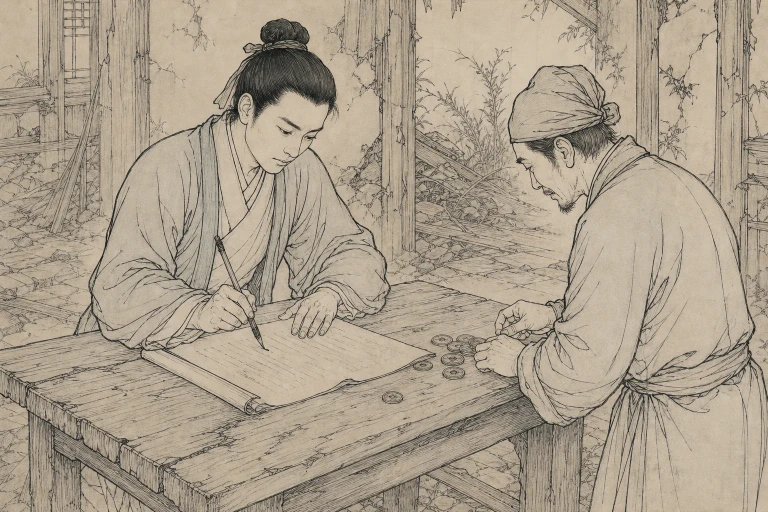
When he heard about the haunted house, Su knew it would be cheap. He approached the owner and was overjoyed when he was sold the house for a few coins. As the saying goes: “A hungry man will not choose his food, a cold man will not choose his clothes.” At that moment, he didn’t care about the house’s condition; as long as he had shelter from the rain and wind, he was content. He signed a contract with the owner and became the new landlord. That evening, he borrowed an empty bed from a friend and brought it into the house, placing it in the center of the hall, as it was the only bright and clean place. He slept soundly in his room only to be awoken after the first watch of the night, which runs from sunset to ten o’clock.
Seeing the bright moonlight and the misty grass outside, he was inspired to write poetry and went outside for a stroll to admire the moonlit scenery. As he walked and recited poetry, he suddenly spied a golden object under the east wall, shaped like a person, but without hands or feet, shimmering inside and out. The object seemed not to see him; instead of fleeing immediately, it shouted: “Hey!” Su was startled and stood frozen, afraid to move. After a while, the golden thing yelled out again: “Rotten wood!” Something at the base of the west wall responded: “Yes! Is anyone there?” The golden thing listened for a moment and exclaimed: “I don’t know!” Then it said: “Big hard hammer.” The rotten wood replied: “Terrible.” The two things talked for a long time, then disappeared.
A spirit reveals the house’s secrets to the poor scholar
Su felt very strange, wondering what exactly this golden thing was, and what that thing called rotten wood was. He walked to the middle of the courtyard and suddenly blurted out: “Golden essence belongs to me, fate dared not call out!” He himself didn’t know what he was saying. At this moment, the rotten wood replied: “I don’t know.” he asked again where all the people they had killed before were, and the rotten wood said that was all done by Jin Jing and no one else. Those people were unlucky and unfortunate, unsuitable to live in this house, so their families were destroyed, and they died, while the spirits never touched a hair on their heads. Upon hearing this, he thought the golden thing must be Jin Jing, having heard that when gold and silver encounter people, they transform into strange objects, and those not fortunate enough to obtain them not only fail to get them but also attract misfortune. It seemed Jin Jing took pity on his poverty and wanted him to dig it out to help the poor.
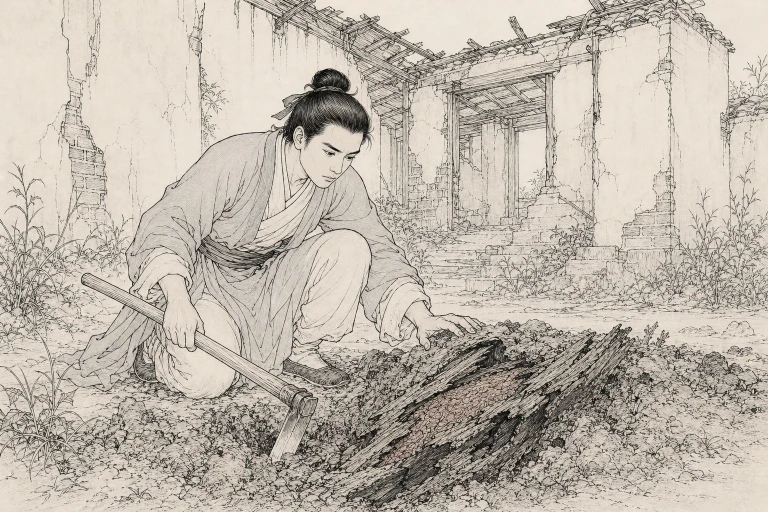
The next day, everything was the same, as if the previous night’s events had been a dream. With a try-it-and-see attitude, Su borrowed a hoe and shovel and began digging at the base of the west wall. After digging about three feet deep, he found a piece of rotten wood with a blood-red center, and when he tapped it, it was as hard as stone. He dug a few more feet but found nothing, so he turned to the base of the east wall. After two days of digging, he finally found a huge rock beneath it, over ten feet deep. The rock was fourteen feet wide and eighteen feet long, and a line of seal script was inscribed on it: “Thirty catties of purple gold from the Emperor, bestowed upon the virtuous.” He wondered what virtue he possessed that deserved such a reward, then thought that if he obtained these treasures and cultivated virtue, that too would be considered virtuous. After much deliberation, he decided against it because he was a good man and dared not casually take the thirty catties of gold.
The scholar renames himself and earns a bright future
Night fell, and Su lay in bed, sighing, unsure of how to rightfully obtain these treasures. Just as he was deep in thought, the rotten wood suddenly said to him: “Why don’t you change your name to Su Youde? Changing your name will solve everything.” He jumped out of bed, clapping his hands and laughing, asking why he hadn’t thought of that, so he prayed to the gods and changed his name. The rotten wood then said his hometown was in Kunming Lake, and if he could send him home, he would no longer trouble him, which he agreed to immediately.
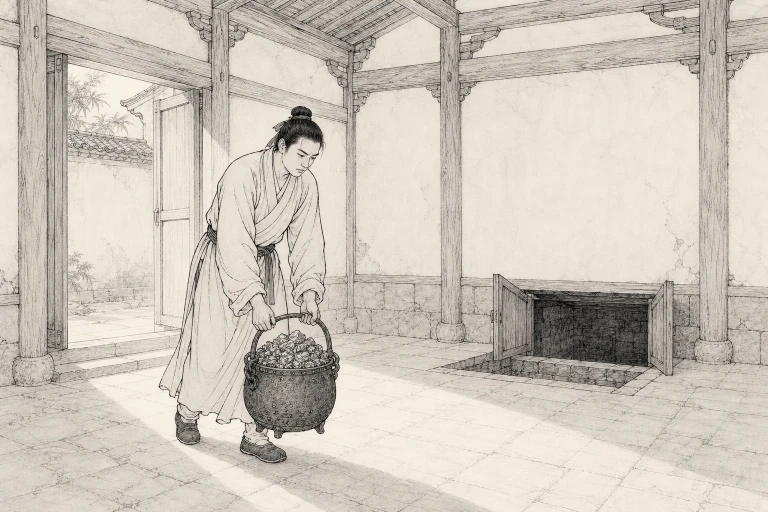
The next morning, Su dug frantically again, digging another ten feet deep, and discovered an iron urn containing thirty catties of purple gold. He carried the urn and gold out and placed them inside his house, and a few days later, he went to the city and hired several masons and carpenters to renovate the entire house, restoring it to its former glory. After the house was repaired, and as promised, he took the rotten wood to its home on the banks of Kunming Lake. Returning home, he secluded himself to study diligently, prepared for that year’s imperial examination, passed it, and then joyfully awaited his official appointment. Soon after, the military governor of Fanyang invited Su to serve as his advisor; he was virtuous and talented, did many good deeds for the people, and earned the governor’s appreciation. Seven years later, the imperial court appointed him governor of Jizhou, and his career flourished while his household remained peaceful and undisturbed.
Translated by Eva and reviewed by Maria
Follow us on X, Facebook, or Pinterest
