
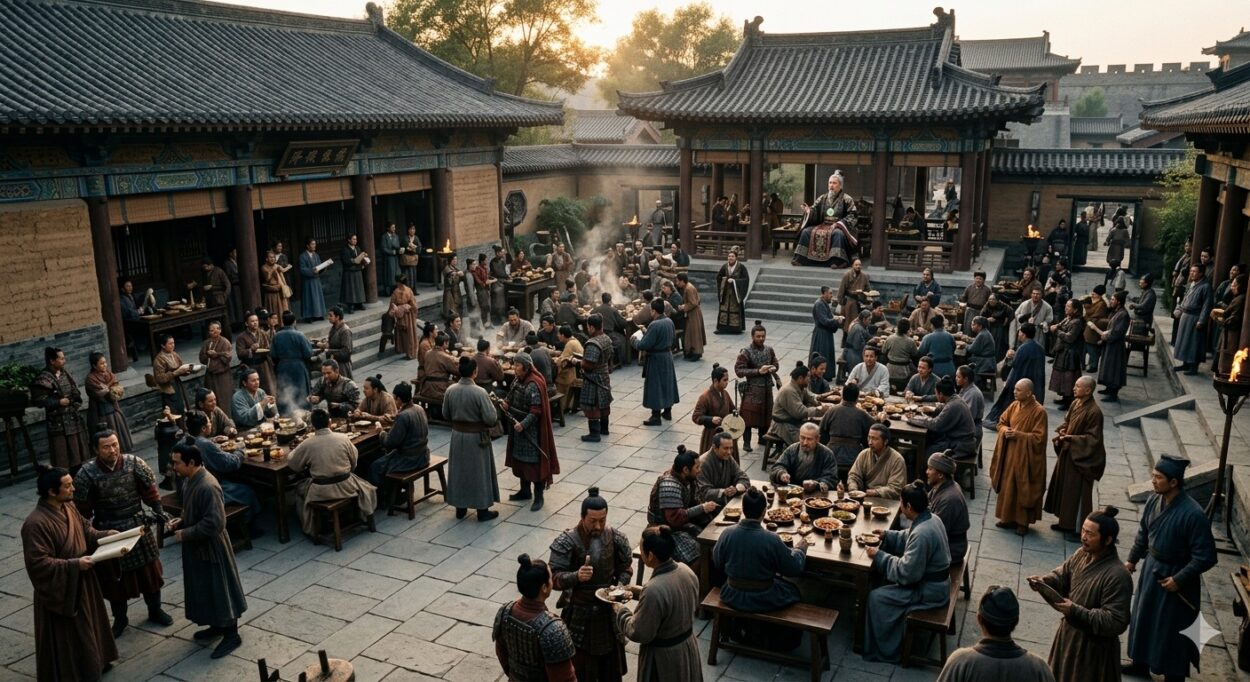
In The Strategies of the Warring States: National Strategies, there is a story entitled “Feng Xuan, Guest of Lord Mengchang.” It tells of Lord Mengchang of the State of Qi during the Warring States period (475-221 B.C.), who hosted thousands of guests under his roof.
Among them was a man named Feng Xuan, who once drew his sword and sang at Lord Mengchang’s residence: “When shall I return with my long sword? I have no fish to eat, no carriage to ride, and no means to support my family.” As a result, Feng Xuan was provided with fish to eat and a carriage to ride, and his mother also received care from Lord Mengchang.
One day, Lord Mengchang issued a notice asking the guests in his household: “Is there anyone here skilled in accounting and financial management who can go to Xue on my behalf to collect debts?” Feng Xun wrote on the notice: “I can.” So Lord Mengchang sent Feng Xun to collect the debts. As he was taking his leave, Feng Xun asked: “Once all the debts have been collected, what should I buy with the money?” Lord Mengchang replied: “See what my household lacks, and buy that.”
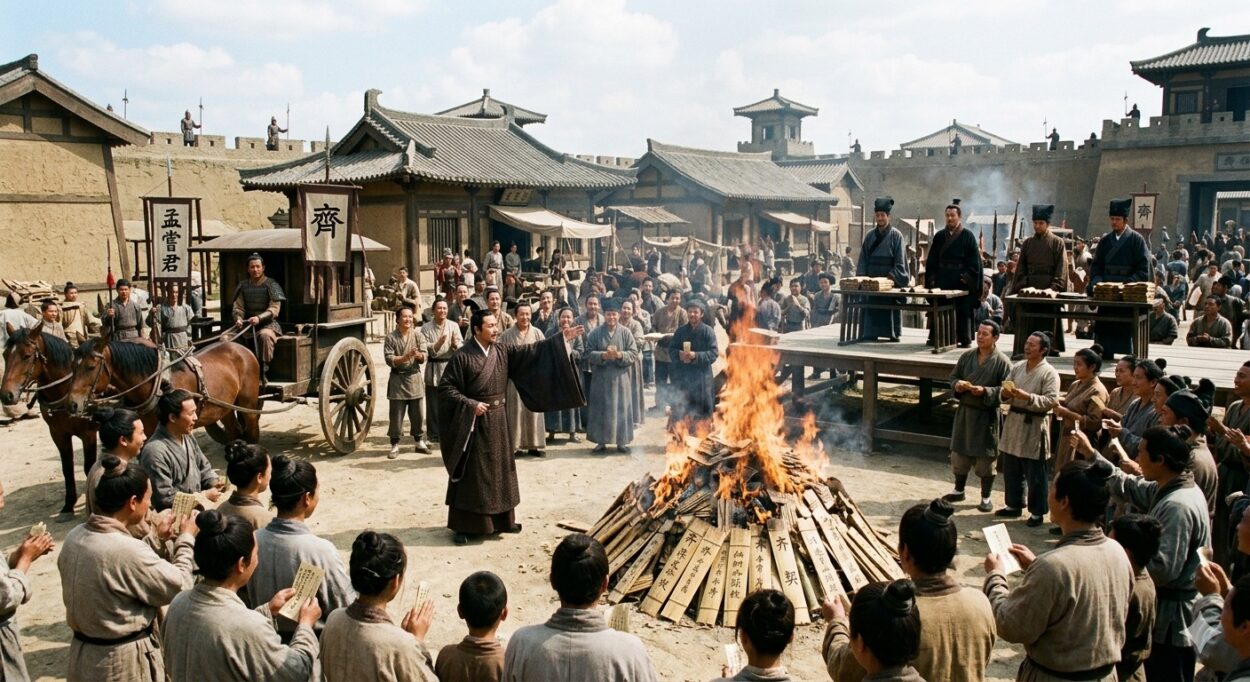
Debts forgiven
Feng Xuan drove his carriage to Xue City. There, he summoned the officials and ordered them to gather all the citizens who owed debts, so that their loan contracts could be verified. Once the records were examined and confirmed, Feng Xuan declared — falsely claiming to act under Lord Mengchang’s authority — that the debts were to be forgiven. He returned the borrowed funds to the people and publicly burned all the loan contracts. The people were overjoyed. They cheered in unison, crying out: “Long live our lord!”
Feng Xuan then hurried back to Qi’s capital without delay and requested an audience with Lord Mengchang early the next morning. Lord Mengchang was surprised at his swift return. He quickly dressed in his robes and cap to receive him and asked: “Have you collected all the debts? How did you return so soon?”
Feng Xuan replied: “I have collected them all.” Lord Mengchang asked again: “What did you buy with it?” Feng Xuan said: “You instructed me to ‘buy whatever your household lacks.’ I considered your mansion already filled with treasures, your stables crowded with fine dogs and horses, and your halls lined with beautiful women. The only thing your household lacks is ‘righteousness,’ so I have bought righteousness for you.”
Lord Mengchang pressed further: “And how exactly did you go about buying righteousness?” Feng Xuan replied: “At present, you possess only the small territory of Xue, yet you do not nurture or care for its people. Instead, you treat them as merchants would, collecting interest from their debts. I took it upon myself to claim your authority and burn the loan contracts. The people rejoiced in unison, crying out ‘Long live the lord!’—this is the righteousness I have purchased for you.” Lord Mengchang was displeased and said, “Very well, let it be.”

The meaning of righteousness is revealed
A year later, King Min of Qi said to Lord Mengchang: “I do not dare to treat the ministers of my predecessor as my own ministers.” In effect, this meant that Lord Mengchang could no longer remain in his position and had no choice but to return to his fiefdom at Xue City.
When he was still about 50 kilometers from Xue City, the people of Xue came out in full force. Many brought their elderly parents and guided their young children by hand, helping them along the road as they lined the main route to welcome Lord Mengchang. They remained there waiting for him throughout the entire day. Seeing this, Lord Mengchang turned to Feng Xuan and said, “The ‘righteousness’ you bought for me has finally been revealed today.”
Benevolence and righteousness are not as tangible as money or material goods; therefore, Lord Mengchang was initially very displeased with Feng Xuan’s decision to “purchase” them. It was only when he was later exiled by the King of Qi and returned to Xue that he realized what he had once lost had now been repaid to him many times over. At that moment, he came to understand the truth: “Benevolence and righteousness outweigh material gain!”
Translated by Audrey Wang and edited by Tatiana Denning
Follow us on X, Facebook, or Pinterest
