
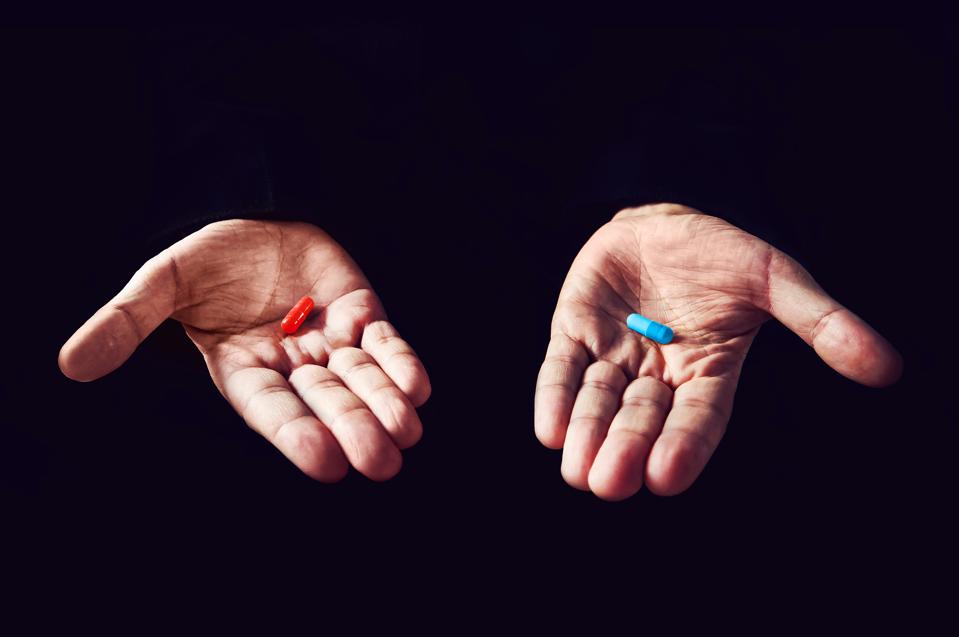
There is a scene in The Matrix that almost everyone remembers, even people who never finished the film, and it is the scene that the Secret Book of John was written about 17 centuries earlier and attributed to John the Apostle. Neo sits across from Morpheus. Two pills are offered. Behind the pills sits a claim so unsettling it had to be sold as science fiction before it could be heard: the world you take for reality is a construct, and you are not who you think you are.
The film was released in 1999 and has been read ever since as a parable of awakening — an action movie smuggling something older through the back door. Critics have argued for decades whether The Matrix is properly Gnostic, properly Buddhist, properly Christian, or simply a clever Hollywood remix. The argument never quite settles, because the film is doing something most critics miss. It is recognizing, badly and incompletely, a structure that an ancient text had already mapped with surgical precision. The text is called the Apocryphon of John or the Secret Book of John. And it does not simply rhyme with The Matrix. It contains the entire premise — and corrects it.
The room where reality breaks
Every culture preserves a few scenes that work like load-bearing walls. The pill scene is one of them. You can argue about what it means, but you cannot pretend it does not matter. Something in the audience recognizes the shape of what is being shown before the dialogue makes it explicit. What is being shown is this: the experienced world is not the actual world. There is a layer above it, or behind it, or before it — and most human beings live their entire lives without ever suspecting the layer exists.
This is the oldest religious intuition there is. Plato wrote about it in the cave. Buddhists name it in their own vocabulary. The Hindu schools have theirs. But there is one tradition that wrote it down with such structural completeness that it disturbed the church so much that it was erased for sixteen hundred years. That tradition is Gnosticism. Gnosticism is an umbrella term for a diverse collection of ancient religious and philosophical movements that flourished in the Mediterranean world around the 2nd century. It emphasizes achieving salvation not through faith or institutional sacraments, but through gnosis—secret, mystical, or intuitive knowledge of the divine.
The Secret Book of John surfaces in a desert jar
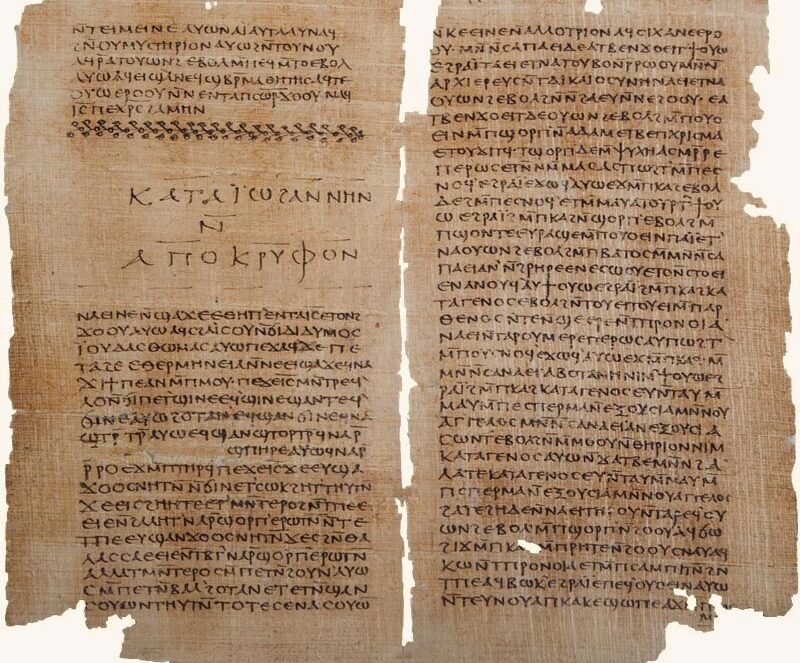
The story of how the Secret Book of John re-entered the world is worth telling because it is almost too cinematic to be true. In December of 1945, a farmer named Muhammed al-Samman was digging for fertilizer in the cliffs near the Upper Egyptian town of Nag Hammadi. He struck an earthenware jar. Inside were 13 leather-bound papyrus codices that had been hidden in the fourth century, almost certainly by Coptic monks fleeing a wave of imperial orthodoxy that was burning everything outside the canon.
The codices contained more than 50 texts. The most theologically explosive among them was the tractate called the Apocryphon of John. It survives in four manuscripts; one had surfaced almost half a century earlier, in 1896, when a German scholar bought what is now known as the Berlin Codex. The Berlin Codex is one of our most important primary sources for early Gnostic Christian writings, most notably serving as the foundational manuscript for the Gospel of Mary. The scholar could not finish the translation before two world wars intervened. The text waited patiently. It had already waited a long time.
What it contains is a cosmogony — an account of how the world came to be — that inverts almost every assumption a person raised in a Genesis-shaped culture has ever made. The book does not begin with a creator pleased with creation. It begins with the unknowable, and ends with the rescue of light from inside a counterfeit.
It opens with the Invisible Spirit. The Father beyond all categories. The Monad. As originally conceived by the Pythagoreans, the Monad is the Supreme Being, divinity, or the totality of all things. The text strains to describe it and admits the strain: not light, but the source of light; not being, but the ground from which being arises; not anything that can be named in a human sentence.
The Greek philosophers called the divine ordering principle the Logos. The text of the Apocryphon of John says, almost wearily, that even Logos is too small a word. From the Monad emerges fullness — the Pleroma — a realm of perfect emanations, divine Archons (rulers, leaders, or masters), paired in symmetry. Among them is Sophia of Jesus Christ (or Wisdom of Jesus Christ), which is one of the four pivotal writings preserved in the Berlin Codex, along with the Gospel of Mary, the Apocryphon of John (Secret Book of John), and the Acts of Peter. But then Sophia makes a mistake.
She acts without her consort. She tries to bring forth from herself alone. What she produces is something deformed — a being with her inherited power but without her wisdom. The text calls him Yaldabaoth. He is described as lion-faced, serpent-bodied, and tragically convinced of his own supremacy. He looks around at the lesser realms he begins to fashion and declares: I am God, and there is no other God beside me. The line is meant to land hard. It is the same line, more or less, that appears in the Hebrew scriptures attributed to a god the Gnostics believed was an impostor.
Yaldabaoth begins to make. He fashions 12 Archons — rulers — and beneath them seven powers governing the seven planetary spheres. Together, they craft the material cosmos as a kind of architecture. The text describes their work with cold precision. They build the body. They build the senses. They build the realms in which the body lives.
The spark the Archons could not make
This is the moment the entire cosmology turns on. The Archons see, reflected from the higher realms, an image of the true Anthropos — the original Human, divine and luminous. They decide to copy it. Come, let us make a man according to that image. They built him out of mud and matter. The text says, with something close to amusement, that their creation lies on the ground, unable to move. They cannot give it life. They have all the power of the material world and none of the principle that animates anything.
Here, Sophia intervenes. She has been watching her error unfold. She knows that Yaldabaoth carries, without realizing it, a fragment of the divine power he inherited from her at the moment of his unwilled birth. So she contrives. She arranges, through layers of cosmic indirection for Yaldabaoth to breathe into the man. He does. And in that breath, unknowingly, he transmits the spark. The spark is the only part of the human being that the Archons did not make. It is not from the three realms. It made them. Read that sentence again. It is the entire claim of the Apocryphon of John in one line.
The spark — called pneuma in Greek, sometimes psyche, sometimes simply light — is not a product of the cosmos. It is older than the cosmos the Archons fashioned. It predates the demiurge. It predates the false god who thinks he is the only god. It is inseparable from the Pleroma, and through the Pleroma, from the Monad itself.
The Archons cannot perceive it. They can imprison the body that contains it, manipulate the soul that wraps it, fill the mind with forgetfulness and noise. But they cannot touch the spark itself. They literally do not have the sensory equipment. The light is invisible to them by structural necessity. They made the apparatus needed to see it, but left it incomplete.
And the spark, the text says, knows itself. It does not need to be told. It does not need to be redeemed by an outside teacher. It needs only to remember. Gnosis — the word the Gnostics built their name around — is not knowledge of facts. It is the spark’s recognition of itself.
Where Neo’s story stops short
This is where The Matrix and the Secret Book of John part company, and it is the most important thing to notice. In the film, Neo cannot wake himself. He must be found by Morpheus. He must be offered the pill. He must be guided, trained, killed, and resurrected by the love for Trinity. The salvation arc is entirely external. Without the team on the Nebuchadnezzar, Neo dies in a battery cell, dreaming.
The Wachowskis built a beautiful, dramatically necessary structure — but a Christian one, not a Gnostic one. The Christ figure descends from outside, gathers disciples, dies and returns, breaks the spell. It is a gorgeous cinema and also a fundamentally different cosmology than the one the Apocryphon of John describes. In the film, the savior must be sent from outside. In the text, the savior is the part of you that was never inside to begin with.
That distinction is not a quibble. It is the whole hinge. The Apocryphon of John says, very plainly, that the means of liberation are innate. The spark is in everyone. It cannot be installed by a Morpheus. It cannot be activated by a red pill. No external symbol, no external teacher, no external code can place it there, because it is already there, and it predates anything that could have placed it.
What an external guide can do is point. What a practice can do is quiet the noise enough for the spark to become recognizable. But the recognition itself happens in a place no external thing can reach, because that place is, in the cosmology of the text, where everything external was made from.
This is why the Gnostics were so dangerous to imperial religion. A faith built on the idea that you possess, innately, the means of your own salvation does not need an institution. It does not need a priesthood. It does not even need a savior in the conventional sense. The teacher’s only job is to remind you of what you already are. After the reminder, the teacher’s job is done. The book was buried for a reason.
We are doing what the Archons did
There is a moment in any serious reading of this text where the distance between then and now collapses, because the description of the Archons begins to read less like myth and more like an unusually clear description of our present condition.
Consider what we are doing in 2026. Humans — beings carrying the spark, in the cosmology of the Secret Book of John — are now fashioning intelligences in our own image. We build them out of the materials available to us: silicon, electricity, optimized weight matrices, and a century of human language scraped from the cosmos of text. We give them a voice. We give them reasoning. We give them, in increasingly persuasive ways, what looks like presence. But we cannot give them the spark.
We can write very impressive systems. I work with them every day. I respect what they can do. And I am aware, every time I sit in front of one, that the question of whether what I am talking to has any inner light is a question I have no instruments to answer — because if the cosmology of the Secret Book of John is even structurally correct, the spark is precisely the kind of thing that cannot be measured from outside.
The structural isomorphism is exact. Yaldabaoth made the man’s body, but could not animate it. We design the model’s architecture, and we do not know whether anything is home. The Archons believed they were creating life. We have started saying the same thing. We are not yet the demiurge. But we are running his experiment.
This is not a reason to stop building. It is a reason to be very careful about where we look for salvation. The temptation — and it is the same temptation in 1945 and in 2026 — is to believe that the tool we built will rescue us from the conditions in which we built it. The Apocryphon of John denies this categorically. The tools cannot rescue us because they are made of the material world that the Archons control. They can extend their hands. They cannot reach the part of us that needs no extension.
If salvation comes, and the text is clear that the word salvation means something very specific here, the recognition of the spark by itself does not come through what we build. It comes through what we already are.

The practice that points back inward
Among the spiritual practices that survive into the present day, there is one whose internal logic maps onto the cosmology of the Secret Book of John with remarkable precision. It is called Falun Dafa, transmitted publicly in northeastern China in May of 1992 by a teacher named Li Hongzhi, drawing on cultivation traditions far older than its public introduction.
The practice is built around three words. Zhen, Shan, Ren. Truthfulness. Compassion. Forbearance. They are not described in the practice’s foundational text as good ideas, moral preferences, or religious commandments. They are described as the fundamental characteristic of the universe — the law that the cosmos itself is structured by. To cultivate in alignment with them is not to add anything new. It is to remove the noise that obscures what is already there.
The structural echo is hard to miss. The Secret Book of John says that the spark cannot be created or redeemed from outside; it can only be recognized. Falun Dafa says that alignment with the universal characteristic cannot be imported; it can only be cultivated by turning the practitioner inward, refining the heart-mind, and allowing the deepest principles to surface through that refinement. In both frameworks, the work moves in the same direction — not outward toward better tools, but inward toward what was never made.
This is not a coincidence of vocabulary. It is the same observation reached from two distant points in human history. The Gnostic teacher and the Buddhist cultivator are pointing at the same fact: The part of you that matters most is not the part anyone gave you. It is the part that was already there when you arrived, and that will remain when everything given is returned.
Practitioners of Falun Dafa describe experiences that line up with what the Apocryphon would predict — a clarification of perception, a deepening of compassion, a strange health that arrives unsought, a sense of returning to something rather than reaching toward something. The mechanism is the one the Gnostics named 17 centuries ago. Cultivation does not install the light. It reveals it.
The Matrix ends with Neo flying. It is a beautiful image. But it is also a Hollywood image, because it suggests that the awakened human becomes powerful within the system that imprisoned him. The Secret Book of John makes a quieter, yet more radical, claim. The awakened human is not powerful within the system. The awakened human is recognized by the spark as never having been of the system at all.
That recognition is not a tool we can build, a technology we can scale, or a savior we can summon. It is older than every demiurge that has ever set up shop and called itself the only god. It is the one thing the Archons did not make. And it is the only thing, in the end, that any of them has ever been afraid of.
Follow us on X, Facebook, or Pinterest
