
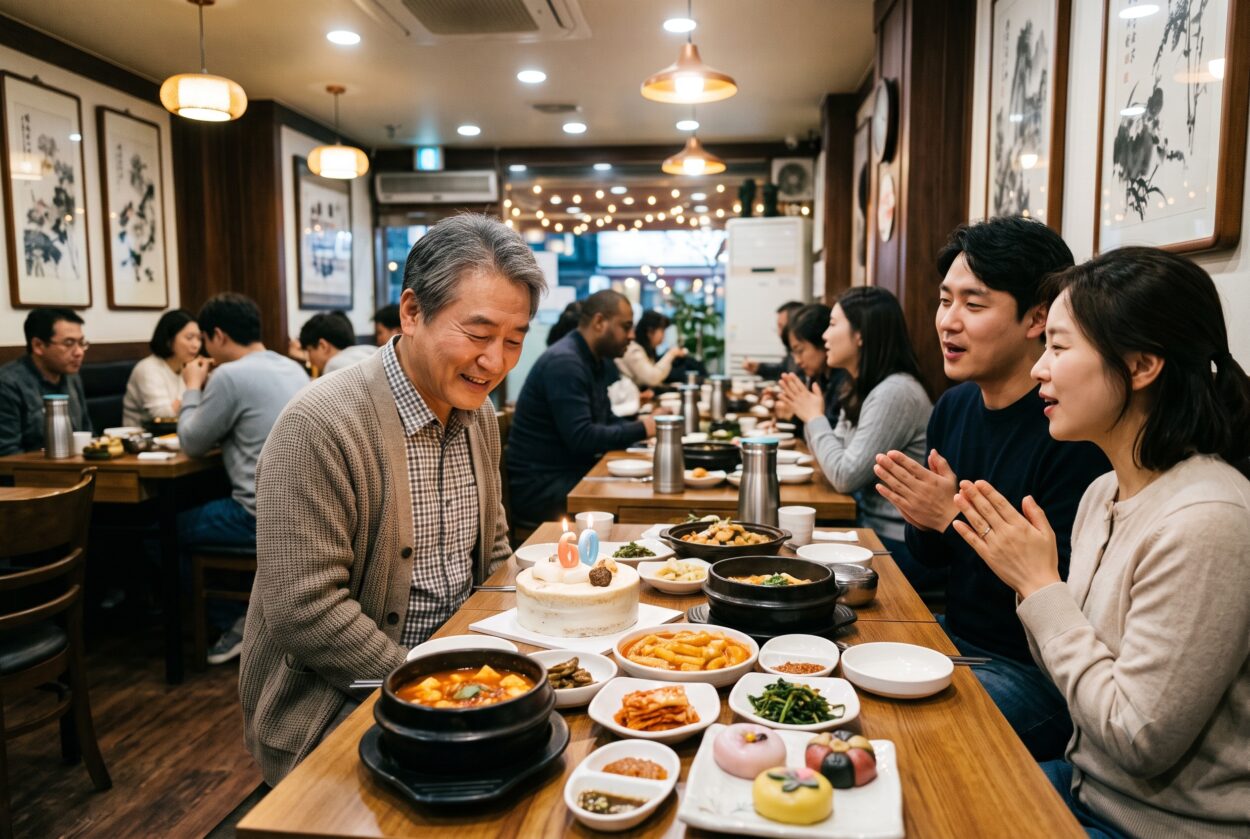
The Korean restaurant was bustling with happy diners. Before me sat a steaming bowl of fragrant tofu stew, an irresistible array of side dishes, and beautifully crafted cakes that filled the air with sweetness. My children smiled warmly as they softly sang “Happy Birthday.” Having completed my 6th decade of life and stepped into what the Chinese call “the age of er-shun” — the age when one hears life’s truths with ease and acceptance — I found my heart overflowing with gratitude and happiness. At 60, one realizes that happiness is often much quieter than one imagined in youth. It may simply be a meal shared with loved ones, a birthday song sung softly across the table, and the privilege of growing older together.
Middle age brings far more farewells than hellos
In ancient times, people generally lived much shorter lives. Even among China’s emperors — men who enjoyed wealth, power, and every imaginable luxury — more than eighty percent failed to reach the age of 60. To celebrate one’s 60th birthday was therefore considered a truly joyous milestone. When I was younger, life felt like an endlessly spinning top — juggling family responsibilities, career obligations, and countless daily concerns. Retirement has gradually quieted the pace of life. Desires have become fewer, attachments lighter. I no longer feel compelled to compete with others or argue over trivial matters. Perhaps this is what Confucius meant by er-shun — a state of calm acceptance and gentle understanding.
We contemplate what it feels like to walk downhill on the road of life
The renowned writer Liang Shiqiu offered a humorous description in his essay Middle Age: “Obituaries arrive one after another. Some impatient friends have gone ahead of us, which is rather discouraging. At the same time, one suddenly discovers that countless young people have appeared out of nowhere.” He continued: “Middle age is when one frequently hears of old friends passing away while seeing more and more young faces before one’s eyes… Looking ahead, life is all downhill — and much easier to walk.” The downhill path may be easier to walk. The only mystery is how much farther the road extends.
The moments that come too late teach us to treasure today
Life’s train never stops moving. Along the journey, people board and depart at different stations. We cannot stop the train, nor can we turn it around. As the years pass, I have come to believe that everything in life unfolds according to a greater arrangement. What we call “coincidence” may be destiny arriving sooner than expected. Life’s greatest regrets are hidden inside two words: “next time.”
By a fortunate coincidence, I reconnected with one of my beloved junior high school teachers. Two classmates and I brought our children to visit her. We spent an afternoon talking and laughing together. As we prepared to leave, she reached for her wallet and repeatedly insisted on treating us to dinner. Feeling awkward letting our teacher pay, we declined and promised to visit soon. None of us knew that “next time” would never come. That farewell became our last. I have regretted it ever since.
A gifted artist friend collapsed unexpectedly while teaching at a university. Although doctors saved his life, he never regained consciousness, spending his remaining days bedridden. In my memories, he remains forever young, talented, and cheerful. We never had the chance to say goodbye.
After more than thirty years, I finally reunited with a former college classmate who had retired to the beautiful mountains of Puli. Excitedly, he promised to take us on a tour of Mount Hehuan and Cingjing Farm — his “secret garden” in the mountains. Then the pandemic swept through. By the time we heard from him again, he was gone. Our long-awaited reunion among the mountains vanished like mist in the morning sun.
My children’s gentle piano teacher patiently accompanied them throughout their childhood. Even after the children left for college, whenever they came home, we kept meeting regularly over coffee. One day, when I invited her to join us again, her phone was disconnected. Had she moved away without leaving any contact information? Or something else? And so another “next time” quietly disappeared. Life’s many encounters — and its many unfinished farewells — have taught me to treasure the happiness that still rests within my reach today.
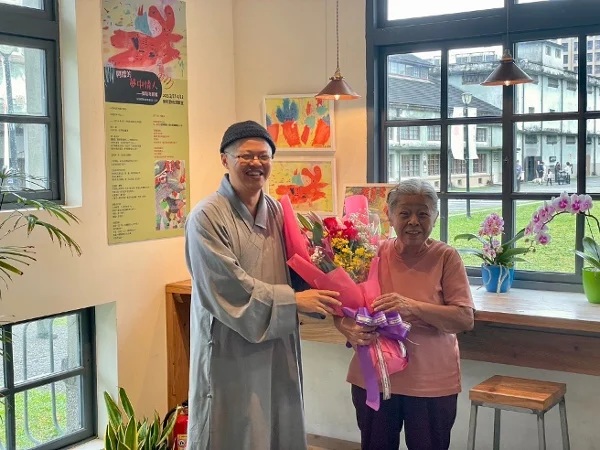
Grandma Jimei is an ordinary woman who discovered an extraordinary dream at eighty
During Taiwan’s long holiday commemorating the February 28 Peace Memorial Day, I attended the opening of an art exhibition titled: “Grandma’s Dream Lover — The Paintings of Cheng Ju-Mei.” The star of the exhibition was my eighty-year-old aunt, who signs her paintings simply as “Jimei.” She has no impressive academic credentials or professional artistic training. She is not an eloquent speaker. Yet the gallery opening was filled with laughter, warmth, and people eager to celebrate her work. In many ways, my aunt is a portrait of countless Taiwanese women of her generation.
Because of poverty, she was unable to continue her education after elementary school and entered the workforce at an early age to help support her family. After marriage, her husband suffered from chronic illness while her son was still young. She worked tirelessly and quietly shouldered life’s responsibilities. From youth to old age, her days were simple and repetitive. She never imagined life would one day put her in the spotlight at her own art exhibition. Three years ago, she suffered a serious fall. Fortunately, kindhearted people appeared along her path, and through an unexpected opportunity, she began studying painting under an art teacher. Sometimes life closes one door only to reveal a window we never knew existed.
We realize that it is never too late to begin
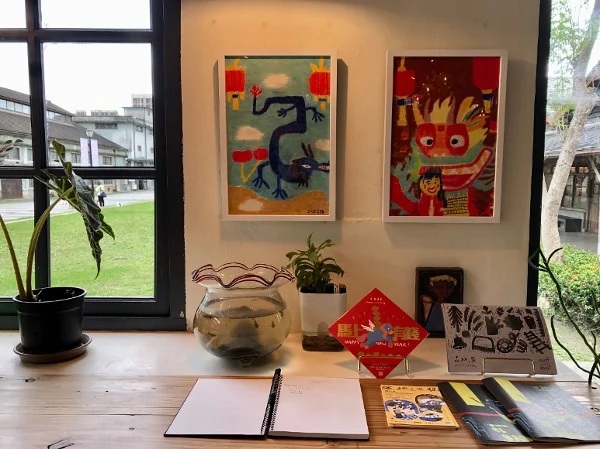
My aunt had always believed that painting was something reserved for highly educated people. Then one day, someone placed a sheet of paper and a box of crayons before her. Using only her eyes, heart, memories, and intuition, she began to draw. Her artwork is vibrant and richly layered — at once concrete and abstract, whimsical and mysterious. Her paintings carry a childlike innocence, yet they also reflect a soul quietly exploring the beauty of freedom and self-expression. They are deeply moving precisely because they are so genuine. I could not be more proud of her. Standing at the crossroads of 60, I found myself asking: What dreams still remain unfinished in my own life? My aunt’s story offers a simple but profound answer: It is never too late to begin. Or, as a popular saying wisely reminds us: “You don’t become great before you start — you become great because you started.”
My mother’s life serves as a beautiful portrait of strength and sacrifice
When I excitedly told my bedridden mother about my aunt’s art exhibition and encouraged her to pick up some crayons herself, she quietly replied: “My hands shake. I can’t draw.” So I suggested: “You could sing. The doctor said singing would be good for you.” She answered: “My hands shake. I can’t hold a microphone.” At that moment, I was at a loss for words — and smiling ever so slightly at my mother’s wonderfully creative logic.
My mother has spent her entire life fighting against hardship. She left elementary school to work as a domestic helper and nanny in order to support her younger siblings. After marriage, she devoted herself entirely to her husband and children. When my father passed away, she became both shelter and strength for our family. Life was never easy. She painted walls herself, mixed cement, climbed onto rooftops to apply waterproof tar, and trimmed large tree branches before typhoons arrived. During fierce storms, she nailed protective boards over the windows. When one has no one to rely upon, one learns to become capable of almost everything.
Through poverty and struggle, our family also received the kindness of many generous people whose compassion helped us continue moving forward. Eventually, after years of perseverance, better days finally came. Yet illness found my mother in her later years. Unlike my optimistic and outgoing aunt, my mother is naturally shy and withdrawn. To her, home has always been the safest place in the world. Slowly, within the comfort of those familiar walls at home, she has begun to wither like a flower that no longer reaches for the sunlight. That, perhaps, is the greatest difference between the two sisters.
I contemplate what will happen if I have 20 more years
Looking honestly at myself, I realize that I, too, have inherited some of my mother’s tendency to retreat — to stay within self-imposed boundaries and avoid stepping beyond what feels comfortable. So I ask myself: If I am fortunate enough to have 20 more years, what kind of eighty-year-old woman do I hope to become? Will I shine with the same vitality and curiosity that my aunt embodies today? Or will I quietly retreat into a smaller and lonelier world? We cannot choose the length of our lives, but we can choose their depth and breadth. We can still choose to live fully without regrets.
The bluebird of true happiness is always right beside you
I am deeply grateful to my mother for giving me life and spending hers in selfless devotion to our family. I hope she may yet open her heart a little wider, welcome change, embrace the sunshine, and enjoy peace and companionship in her later years. As for myself, I intend to follow my aunt’s example — to cherish the present moment and pursue my dreams with courage. Fame, wealth, and worldly success cannot accompany us when we leave this world. Looking back, I am grateful even for the years of poverty and hardship. They taught me courage, resilience, independence, and perseverance. They also taught me to be content, grateful, compassionate, and kind. To smile at life — even when life smiles mischievously back at us — is perhaps one of its greatest blessings.
At certain unexpected turning points in life, we are given a moment to pause and look back. In those quiet moments, we may discover a truth we had overlooked: the happiness we were searching for was never as distant as we imagined. Like the legendary Bluebird of Happiness, it has been quietly near us all along — not hidden in some faraway place, but woven into the love we share, the dreams that continue to call to us, the kindness we receive and give, and the simple blessing of being present for this moment.
Translated by Katy Liu and reviewed by Tatiana Denning
Follow us on X, Facebook, or Pinterest
