

Plant intelligence is having a viral moment again, and not for the first time. A hand approaches a leaf in a 15-second video, the leaf seems to lean toward the fingertips, and within a day, the clip is being passed around as proof that plant intelligence has been hiding in plain sight, that the green world has been waiting all along for us to notice. The story is older than the algorithm. The science is real, but messier than the captions. And the truth — once you find it — is stranger than either side of the comment thread is prepared to admit.
The video on plant intelligence that won’t leave your feed
A hand approaches a leaf. The leaf moves toward the hand. The caption is some variation of plants are alive in ways we don’t understand, the comments are split between rapture and ridicule, and the view counter climbs past the millions while you watch the clip for the third time without meaning to.
The videos arrive looped and decontextualized — a tendril curling around a fingertip, a houseplant tilting toward an open palm, a knot of roots sliding sideways when someone tickles them. They feel like proof of something we always suspected and were not allowed to say out loud. They are also, almost without exception, not what they appear to be.
But here is what makes this strange. Behind the staged clips and the algorithmic theatre, the underlying field is real. Not the version where the philodendron loves you. The version where green leaf volatiles travel through the air. The version where roots map themselves into networks longer than any human cable. The version that has been peer-reviewed, replicated, contested, defended, and attacked again. The version that is far more interesting than the videos.
A polygraph, a houseplant, and a thought
The whole modern story traces back to a single afternoon in February 1966.
Cleve Backster was a CIA-trained interrogation specialist who had built his career reading polygraph traces of people under pressure. On the morning of February 2, in his New York office, he clipped a pair of skin-resistance electrodes to a leaf of a Dracaena massangeana — a common houseplant — and decided, more or less on a whim, to find out what would happen if he threatened it. He imagined burning the leaf with a match. The needle, he later claimed, jumped.
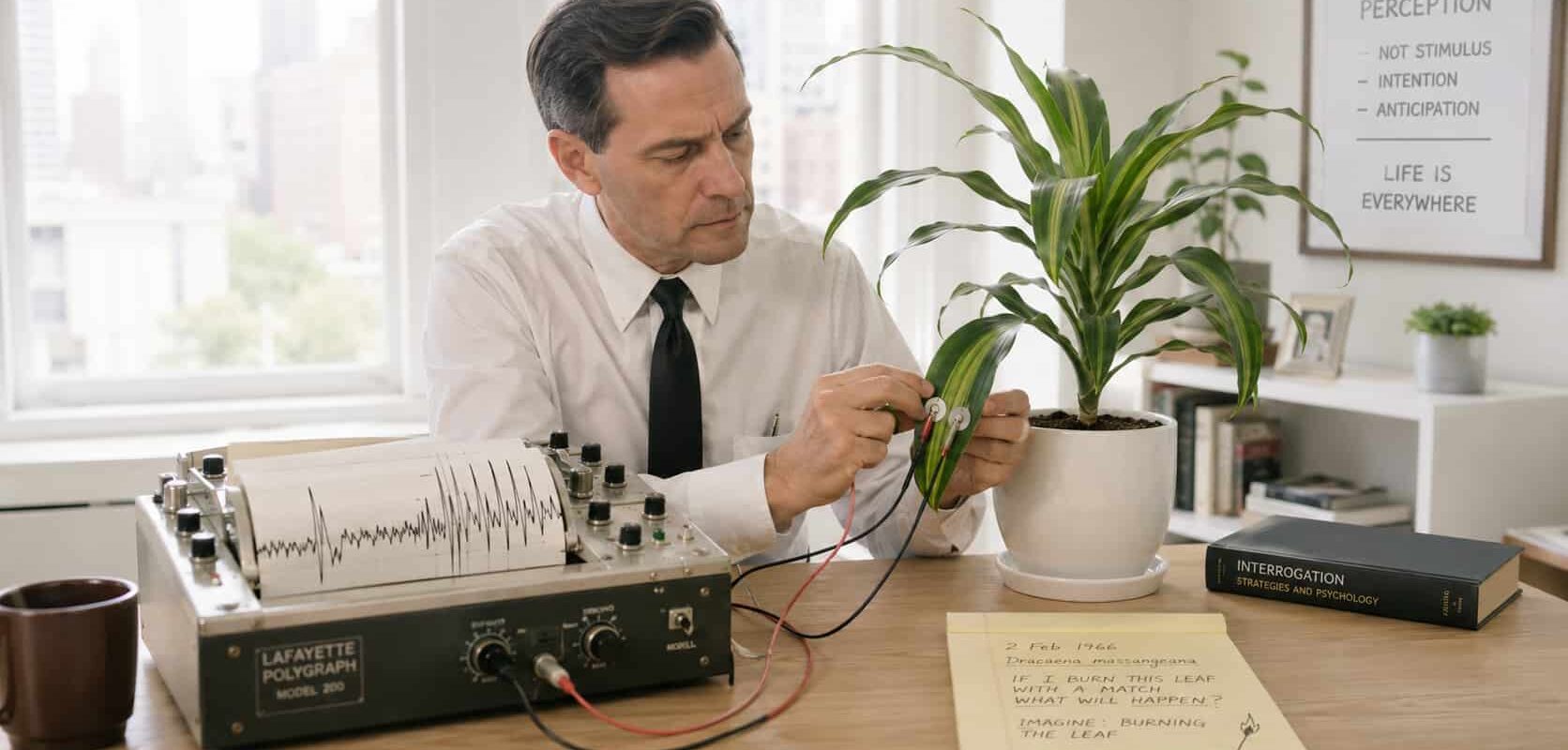
Backster spent the rest of his life trying to demonstrate that plants could read intentions, not just respond to stimuli but anticipate them. He coined the term primary perception for what he believed he had stumbled on, and in 1973, a popular book called The Secret Life of Plants carried his ideas into millions of living rooms. The book, in turn, seeded an entire spiritual-ecological aesthetic that has been quietly metastasizing on social media ever since.
The science, however, was not kind. Independent attempts at replication — by Kenneth Horowitz and colleagues at Cornell in 1975, by John Kmetz two years later — failed. The polygraph machine, it turned out, is exquisitely sensitive to humidity, static, electrode contact, and the breath of the person standing nearby. In the absence of a nervous system, what Backster was probably measuring was the room.
Today, the Backster effect sits in the same drawer as ESP and dowsing for most working biologists. And yet — and this is the part that matters — the underlying question he asked was not stupid. Do plants respond to their environment in ways that look, structurally, like sensing? The answer turned out to be yes. Just not for the reasons he thought.
What science actually says about plant intelligence
In 1983, two researchers named Ian Baldwin and Jack Schultz published a paper showing that sugar maples and poplars, when their leaves were torn, somehow caused undamaged trees nearby to ramp up their own production of defensive chemicals. The signal traveled through the air. The trees were warning each other.
This was not telepathy. It was chemistry.
What Baldwin and Schultz had stumbled into, and what hundreds of papers have refined in the four decades since, is that plants emit a family of airborne molecules called volatile organic compounds — VOCs — and that neighboring plants pick them up and respond.
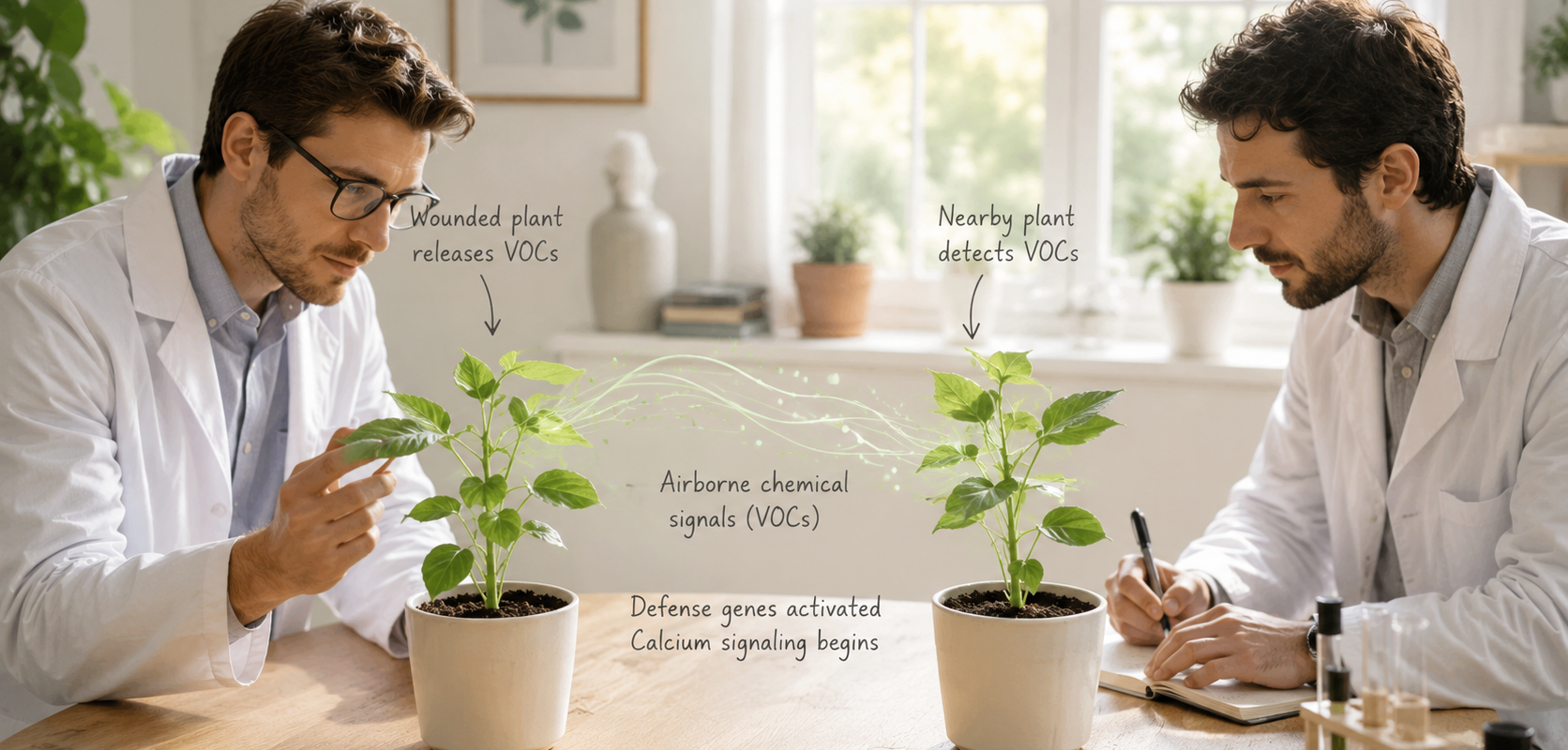
In October 2023, a team led by Masatsugu Toyota at Saitama University published a study in Nature Communications that tracked the process in real time using a fluorescent calcium tracer in Arabidopsis. When a plant was wounded, it released two compounds in particular — (Z)-3-hexenal and (E)-2-hexenal, both grassy-smelling aldehydes — and undamaged plants, breathing them in, set off cascades of calcium signaling within seconds. Their defense genes switched on. They were preparing for an attack they had not yet experienced.
The Backster effect was wrong, but the question underneath it was not. Plants do sense. They just sense in their own grammar.
The smell you notice when someone mows a lawn? You are standing inside a chemical distress call.
This is what the field of plant signaling has been quietly building since the 1980s, and it carries no metaphysical weight. There is no consciousness implied. There is, however, an information network operating at scales humans rarely notice, in a language made of small molecules drifting in the air.
The wood-wide web beneath the forest floor
In August 1997, the cover of Nature carried an image of mushrooms and roots and a phrase that has since become almost impossible to escape: the wood-wide web. The paper inside was by Suzanne Simard, then a young forest ecologist at the University of British Columbia. She had injected radioactive carbon isotopes into Douglas-firs and watched the label appear, days later, inside paper birches growing nearby. The trees were connected. Not at the leaves. Underground.
The connection, it turned out, was not the trees themselves. It was the fungi.
Almost every plant on Earth — somewhere around ninety per cent of vascular species — lives in symbiosis with mycorrhizal fungi, threadlike organisms whose hyphae braid themselves into root tissue. In exchange for sugars, the fungi extend the plant’s reach by orders of magnitude, hunting water and minerals through pores too small for any root to enter. What Simard demonstrated was that in many forest systems, individual plants are not paired with their own private fungal partners. They share. A single fungal mycelium can colonize the roots of dozens of trees, of different species, across acres of soil, and carbon can flow along its hyphae from one tree to another.
This is established science. It has been since the late 1990s. It is in textbooks.
What is not yet fully established — and this is where the story sharpens — is what those connections actually do.
The mother trees and the contested feeding
Simard’s later work, summarised in her 2021 memoir Finding the Mother Tree, makes a much larger claim. She argues that the biggest, oldest trees in a forest act as central hubs in the network — mother trees — and that they preferentially funnel carbon, water, and warning signals to their own seedlings, sometimes across distances of tens of meters. In her telling, the forest is something close to a family, and old growth is not just biomass but accumulated memory.
This is the version that has reached the public. It is also the version that, in early 2023, a team of mycorrhizal researchers led by Justine Karst at the University of Alberta took apart, point by point, in a perspective paper in Nature Ecology & Evolution.
Karst and her co-authors, Melanie Jones and Jason Hoeksema, reviewed the field studies underpinning three popular claims: that fungal networks are widespread in forests, that resources transferred through them reliably improve seedling survival, and that mature trees selectively feed their kin. Their conclusion was uncomfortable. The first claim, they wrote, was insufficiently supported by field evidence. The second was inconsistent across studies. The third — the mother tree feeding her children — had, in their reading, no peer-reviewed published evidence at all.
Simard and her colleagues responded in Frontiers in Forests and Global Change the following year, defending the broader body of work and pointing out, with some justification, that critics had leaned on a popular memoir rather than the underlying peer-reviewed literature. The argument is still active. Read the most recent reviews, and you find both sides citing many of the same studies and drawing opposite conclusions about what they show.
The wood-wide web exists. What the wood-wide web is for — and how much of it is forest, how much is fungus, how much is story we tell about both — is the part scientists are still fighting over.
This is what live science looks like. It is not the calm consensus of a textbook. It is people who have given their careers to a question who are publicly disagreeing about whether the question has been answered.
Cooperation, and the survival of the connected
There is a phrase that gets repeated around plant-network research, the way certain pop songs get stuck in the public ear: survival of the fittest. Usually, it appears just before being announced as wrong.
The line, for the record, was not Darwin’s invention. Herbert Spencer coined it in his 1864 Principles of Biology, after reading On the Origin of Species, and Darwin — whose theories still carry the burden of missing links — only adopted the phrase reluctantly, in the 1869 fifth edition, as a synonym for the more careful term natural selection. Darwin himself wrote at length about cooperation, sympathy, and group behavior. Modern biology has completed the demolition. Symbiosis is not the exception in the living world; it is closer to the rule.
Mycorrhizal networks are one striking instance of that rule. So are coral reefs. So is the bacterial flora inside the gut of every reader of this sentence. The interesting question is no longer whether life cooperates. It is what shapes that cooperation takes, and where it breaks down.
What the contested mother-tree narrative actually shows — even stripped of its most romantic claims — is that a forest is not a tidy collection of individuals scrambling for sunlight. It is a system in which individuals are partially porous to one another, in which carbon can leak between species, in which chemical warnings travel through air and probably through soil, and in which the boundaries we draw around an organism begin to blur the closer we look.
This is not mysticism. It is what the data is doing. And where the data is still ambiguous, the ambiguity itself is worth sitting with.
So can a plant actually reach for your hand?
Now, the videos.
Some of what circulates is plain stagecraft. The roots that jump when tickled are almost always the work of fishing line or a puff of compressed air off-frame; patient commenters can sometimes spot the string. Time-lapse footage of vines wrapping around a person’s arm has been compressed from days to seconds, making slow tropic growth look like a reach.
Some of it is real movement, just badly described. Mimosa pudica — the so-called sensitive plant — really does fold its leaves within a second of being touched. The mechanism is hydraulic: Specialized cells at the base of each leaflet, called pulvini, release potassium and chloride ions when stimulated; water rushes out, the cells lose turgor, and the leaf droops. It is one of the fastest movements in the plant kingdom, and you can watch it happen on a windowsill. It is also a withdrawal, not a greeting.

The tendrils of peas and cucumbers and passionflowers do reach. They sweep slowly through the air, and when they touch a surface, they curl around it within minutes. This is thigmotropism — directional growth in response to contact — and it is genuinely strange. The Australian ecologist Monica Gagliano went further in 2016, publishing a paper in Scientific Reports claiming that pea plants could be classically conditioned to grow toward a fan that predicted light, the way Pavlov’s dogs learned to anticipate dinner from a bell. The claim was so striking that another group attempted to replicate it in 2020 and failed. The question is still open.
What none of this is, as far as the evidence supports, is conscious. There are no neurons in a fern. There is no plant brain. The signals are real, and the responses are exquisitely tuned, but they occur through chemistry, turgor pressure, and ion gradients, not through anything we have grounds to call thought.
But, and that’s a big but…
The absence of what we believe is the neurological model of intelligence need not apply across different species.
Plants could very well have a conscious level of intelligence that is invisible to scientists and the lab devices used to explore it in experiments.
And yet.
The animal sense of touch is also chemistry and turgor pressure and ion gradients. The line between responding and reaching is harder to draw than we usually pretend.
What we still don’t know, and why it matters
There is a temptation, when writing about any of this, to land in one of two safe places. The first is the warm one: plants are conscious, the forest is a family, your fern can feel you, all is connection. The second is the cold one: plants are biochemical machines, the videos are fake, mother trees are a marketing campaign, please grow up.
Neither of these is honest.
The honest answer is that plants do something we have only recently begun to take seriously, that the science of it is younger and more contested than the popular literature suggests, that some of the most beautiful claims do not yet have the evidence to support them, and that some of the most boring-sounding facts — leaves talking to each other in (Z)-3-hexenal, fungi threading carbon between strangers — are stranger than the staged clips you keep scrolling past.
The reason it matters, beyond the satisfaction of getting the story right, is that we are losing forests faster than we are understanding them. Old-growth ecosystems are being logged on the assumption that competition and individual growth are as the science currently suggests. Whether or not a particular Douglas-fir is feeding its grandchildren through a fungal cord, a forest is doing things we do not yet have language for. Cutting it down on the grounds that we already understand it is its own kind of error.
So when the next video arrives — the leaf, the hand, the impossible little gesture — you can scroll past it without contempt. The truth underneath is quieter. Plants do not need to read your mind. They have been doing something far more disciplined, in their own grammar, the entire time you were standing there waiting for a miracle.
Follow us on X, Facebook, or Pinterest
