

A traveler once arrived in the countryside of Henan and saw a wooden yoke resting against a farmer’s cart. He had never laid eyes on such a thing. When a passerby told him its name, the traveler nodded. But a moment later he noticed a second yoke of a slightly different shape, and the same man called it by the same name. Something in him snapped. Convinced he was being mocked, the traveler raised his hand and struck the stranger, shouting that two different-looking things could not possibly share one name.
It is a small, almost comic scene. Yet this is one of those ancient Chinese wisdom stories that lingers, because we recognize the man. We have all met someone who would rather call an honest person a liar than accept a simple fact. And if we are honest, there are mornings when that stubborn traveler looks a little like us.
The story comes from the Han Feizi, a collection of essays and fables written more than 2,000 years ago. In just a few lines it holds up a mirror to human nature, and the reflection has not changed in all the centuries since. Here are three short parables from one remarkable Chinese thinker, and what they still reveal about why we resist the truth.
A stubborn stranger and a wooden yoke
Return to that dusty road in Henan for a moment. The yoke itself was nothing special, just a curved wooden frame laid across the necks of oxen so they could pull a plow or a cart together. To the local farmers it was as ordinary as a spoon. To the traveler, who had never seen one, it was a mystery.
The trouble began not with the object but with the traveler’s certainty. He had already decided how the world should work. In his mind, one shape meant one name, and anything that broke that rule had to be a trick. So when a single word stretched to cover two shapes, he did not pause to wonder whether he might be missing something. He grew angry. He lashed out. And in doing so, he made a small misunderstanding into a fight.
The moral the Han Feizi draws is gentle but sharp: a truth can be too simple to believe. We expect important facts to be complicated, hard-won, wrapped in mystery. When the answer turns out to be plain and obvious, part of us refuses it, almost offended that it should be so easy. The traveler could have learned the whole matter in a breath. Instead, his pride cost him the lesson and cost the stranger a blow.
This kind of teaching sits at the heart of Chinese tradition, where a brief tale often carries more weight than a long argument. You can find the same spirit in Nspirement’s collection of sayings and parables from Chinese tradition, where ordinary moments open into lasting wisdom.
Who was Han Feizi?
Han Feizi (韩非子, Hán Fēizǐ) was a philosopher and prince who lived from about 280 to 233 B.C., during the turbulent Warring States period, when rival kingdoms fought to unify China. He studied under the Confucian master Xunzi, then broke away to become the greatest voice of Legalism (法家, fǎjiā), the school that argued a stable society rests not on ritual or virtue but on clear laws and firm authority.

His ideas were austere. Han Feizi believed people are moved chiefly by self-interest, and that a wise ruler governs through consistent rewards and punishments rather than moral persuasion. According to Britannica, his essays so impressed the king who would become Qin Shi Huang, China’s first emperor, that Legalist principles helped shape the empire that unified the country in 221 B.C.. There is a bitter irony in his end. The philosopher who saw human self-interest so clearly fell prey to it himself, dying in prison in 233 B.C., forced to take poison by Li Si, a jealous former classmate. The Stanford Encyclopedia of Philosophy still treats him as the tradition’s defining thinker.
Yet Han Feizi is remembered today less for his politics than for how he taught. The book that bears his name gathers 55 chapters, and its most beloved sections are storehouses of parables he called the “Forest of Sayings.” He knew that a picture lodges in the mind where a lecture slides off it. That instinct is why his tales outlived his empire, and why they belong in any conversation about ancient Chinese wisdom stories.
Two more Han Feizi parables that named our flaws
The traveler and the yoke is not the only mirror Han Feizi left us. Two of his other stories became so famous that they folded into the Chinese language itself, living on as idioms that people still use every day without always knowing where they came from.
The spear and the shield
In the state of Chu, a merchant set up his stall to sell weapons. Lifting a shield, he cried out that it was so strong nothing in the world could pierce it. Then, raising a spear, he boasted that it was so sharp it could pierce anything at all. A quiet bystander asked the obvious question: “What happens if you take your spear and strike your shield?”
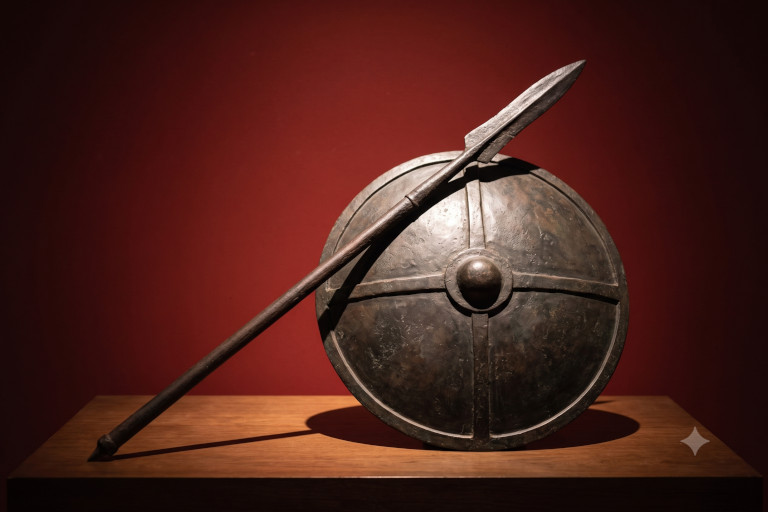
The merchant had no answer. His two boasts could not both be true.
From this little scene comes the Chinese word for contradiction, 矛盾 (máodùn), which literally means “spear and shield.” When two claims cannot stand together, a Chinese speaker still reaches, knowingly or not, for Han Feizi’s ancient merchant. The lesson is one of self-honesty: before we defend our position to a stranger, it is worth asking whether it quietly argues with itself.
Waiting by the tree stump
A farmer in the state of Song was working his field when a hare bolted across it, struck a tree stump, broke its neck, and died. Delighted with his free meal, the farmer set down his plow and sat beside the stump, waiting for the next hare to deliver itself in the same way. No hare came. His crops withered, and he became the laughingstock of the whole country.
This tale gave China the idiom 守株待兔 (shǒu zhū dài tù), “guarding the stump, waiting for the hare,” a phrase for anyone who trusts to luck instead of effort, or clings to a method that worked once and refuses to adapt. Han Feizi aimed it at rulers who governed the present by blindly copying the past. It lands just as neatly on us whenever we repeat what once succeeded and wonder why the results have dried up.

(Image: via Nano Banana)
Told together, these three stories form a kind of gallery of very human mistakes: the pride that rejects a simple fact, the boasting that contradicts itself, and the laziness that waits for luck. Nspirement explores this same tradition of moral tales in stories like the ancient lessons in humility drawn from the Tang Dynasty.
Why we refuse simple truths: Ancient insight, modern science
Here is the striking part. Everything Han Feizi noticed about human stubbornness 2,300 years ago, modern psychology has spent the last century confirming in the laboratory.
When a plain fact collides with what we already believe, we feel a flicker of discomfort. Psychologists call it cognitive dissonance, the mental friction of holding two clashing ideas at once. The easiest way to end that discomfort is not to change our mind but to reject the new fact, exactly as the traveler rejected the second yoke. Researchers have even documented a “backfire effect,” in which presenting people with clear evidence against a cherished belief can push them to hold it more tightly, not less.
Han Feizi, watching a man punch a stranger over the name of a yoke, understood this without any of the vocabulary. His genius was to see that the obstacle to truth is rarely the truth’s complexity. Far more often, it is our own unwillingness to be surprised. This is one of the reasons ancient wisdom keeps meeting modern life: the technology changes, but the human heart is remarkably consistent.
Cultivating an open mind: A lesson in Chinese wisdom
If the problem is old, so is the remedy. Chinese thinkers of every school, Legalist and Confucian alike, returned again and again to a single practice: cultivating the mind so that it stays humble and open. The same conviction shaped how families raised their children, as in the story of Mencius’s mother, who moved house three times to protect her son’s developing character. Here are a few gentle ways to keep the stubborn traveler in check.
- Pause before you reject. The moment you feel that hot flash of “that can’t be right,” treat it as a signal to slow down, not to strike out. Surprise is often the doorway to learning.
- Separate your ego from the fact. A truth does not care about your pride, and admitting you were mistaken costs far less than defending an error for years.
- Welcome the simple answer. Not every truth is hidden or hard. Sometimes the plain explanation is the correct one, and wisdom means letting it be that easy.
- Stay curious about what you don’t know. The traveler had never seen a yoke, and there is no shame in that. His only mistake was refusing to learn.
None of this is about becoming a pushover who believes everything. Han Feizi, of all people, prized careful judgment. It is about the difference between weighing a new fact and swatting it away. That quiet discipline of the mind is exactly what Chinese tradition means by cultivation, a theme Nspirement traces in reflections like the practice of cultivation expressed through the simple act of bowing. For more stories rooted in this heritage, explore Nspirement’s coverage of Chinese culture and philosophy.
Ancient Chinese wisdom stories: Common questions
What is the moral of the man who couldn’t accept the truth?
The moral is that a truth can be too simple to believe. In Han Feizi’s parable, a traveler would rather strike an honest stranger than accept that two yokes share one name. It warns us to pause and consider a plain fact calmly before rejecting it out of wounded pride.

Why do people refuse to accept the truth?
People refuse to accept the truth mainly to protect their sense of self. Psychologists describe this as cognitive dissonance, the discomfort of holding two clashing beliefs. Rejecting the new fact feels easier than admitting we were wrong, which is why evidence alone often fails to change a stubborn mind.
What does “waiting by the tree stump” (守株待兔) mean?
Waiting by the tree stump (守株待兔, shǒu zhū dài tù) describes trusting to luck instead of effort, or clinging to a method that worked once. It comes from Han Feizi’s story of a farmer who abandoned his plow to wait for another hare to run into a stump, and lost his whole harvest.
Conclusion
Three small scenes, one enduring truth. A traveler strikes a stranger rather than accept the name of a yoke. A merchant boasts himself into a corner. A farmer trades his livelihood for a lucky hare that never returns. Across 2,000 years, these ancient Chinese wisdom stories keep their power because they are not really about yokes or spears or hares at all. They are about us.
What unites them is a single, humbling insight: the greatest barrier between a person and the truth is usually that person’s own certainty. Han Feizi saw it in a crowded marketplace during China’s Warring States period, and modern science sees it in the brain scans of the present day. The simplest fact in the world is worthless to a person that has already made up their mind.
The hopeful news is that an open mind is not a fixed trait but a practice, one we can begin again on any ordinary day. The next time a small truth arrives and something in you wants to push it away, remember the traveler on that dusty road in Henan, and choose instead to look, to wonder, and to learn. That is the quiet gift these ancient Chinese wisdom stories still offer us: the reminder that it is never too late to set down our certainty and simply see.
Follow us on X, Facebook, or Pinterest
